2,281 posters, 63 videos, 56 audios, 43 topics, 18 sessions, 6,174 authors, 2,323 institutions
ePostersLive by SciGen Technologies S.A. All rights reserved.
RCOG World Congress 2025
June 23 - 25, 2025 | ExCeL London, UK
PP.0043
Reducing Unrecognised Postpartum Voiding Dysfunction to Zero –Introduction of The VESSI Protocol.
Poster Presenter
Authors
Grace Guinness, Ellen Dunlop, Nadera Layyous, Lauren Cushley, Ciara Daly
Affiliations
Part of Topic
Quality improvement
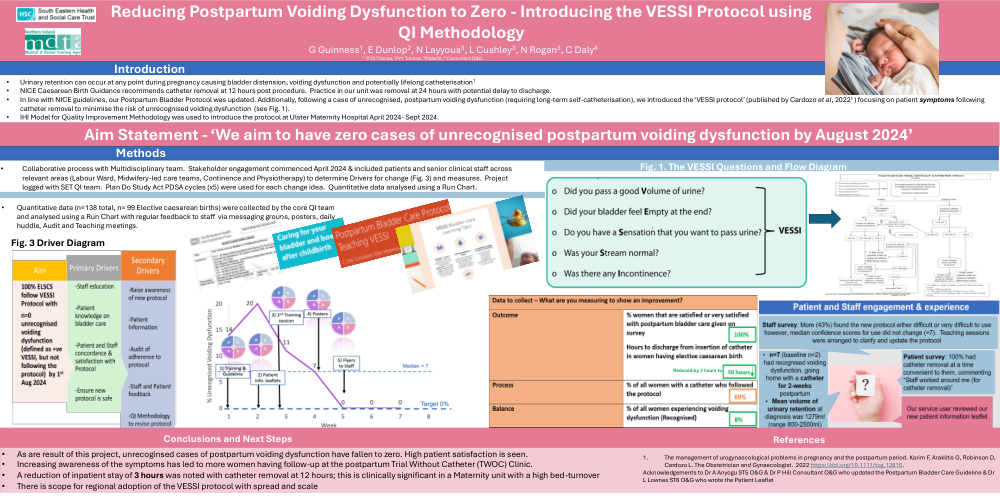
Reducing Postpartum Voiding Dysfunction to Zero - Introducing the VESSI Protocol using QI Methodology
Introduction
•Urinary retention can occur at any point during pregnancy causing bladder distension, voiding dysfunction and potentially lifelong catheterisation1
•NICE Caesarean Birth Guidance recommends catheter removal at 12 hours post procedure. Practice in our unit was removal at 24 hours with potential delay to discharge.
•In line with NICE guidelines, our Postpartum Bladder Protocol was updated. Additionally, following a case of unrecognised, postpartum voiding dysfunction (requiring long-term self-catheterisation), we introduced the ‘VESSI protocol’ (published by Cardozo et al, 20221 ) focusing on patient symptoms following catheter removal to minimise the risk of unrecognised voiding dysfunction (see Fig. 1).
•IHI Model for Quality Improvement Methodology was used to introduce the protocol at Ulster Maternity Hospital April 2024- Sept 2024.
Methods
•Collaborative process with Multidisciplinary team. Stakeholder engagement commenced April 2024 & included patients and senior clinical staff across relevant areas (Labour Ward, Midwifery-led care teams, Continence and Physiotherapy) to determine Drivers for change (Fig. 3) and measures. Project logged with SET QI team. Plan Do Study Act PDSA cycles (x5) were used for each change idea. Quantitative data analysed using a Run Chart.
•Quantitative data (n=138 total, n= 99 Elective caesarean births) were collected by the core QI team and analysed using a Run Chart with regular feedback to staff via messaging groups, posters, daily huddle, Audit and Teaching meetings.
Results and Conculsion
•As are result of this project, unrecoginsed cases of postpartum voiding dysfunction have fallen to zero. High patient satisfaction is seen (100%)
43% staff found the protcol either difficult or very difficult to use, however, median conference scores for use (n=7) did not change.
•Increasing awareness of the symptoms has led to more women having follow-up at the postpartum Trial Without Catheter (TWOC) Clinic - N=7 (baseline N=2) women had recognised voiding dysfunction and went home with a catheter for 2 weeks post partum.
•A reduction of inpatient stay of 3 hours was noted with catheter removal at 12 hours; this is clinically significant in a Maternity unit with a high bed-turnover
•There is scope for regional adoption of the VESSI protocol with spread and scale