2,281 posters, 63 videos, 56 audios, 43 topics, 18 sessions, 6,174 authors, 2,323 institutions
ePostersLive by SciGen Technologies S.A. All rights reserved.
RCOG World Congress 2025
June 23 - 25, 2025 | ExCeL London, UK
EP.1819
Audit of Management and outcomes of Gestational Diabetes in Pregnancy
Poster Presenter
Authors
Affiliations
Part of Topic
Quality improvement
Audit of Management and outcomes of Gestational Diabetes in Pregnancy
Introduction
Gestational diabetes mellitus (GDM) is high blood sugar (glucose) that develops during pregnancy and usually disappears after giving birth. GDM is the most common medical condition to affect pregnant women. If it is untreated during pregnancy it can led to poor maternal and neonatal outcomes. However, effective treatment substantially reduces these risks and should lead to successful pregnancy outcomes. The pooled global standardized prevalence of GDM was 14.0% (95% confidence interval: 13.97-14.04%). The standardized prevalence of GDM in low-, middle- and high-income countries were 12.7% (11.0-14.6%), 9.2% (9.0-9.3%) and 14.2% (14.1- 14.2%), respectively (Hui Wang et.al., 2022) According to NHS diabetes prevention program (NHS DPP), every year in England, out of the approximate 700,000 women that give birth, it is estimated that around 30,000 have GDM. .
Aim
to identify the management and outcomes of pregnancy with gestational diabetes (GDM) at Noble’s Hospital, Isle of Man Design: retrospective clinical audit
Method: Retrospective clinical audit and Data collection was done retrospectively from the medical records of 43 pregnant patients with GDM from 01/01/2022 to 31/12/2023. Data collection included demographic and clinical characteristics of the patients, antenatal management (timing of referral after diagnosis of GDM, referral to dietician, anatomy scan at 20 weeks, four weekly growth scan monitoring, joint diabetes and antenatal clinic every 1-2 weeks, offering glucose test after birth to exclude diabetes), diabetes control during pregnancy, pregnancy outcomes, mode of delivery, neonatal outcomes and birth weight of the babies.
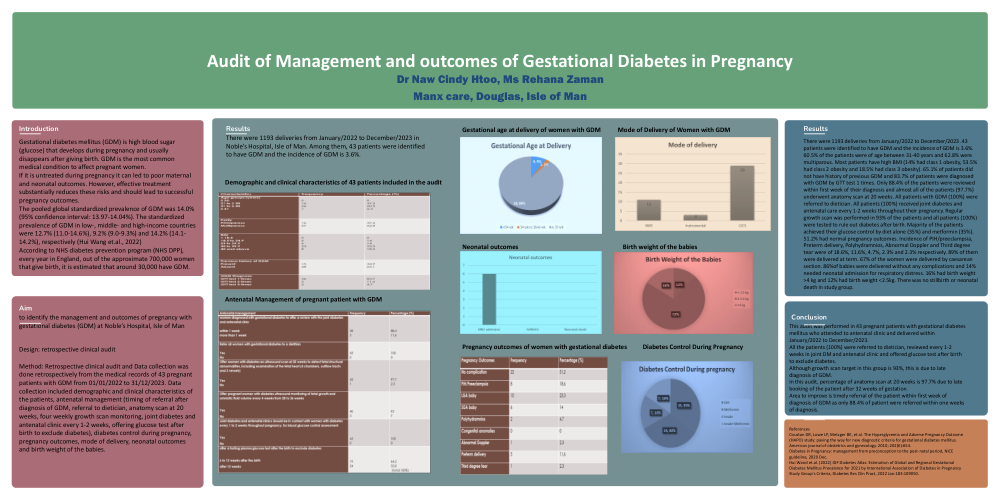
Results There were 1193 deliveries from January/2022 to December/2023 .43 patients were identified to have GDM and the incidence of GDM is 3.6%. 60.5% of the patients were of age between 31-40 years and 62.8% were multiparous. Most patients have high BMI (14% had class 1 obesity, 53.5% had class 2 obesity and 18.5% had class 3 obesity). 65.1% of patients did not have history of previous GDM and 83.7% of patients were diagnosed with GDM by GTT test 1 times. Only 88.4% of the patients were reviewed within first week of their diagnosis and almost all of the patients (97.7%) underwent anatomy scan at 20 weeks. All patients with GDM (100%) were referred to dietician. All patients (100%) received joint diabetes and antenatal care every 1-2 weeks throughout their pregnancy. Regular growth scan was performed in 93% of the patients and all patients (100%) were tested to rule out diabetes after birth. Majority of the patients achieved their glucose control by diet alone (35%) and metformin (35%). 51.2% had normal pregnancy outcomes. Incidence of PIH/preeclampsia, Preterm delivery, Polyhydramnios, Abnormal Doppler and Third degree tear were of 18.6%, 11.6%, 4.7%, 2.3% and 2.3% respectively. 89% of them were delivered at term. 67% of the women were delivered by caesarean section. 86%of babies were delivered without any complications and 14% needed neonatal admission for respiratory distress. 16% had birth weight >4 kg and 12% had birth weight <2.5kg. There was no stillbirth or neonatal death in study group.
Conclusion
This audit was performed in 43 pregnant patients with gestational diabetes mellitus who attended to antenatal clinic and delivered within January/2022 to December/2023. All the patients (100%) were referred to dietician, reviewed every 1-2 weeks in joint DM and antenatal clinic and offered glucose test after birth to exclude diabetes. Although growth scan target in this group is 93%, this is due to late diagnosis of GDM. In this audit, percentage of anatomy scan at 20 weeks is 97.7% due to late booking of the patient after 32 weeks of gestation. Area to improve is timely referral of the patient within first week of diagnosis of GDM as only 88.4% of patient were referred within one weeks of diagnosis.
References
Coustan DR, Lowe LP, Metzger BE, et al. The Hyperglycemia and Adverse Pregnancy Outcome (HAPO) study: paving the way for new diagnostic criteria for gestational diabetes mellitus. American journal of obstetrics and gynecology. 2010; 202(6):654.
Diabetes in Pregnancy: management from preconception to the post-natal period, NICE guideline, 2020 Dec.
Hui Wand et.al. (2022) IDF Diabetes Atlas: Estimation of Global and Regional Gestational Diabetes Mellitus Prevalence for 2021 by International Association of Diabetes in Pregnancy Study Group's Criteria, Diabetes Res Clin Pract, 2022 Jan:183:109050