2,281 posters, 63 videos, 56 audios, 43 topics, 18 sessions, 6,174 authors, 2,323 institutions
ePostersLive by SciGen Technologies S.A. All rights reserved.
RCOG World Congress 2025
June 23 - 25, 2025 | ExCeL London, UK
EP.0017
Impact of Task-Sharing on the Uptake of Contraceptive Methods in Sierra Leone
Poster Presenter
Authors
Affiliations
Part of Topic
Abortion care
Video
Impact of Task-sharing On Uptake of Contraception
Introduction
The Sierra Leonean government is actively implementing strategies to enhance access to family planning services in rural communities. This requires a reevaluation of existing supply chain mechanisms and service delivery to effectively meet these goals. This study investigates the distribution of family planning commodities and the provision of postabortion care by informal healthcare personnel outside public facilities.
Methods
Design: Quasi-experimental design with pre and post-evaluation.
Setting: Koidu and 3 surrounding chiefdoms
Intervention: 28 intermediaries trained over 3 days
Analysis: Uncontrolled interrupted time series.
Results
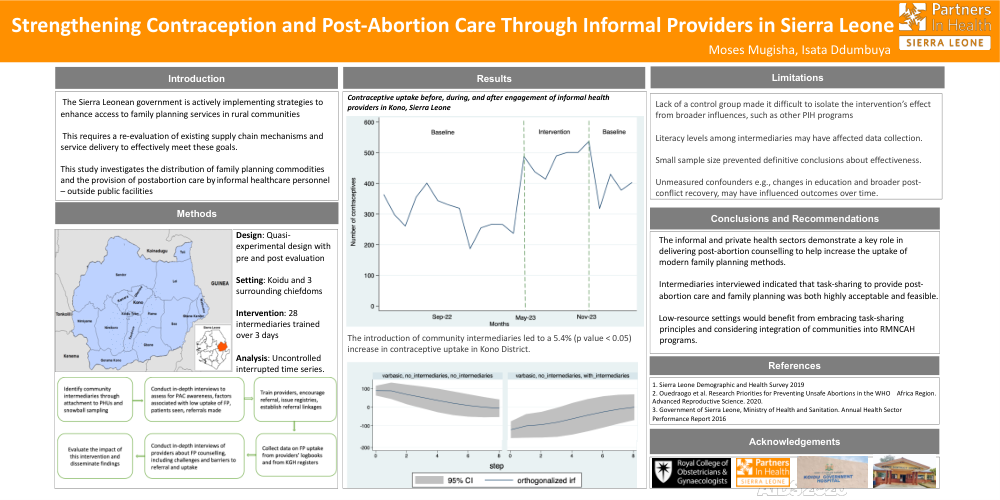
The introduction of community intermediaries led to a 5.4% (p-value < 0.05) increase in contraceptive uptake in Kono District.
Limitations
Lack of a control group made it difficult to isolate the intervention’s effect from broader influences, such as other PIH programs. Literacy levels among intermediaries may have affected data collection. Small sample size prevented definitive conclusions about effectiveness. Unmeasured confounders e.g., changes in education and broader post-conflict recovery, may have influenced outcomes over time.
Conclusions and Recommendations
The informal and private health sectors demonstrate a key role in delivering post-abortion counselling to help increase the uptake of modern family planning methods. Intermediaries interviewed indicated that task-sharing to provide post-abortion care and family planning was both highly acceptable and feasible.
Low-resource settings would benefit from embracing task-sharing principles and considering integration of communities into RMNCAH programs.