2,281 posters, 63 videos, 56 audios, 43 topics, 18 sessions, 6,174 authors, 2,323 institutions
ePostersLive by SciGen Technologies S.A. All rights reserved.
RCOG World Congress 2025
June 23 - 25, 2025 | ExCeL London, UK
EP.1804
Burden of Primary Ovarian Insufficiency In Socially Deprived Populations – A Missed Opportunity
Poster Presenter
Part of Topic
Post reproductive health
Burden of Primary Ovarian Insufficiency In Socially Deprived Populations – A Missed Opportunity
Sasha Tulsyan1, Radhika Patel1, Alpa Shah1, Ferha Saeed1
Background
Primary ovarian insufficiency (POI) is characterized by the loss of ovarian function before the age of 40. It affects 1-2% of women and has a significant impact on long term health and quality of life. Early detection and treatment are crucial for the management of these women, but factors such as minority ethnic background, socioeconomic deprivation, and poor access to healthcare can lead to delays in diagnosis. We reviewed 31 cases of POI managed at Newham University Hospital (NUH), which serves an ethnically diverse and socially deprived population in East London. The aim was to analyse patient demographics, symptoms at presentation, time to diagnosis, investigation results, and POI-related complication rates.
Design and Methods
This was a retrospective, cross-sectional audit. We reviewed patients referred to Menopause clinic at NUH between February 2021 and June 2024. 31 patients were managed for POI during this time. 11 of these patients were diagnosed in the community or other hospitals. A total of 20 patients were diagnosed with POI at NUH using the ESHRE guidelines, and these cases were included in our data analysis. We used electronic hospital records and outpatient clinic letters to collect patient data.
Results
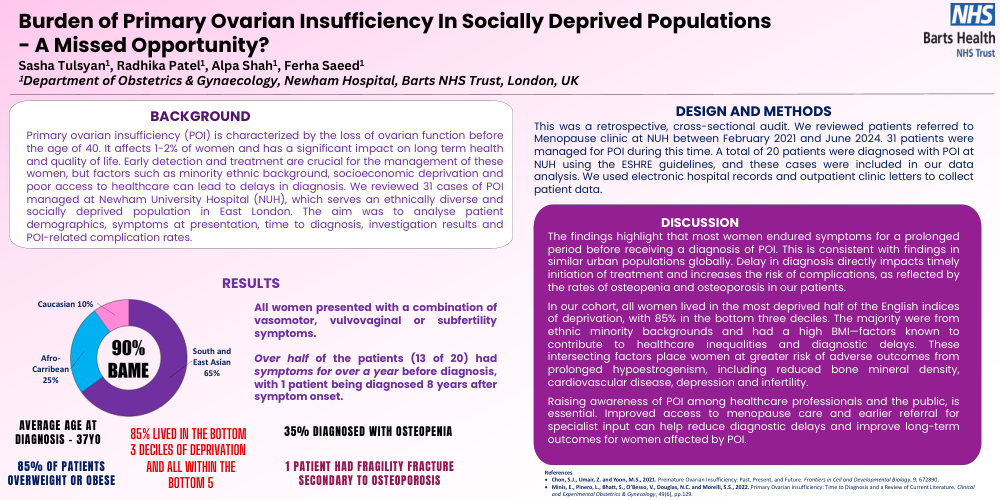
Of the 20 patients included, 2 (10%) were of White ethnicity, 13 (65%) were of Asian ethnicity, and 5 (25%) were of Black ethnicity. The average age of diagnosis was 37 years old. In terms of BMI, 85% of women were classified as overweight or obese. All women lived in areas within the bottom 5 deciles of the English indices of deprivation with 85% living in the lowest 3 deciles. All women presented with a combination of vasomotor, vulvovaginal, or subfertility symptoms. Over half of the patients (13 of 20) had symptoms for over a year before diagnosis, with 1 patient diagnosed 8 years after the onset of symptoms. Of the17 patients who had DEXA scans, 7 were diagnosed with osteopenia and 1 patient developed osteoporosis, which led to a fracture.
Discussion
The findings highlight that most women endured symptoms for a prolonged period before receiving a diagnosis of POI. This is consistent with findings in similar urban populations in the U.S. and globally. Delays in diagnosis directly impact timely initiation of treatment and increase the risk of complications such as low bone mineral density, as reflected by the rates of osteopenia and osteoporosis in our patients.
In our cohort, all women lived in the most deprived half of the English indices of deprivation, with 85% in the bottom three deciles. The majority were from ethnic minority backgrounds and had a high BMI—factors known to contribute to healthcare inequalities and diagnostic delays. These intersecting factors place women at greater risk of adverse outcomes from prolonged hypoestrogenism, including reduced bone mineral density, cardiovascular disease, depression, and infertility.
Raising awareness of POI among healthcare professionals and the public, particularly in communities at higher risk, is essential. Improved access to menopause care and earlier referral for specialist input can help reduce diagnostic delays and improve long-term outcomes for women affected by POI.
References
- Minis, E., Pinero, L., Bhatt, S., O’Besso, V., Douglas, N.C. and Morelli, S.S., 2022. Primary Ovarian Insufficiency: Time to Diagnosis and a Review of Current Literature. Clinical and Experimental Obstetrics & Gynecology, 49(6), pp.129.
- Chon, S.J., Umair, Z. and Yoon, M.S., 2021. Premature Ovarian Insufficiency: Past, Present, and Future. Frontiers in Cell and Developmental Biology, 9, 672890.