2,281 posters, 63 videos, 56 audios, 43 topics, 18 sessions, 6,174 authors, 2,323 institutions
ePostersLive by SciGen Technologies S.A. All rights reserved.
RCOG World Congress 2025
June 23 - 25, 2025 | ExCeL London, UK
EP.1802
Postpartum Mycoplasma Hominis infection - a post-operative clinical and maternal mental health complication
Poster Presenter
Authors
Affiliations
KK women’s and children’s hospital, Singapore Health Services
Part of Topic
PNMH
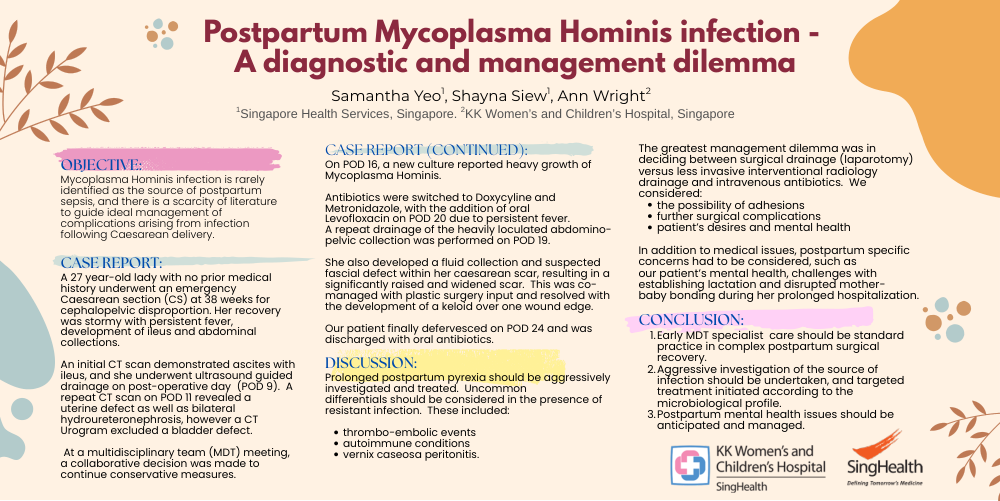
OBJECTIVE:
Mycoplasma Hominis infection is rarely identified as the source of postpartum sepsis, and there is a scarcity of literature to guide ideal management of complications arising from infection following Caesarean delivery.
CASE REPORT:
A 27 year-old lady with no prior medical history underwent an emergency Caesarean section (CS) at 38 weeks for cephalopelvic disproportion. Her recovery was stormy with persistent fever, development of ileus and abdominal collections.
An initial CT scan demonstrated ascites with ileus, and she underwent ultrasound guided
drainage on post-operative day (POD 9). A repeat CT scan on POD 11 revealed a
uterine defect as well as bilateral hydroureteronephrosis, however a CT Urogram excluded a bladder defect.
CASE REPORT (CONTINUED):
On POD 16, a new culture reported heavy growth of Mycoplasma Hominis.
Antibiotics were switched to Doxycyline and Metronidazole, with the addition of oral
Levofloxacin on POD 20 due to persistent fever.
A repeat drainage of the heavily loculated abdomino-pelvic collection was performed on POD 19.
She also developed a fluid collection and suspected fascial defect within her caesarean scar, resulting in a significantly raised and widened scar. This was co-managed with plastic surgery input and resolved with the development of a keloid over one wound edge.
Our patient finally defervesced on POD 24 and was discharged with oral antibiotics.
DISCUSSION:
Prolonged postpartum pyrexia should be aggressively investigated and treated. Uncommon
differentials should be considered in the presence of resistant infection. These included:
thrombo-embolic events
autoimmune conditions
vernix caseosa peritonitis.
The greatest management dilemma was in deciding between surgical drainage (laparotomy)
versus less invasive interventional radiology drainage and intravenous antibiotics. We considered:
the possibility of adhesions
further surgical complications
patient’s desires and mental health
In addition to medical issues, postpartum specific concerns had to be considered, such as
our patient’s mental health, challenges with establishing lactation and disrupted mother-
baby bonding during her prolonged hospitalization.
CONCLUSION:
EARLY MDT SPECIALIST CARE SHOULD BE STANDARD PRACTICE INCOMPLEX POSTPARTUM SURGICAL RECOVERY.
AGGRESSIVE INVESTIGATION OF THE SOURCE OF INFECTION SHOULD BE UNDERTAKEN, ANDTARGETEDTREATMENT INITIATED ACCORDING TO THE MICROBIOLOGICALPROFILE.
POSTPARTUM MENTAL HEALTH ISSUES SHOULD BE ANTICIPATED AND MANAGED.