2,281 posters, 63 videos, 56 audios, 43 topics, 18 sessions, 6,174 authors, 2,323 institutions
ePostersLive by SciGen Technologies S.A. All rights reserved.
RCOG World Congress 2025
June 23 - 25, 2025 | ExCeL London, UK
EP.1791
Prevalence & Factors Associated with Post Cesarean Delivery Anemia at Ghandi Memorial Hospital
Poster Presenter
Authors
Affiliations
Part of Topic
PNMH
Title : Prevalence and Factors Associated with Post Cesarean Delivery Anemia at Ghandi Memorial Hospital, Addis Ababa, Ethiopia:
Investigator : Dr. Semere Fiseha ( MD, Assistant Professor of Obstetrics and Gynecology)
Advisors : Dr. Yitbarek Fantahun ( MD, Assistant Professor of Obstetrics and Gynecology, REI subspecialist)
: Dr. Seid Aragie (MD, Assistant Professor of Obstetrics and Gynecology, MFM subspecialist)
Background
Statement of the problem
Significance of the study
Objectives – To determine the Prevalence and Factors Associated with Post Cesarean Delivery Anemia at Ghandi Memorial Hospital, Addis Ababa, Ethiopia.
Methods – Institutional based cross-sectional study was conducted at Gandhi memorial Hospital. A total of 422 mothers who underwent cesarean delivery were included in this study and using simple consecutive sampling technique, data was collected from October 1 /2022 to February 28/2023. Data were collected through both face-to-face interview and maternal chart review by using a pretested questionnaire. Data were cleaned, coded, and entered using Epi Data version 4.6.0.0 and then exported to SPSS version 24 for analysis. A p-value <0.05 was considered significant. Variables which were significantly associated by bivariate analysis were further processed by multivariate analysis.
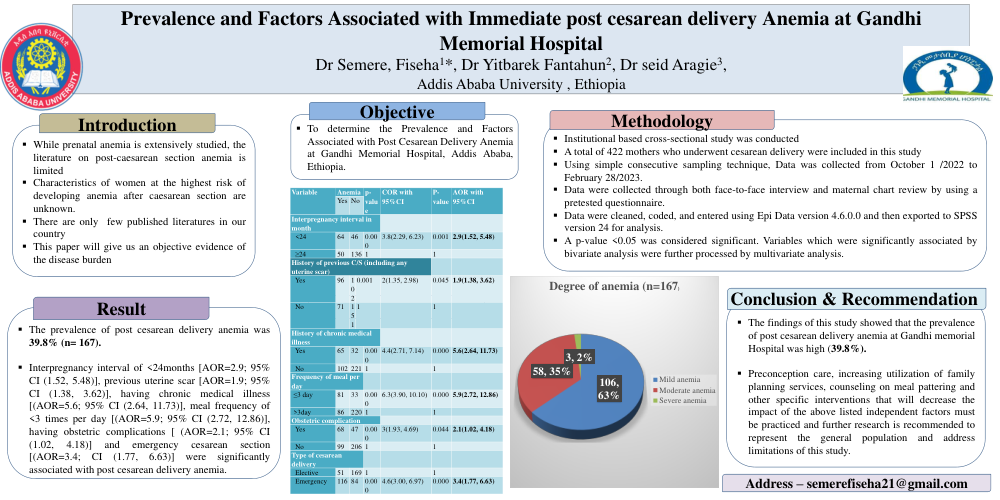
Result - The prevalence of post cesarean delivery anemia was 39.8% (n= 167). interpregnancy interval of <24months [AOR=2.9; 95% CI (1.52, 5.48)], previous uterine scar [AOR=1.9; 95% CI (1.38, 3.62)], having chronic medical illness [(AOR=5.6; 95% CI (2.64, 11.73)], meal frequency of <3 times per day [(AOR=5.9; 95% CI (2.72, 12.86)], having obstetric complications [ (AOR=2.1; 95% CI (1.02, 4.18)] and emergency cesarean section [(AOR=3.4; CI (1.77, 6.63)] were significantly associated with post cesarean delivery anemia.
Conclusion and recommendations - The findings of this study showed that the prevalence of post cesarean delivery anemia at Ghandi memorial Hospital was high (39.8%). Preconception care, increasing utilization of family planning services, counseling on meal pattering and other specific interventions that will decrease the impact of the above listed independent factors must be practiced and further research is recommended to represent the general population and address limitations of this study.