2,281 posters, 63 videos, 56 audios, 43 topics, 18 sessions, 6,174 authors, 2,323 institutions
ePostersLive by SciGen Technologies S.A. All rights reserved.
RCOG World Congress 2025
June 23 - 25, 2025 | ExCeL London, UK
EP.1801
COMPARISON OF POSTPARTUM DEPRESSION AND MOTHER-INFANT BONDING BETWEEN DIABETIC AND NONDIABETIC WOMEN
Poster Presenter
Authors
Affiliations
Part of Topic
PNMH
Video
Comparison of Postpartum Depression and Mother-Infant Bonding Between Diabetic and Non-Diabetic Women : A Prospective Cohort Study
Shreya Mattoo, Nivedita Jha, Chitra T, Balaji Bharadwaj
JIPMER, Puducherry, India
Introduction
Hyperglycaemia in pregnancy (HIP) affects one in every ten pregnancies worldwide, with Gestational diabetes (GDM) forming 85-90% of the cases, and the remaining afflicted by pre-gestational diabetes.1 HIP is linked not only to physical health risks for mothers and children but also to increased mental health issues, particularly higher rates of depression and anxiety. Depression in mothers with diabetes is three times more common and is associated with worsened glycaemic control, poor self-care, and negative outcomes such as hypertension, preeclampsia, and difficulties with breastfeeding.
Several studies worldwide have attempted to describe the relationship between various mental health issues, particularly depression, among women with HIP. While many studies have found a significant association between diabetes and postpartum depression (PPD), others have revealed contradictory findings There is limited research specifically addressing the relationship between depression and maternal diabetes in the Indian population, where the prevalence of GDM is notably high (around 13%). The socio-demographic and cultural differences in India necessitate tailored studies, as findings from Western literature may not be applicable.. Hence this study was designed with the following objectives.
Aims & Objectives
·Primary objective:
To compare the incidence of postpartum depression and mother-infant bonding among women with diabetes on medical management vs those without diabetes
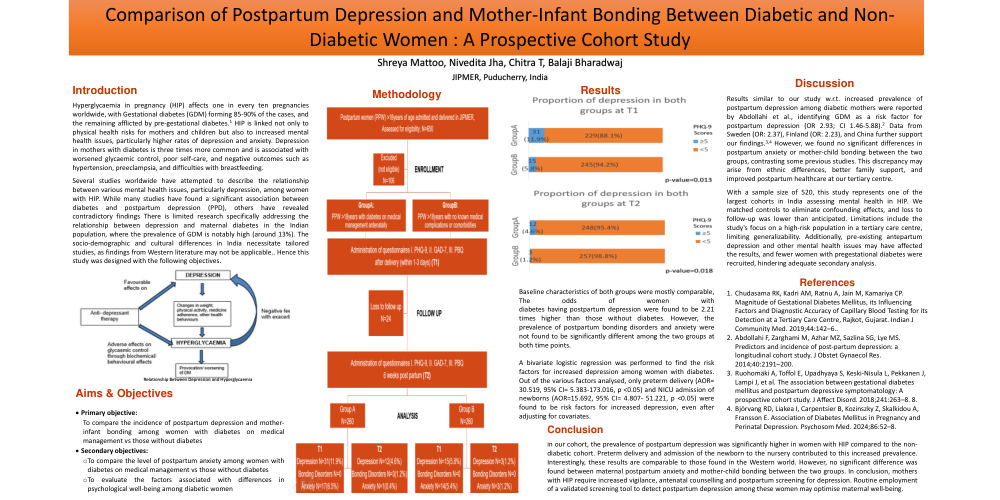
Baseline characteristics of both groups were mostly comparable, The odds of women with
diabetes having postpartum depression were found to be 2.21 times higher than those without diabetes. However, the prevalence of postpartum bonding disorders and anxiety were not found to be significantly different among the two groups at both time points.
A bivariate logistic regression was performed to find the risk factors for increased depression among women with diabetes. Out of the various factors analysed, only preterm delivery (AOR= 30.519, 95% CI= 5.383-173.016, p <0.05) and NICU admission of newborns (AOR=15.692, 95% CI= 4.807- 51.221, p <0.05) were found to be risk factors for increased depression, even after adjusting for covariates.
Discussion
Results similar to our study w.r.t. increased prevalence of postpartum depression among diabetic mothers were reported by Abdollahi et al., identifying GDM as a risk factor for postpartum depression (OR 2.93; CI 1.46-5.88).2 Data from Sweden (OR: 2.37), Finland (OR: 2.23), and China further support our findings.3,4 However, we found no significant differences in postpartum anxiety or mother-child bonding between the two groups, contrasting some previous studies. This discrepancy may arise from ethnic differences, better family support, and improved postpartum healthcare at our tertiary centre.
With a sample size of 520, this study represents one of the largest cohorts in India assessing mental health in HIP. We matched controls to eliminate confounding effects, and loss to follow-up was lower than anticipated. Limitations include the study's focus on a high-risk population in a tertiary care centre, limiting generalizability. Additionally, pre-existing antepartum depression and other mental health issues may have affected the results, and fewer women with pregestational diabetes were recruited, hindering adequate secondary analysis.
Conclusion
In our cohort, the prevalence of postpartum depression was significantly higher in women with HIP compared to the non-diabetic cohort. Preterm delivery and admission of the newborn to the nursery contributed to this increased prevalence. Interestingly, these results are comparable to those found in the Western world. However, no significant difference was found between maternal postpartum anxiety and mother-child bonding between the two groups. In conclusion, mothers with HIP require increased vigilance, antenatal counselling and postpartum screening for depression. Routine employment of a validated screening tool to detect postpartum depression among these women may optimise maternal well-being.
References