2,281 posters, 63 videos, 56 audios, 43 topics, 18 sessions, 6,174 authors, 2,323 institutions
ePostersLive by SciGen Technologies S.A. All rights reserved.
RCOG World Congress 2025
June 23 - 25, 2025 | ExCeL London, UK
EP.1797
Mental Health and Birth Trauma in Women with Perceived Reduced Fetal Movements
Poster Presenter
Part of Topic
PNMH
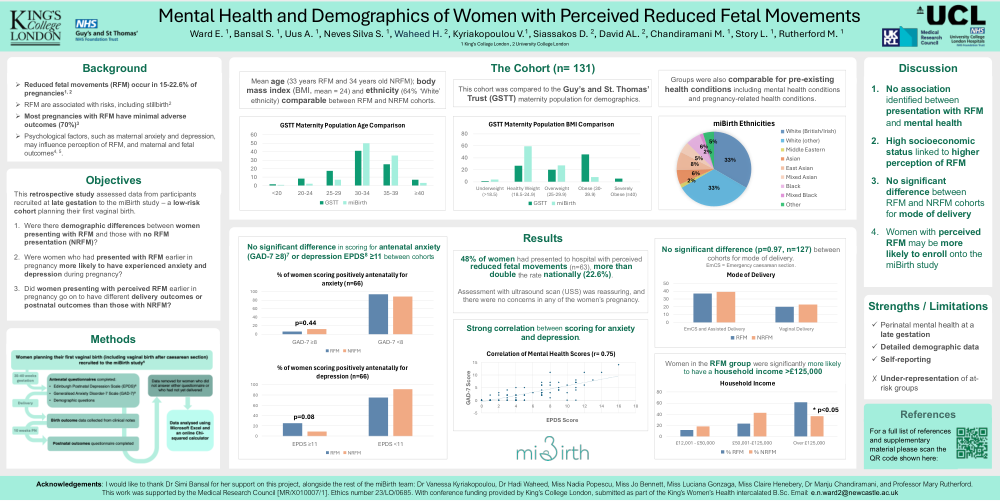
This retrospective study assessed data from participants recruited at late gestation to the miBirth study – a low-risk cohort planning their first vaginal birth.
Mean age (33 years RFM and 34 years old NRFM); body mass index (BMI, mean = 24) and ethnicity (64% ‘White’ ethnicity) comparable between RFM and NRFM cohorts.
This cohort was compared to the Guy’s and St. Thomas’ Trust (GSTT) maternity population for demographics.
Groups were also comparable for pre-existing
health conditions including mental health conditions and pregnancy-related health conditions.
No significant difference in scoring for antenatal anxiety (GAD-7 ≥8)7 or depression EPDS8 ≥11 between cohorts
48% of women had presented to hospital with perceived reduced fetal movements (n=63), more than double the rate nationally (22.6%).
Assessment with ultrasound scan (USS) was reassuring, and there were no concerns in any of the women’s pregnancy.
Strong correlation between scoring for anxiety and depression.
No significant difference (p=0.97, n=127) between cohorts for mode of delivery.
Women in the RFM group were significantly more likely to have a household income >£125,000