2,281 posters, 63 videos, 56 audios, 43 topics, 18 sessions, 6,174 authors, 2,323 institutions
ePostersLive by SciGen Technologies S.A. All rights reserved.
RCOG World Congress 2025
June 23 - 25, 2025 | ExCeL London, UK
EP.1796
Relationship between Hypertensive Disorders of Pregnancy and postpartum mental illnesses: P4 study.
Part of Topic
PNMH
Relationship between Hypertensive Disorders of Pregnancy and postpartum mental illnesses: P4 study.
Alice Scott1, Katie Harris 2,3, Lynne M Roberts 1, Amanda Henry1,2,3
1 Department of Women's and Children's Health, St George Hospital, Kogarah, NSW, Australia
2 The George Institute for Global Health,
3 Faculty of Medicine and Health, University of New South Wales, Sydney, Australia
Introduction
While long-term physical effects of hypertensive pregnancy (HDP) are well documented, the long-term effects on women’s mental health remain poorly understood.
Objective
- Evaluate the relationship between hypertensive disorders in pregnancy (HDP) and postpartum mental illnesses by
- Investigating the prevalence and severity of depression, anxiety and post-traumatic stress disorder (PTSD) 5 – years postpartum after HPD versus normotensive pregnancy
- Comparing longitudinal data 6 months, 2 years and 5 years post-partum
Method
- Prospective longitudinal cohort study (P4) of women 6 months, 2 years and 5 years postpartum with normotensive pregnancy (NBP) versus those with preeclampsia (PE) or gestational hypertension (GH).
- Five-year (final) follow up of the Postpartum, Physiology, Psychology and Paediatric (P4) cohort, women recruited following singleton birth between January 2013-December 2018 in metropolitan Australia.
- Participants (NBP, PE, GH) surveyed for prevalence and severity of depression as measured by Edinburgh Postnatal Depression Scale (EPDS>12), anxiety by 7-item Generalized Anxiety Disorder scale (GAD-7≥10) and PTSD by Posttraumatic stress Diagnostic Scale, (PDS/PDS-5 ≥28%)
- Cross-sectional 5-year postpartum data compared to longitudinal findings from 6 months and 2 years postpartum to understand changes in postpartum mental illnesses over time.
Results
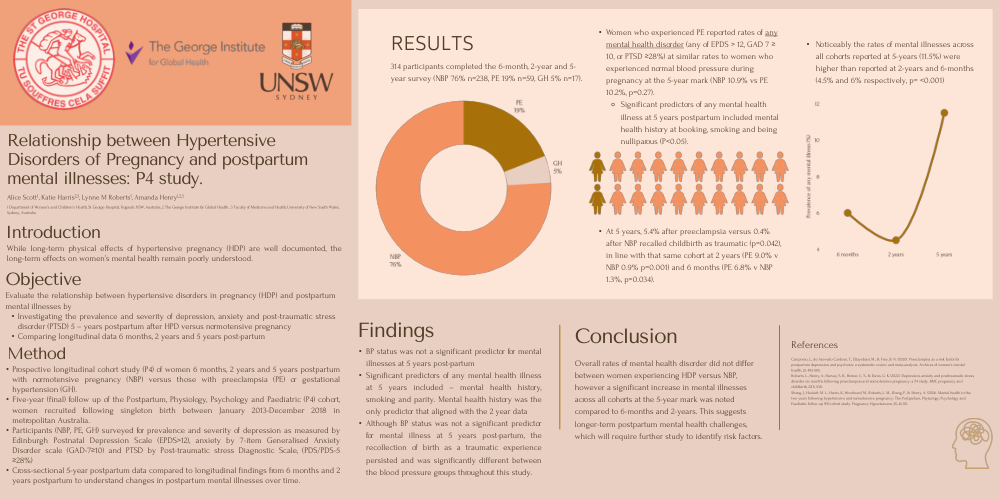
- 314 participants completed the 6-month, 2-year and 5-year survey (NBP 76% n=238, PE 19% n=59, GH 5% n=17).
- Women who experienced PE reported rates of any mental health disorder (any of EPDS > 12, GAD 7 ≥ 10, or PTSD ≥28%) at similar rates to women who experienced normal blood pressure during pregnancy at the 5-year mark (NBP 10.9% vs PE 10.2%, p=0.27).
- Significant predictors of any mental health illness at 5 years postpartum included mental health history at booking, smoking and being nulliparous (P<0.05).
- At 5 years, 5.4% after preeclampsia versus 0.4% after NBP recalled childbirth as traumatic (p=0.042), in line with that same cohort at 2 years (PE 9.0% v NBP 0.9% p=0.001) and 6 months (PE 6.8% v NBP 1.3%, p=0.034).
- Noticeably the rates of mental illnesses across all cohorts reported at 5-years (11.5%) were higher than reported at 2-years and 6-months (4.5% and 6% respectively, p= <0.001)
Findings:
- BP status was not a significant predictor for mental illnesses at 5 years post-partum
- Significant predictors of any mental health illness at 5 years included – mental health history, smoking and parity, mental health history was the only predictor that aligned with the 2 year data
- Although BP status was not a significant predictor for mental illness at 5 years pos-partum, the recollection of birth as a traumatic experience persisted and was significantly different between the blood pressure groups throughout this study.
Conclusion: Overall rates of mental health disorder did not differ between women experiencing HDP versus NBP, however a significant increase in mental illnesses across all cohorts at the 5-year mark was noted compared to 6-months and 2-years. This suggests longer-term postpartum mental health challenges, which will require further study to identify the cause.