2,281 posters, 63 videos, 56 audios, 43 topics, 18 sessions, 6,174 authors, 2,323 institutions
ePostersLive by SciGen Technologies S.A. All rights reserved.
RCOG World Congress 2025
June 23 - 25, 2025 | ExCeL London, UK
EP.1784
Herlyn-Werner-Wunderlich (OHVIRA) syndrome: A rare complex congenital Mullerian anomaly
Poster Presenter
Authors
Affiliations
Part of Topic
Paediatric & adolescent gynaecology
Introduction
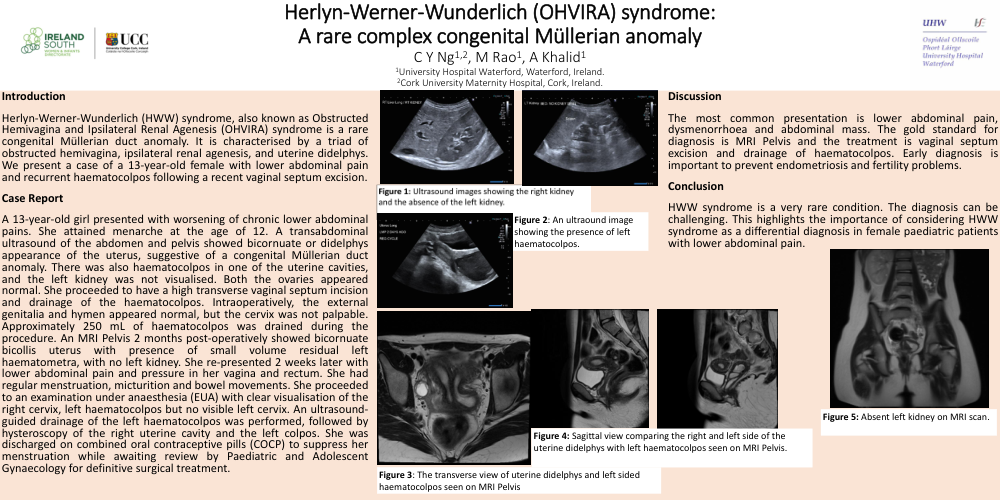
Herlyn-Werner-Wunderlich (HWW) syndrome, also known as Obstructed Hemivagina and Ipsilateral Renal Agenesis (OHVIRA) syndrome is a rare congenital Müllerian duct anomaly. It is characterised by a triad of obstructed hemivagina, ipsilateral renal agenesis, and uterine didelphys. We present a case of a 13-year-old female with lower abdominal pain and recurrent haematocolpos following a recent vaginal septum excision.
Case Report
A 13-year-old girl presented with worsening of chronic lower abdominal pains. She attained menarche at the age of 12. A transabdominal ultrasound of the abdomen and pelvis showed bicornuate or didelphys appearance of the uterus, suggestive of a congenital Müllerian duct anomaly. There was also haematocolpos in one of the uterine cavities, and the left kidney was not visualised. Both the ovaries appeared normal. She proceeded to have a high transverse vaginal septum incision and drainage of the haematocolpos. Intraoperatively, the external genitalia and hymen appeared normal, but the cervix was not palpable. Approximately 250 mL of haematocolpos was drained during the procedure. An MRI Pelvis 2 months post-operatively showed bicornuate bicollis uterus with presence of small volume residual left haematometra, with no left kidney. She re-presented 2 weeks later with lower abdominal pain and pressure in her vagina and rectum. She had regular menstruation, micturition and bowel movements. She proceeded to an examination under anaesthesia (EUA) with clear visualisation of the right cervix, left haematocolpos but no visible left cervix. An ultrasound-guided drainage of the left haematocolpos was performed, followed by hysteroscopy of the right uterine cavity and the left colpos. She was discharged on combined oral contraceptive pills (COCP) to suppress her menstruation while awaiting review by Paediatric and Adolescent Gynaecology for definitive surgical treatment.
Discussion
The most common presentation is lower abdominal pain, dysmenorrhoea and abdominal mass. The gold standard for diagnosis is MRI Pelvis and the treatment is vaginal septum excision and drainage of haematocolpos. Early diagnosis is important to prevent endometriosis and fertility problems.
Conclusion
HWW syndrome is a very rare condition. The diagnosis can be challenging. This highlights the importance of considering HWW syndrome as a differential diagnosis in female paediatric patients with lower abdominal pain.