2,281 posters, 63 videos, 56 audios, 43 topics, 18 sessions, 6,174 authors, 2,323 institutions
ePostersLive by SciGen Technologies S.A. All rights reserved.
RCOG World Congress 2025
June 23 - 25, 2025 | ExCeL London, UK
EP.1783
Heavy Menstrual Bleeding in Pediatric/Adolescent girls-Does the risk increase with BMI?
Poster Presenter
Part of Topic
Paediatric & adolescent gynaecology
Heavy Menstrual Bleeding in Pediatric/ Adolescent girls - Does the risk increase with BMI?
Abstract
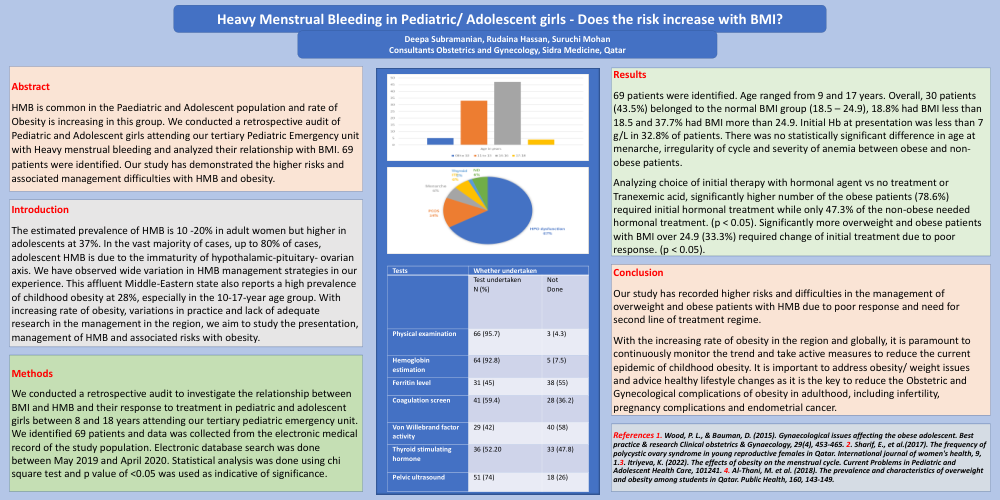
HMB is common in the Paediatric and Adolescent population and rate of Obesity is increasing in this group. We conducted a retrospective audit of Pediatric and Adolescent girls attending our tertiary Pediatric Emergency unit with Heavy menstrual bleeding and analyzed their relationship with BMI. 69 patients were identified. Our study has demonstrated the higher risks and associated management difficulties with HMB and obesity.
Introduction
The estimated prevalence of HMB is 10 -20% in adult women but higher in adolescents at 37%. In the vast majority of cases, up to 80% of cases, adolescent HMB is due to the immaturity of hypothalamic-pituitary- ovarian axis. We have observed wide variation in HMB management strategies in our experience. This affluent Middle-Eastern state also reports a high prevalence of childhood obesity at 28%, especially in the 10-17-year age group. With increasing rate of obesity, variations in practice and lack of adequate research in the management in the region, we aim to study the presentation, management of HMB and associated risks with obesity.
Methods
We conducted a retrospective audit to investigate the relationship between BMI and HMB and their response to treatment in pediatric and adolescent girls between 8 and 18 years attending our tertiary pediatric emergency unit. We identified 69 patients and data was collected from the electronic medical record of the study population. Electronic database search was done between May 2019 and April 2020. Statistical analysis was done using chi square test and p value of <0.05 was used as indicative of significance.
Results
69 patients were identified. Age ranged from 9 and 17 years. Overall, 30 patients (43.5%) belonged to the normal BMI group (18.5 – 24.9), 18.8% had BMI less than 18.5 and 37.7% had BMI more than 24.9. Initial Hb at presentation was less than 7 g/L in 32.8% of patients. There was no statistically significant difference in age at menarche, irregularity of cycle and severity of anemia between obese and non-obese patients.
Analyzing choice of initial therapy with hormonal agent vs no treatment or Tranexemic acid, significantly higher number of the obese patients (78.6%) required initial hormonal treatment while only 47.3% of the non-obese needed hormonal treatment. (p < 0.05). Significantly more overweight and obese patients with BMI over 24.9 (33.3%) required change of initial treatment due to poor response. (p < 0.05).
Conclusion
Our study has recorded higher risks and difficulties in the management of overweight and obese patients with HMB due to poor response and need for second line of treatment regime.
With the increasing rate of obesity in the region and globally, it is paramount to continuously monitor the trend and take active measures to reduce the current epidemic of childhood obesity. It is important to address obesity/ weight issues and advice healthy lifestyle changes as it is the key to reduce the Obstetric and Gynecological complications of obesity in adulthood, including infertility, pregnancy complications and endometrial cancer.