2,281 posters, 63 videos, 56 audios, 43 topics, 18 sessions, 6,174 authors, 2,323 institutions
ePostersLive by SciGen Technologies S.A. All rights reserved.
RCOG World Congress 2025
June 23 - 25, 2025 | ExCeL London, UK
EP.1722
The use of low-fidelity simulation in maximising obstetric and gynaecological surgical training
Poster Presenter
Part of Topic
Medical education
The Use of Low Fidelity Simulation in maximising Obstetrics and Gynaecological Surgical Training
Dr Hashviniya Sekar, Dr Vimbainashe Mudereri, Mr Michael Wong, Miss Elizabeth Egbase
Obstetrics & Gynaecology Department, Royal London Hospital
Introduction
- Obstetrics and Gynaecology (O&G) surgical training faces significant challenges, including inconsistent simulation opportunities, reduced exposure to key procedures, and limited operative experience.
- Post-COVID surgical schedules, which prioritise high-volume, low-complexity cases, have further restricted training opportunities, particularly for foundational procedures such as abdominal hysterectomy and ovarian cystectomies. Additionally, work-hour restrictions compound these limitations.
- Simulation-based training has emerged as a crucial supplement to real-world operating room experience.
- Informed by Kolb’s experiential learning theory, simulation enables learners to engage in concrete experiences, reflective observation, abstract conceptualization, and active experimentation. Compared to laparoscopic simulation, open simulation offers enhanced haptic feedback, more accurately replicates tissue handling and suturing, and allows trainees to develop the intricate skills essential for open surgeries.
-
Design & Method
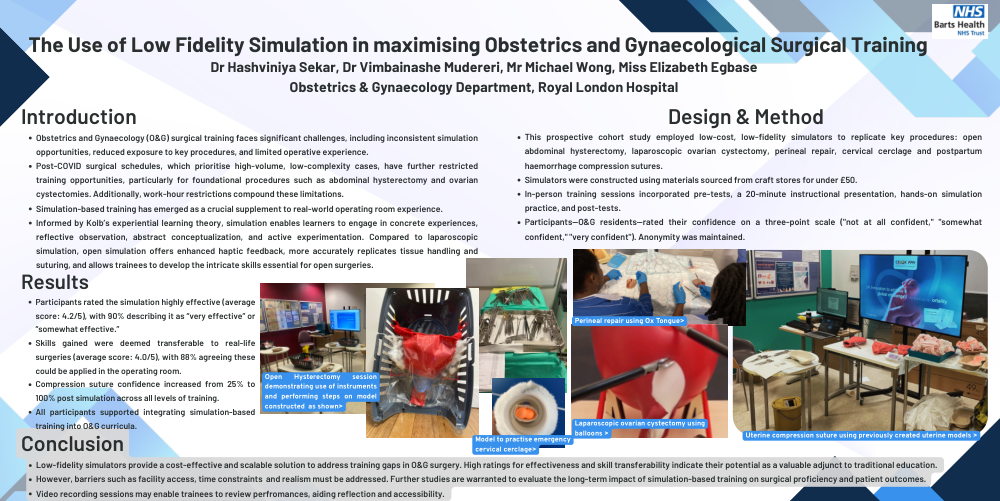
- This prospective cohort study employed low-cost, low-fidelity simulators to replicate key procedures: open abdominal hysterectomy, laparoscopic ovarian cystectomy, perineal repair, cervical cerclage and postpartum haemorrhage compression sutures.
- Simulators were constructed using materials sourced from craft stores for under £50.
- In-person training sessions incorporated pre-tests, a 20-minute instructional presentation, hands-on simulation practice, and post-tests.
- Participants—O&G residents—rated their confidence on a three-point scale ("not at all confident," "somewhat confident," "very confident"). Anonymity was maintained.
Results
- Participants rated the simulation highly effective (average score: 4.2/5), with 90% describing it as “very effective” or “somewhat effective.”
- Skills gained were deemed transferable to real-life surgeries (average score: 4.0/5), with 88% agreeing these could be applied in the operating room.
- Compression suture confidence increased from 25% to 100% post simulation across all levels of training.
- All participants supported integrating simulation-based training into O&G curricula.
-
Conclusion
- Low-fidelity simulators provide a cost-effective and scalable solution to address training gaps in O&G surgery. High ratings for effectiveness and skill transferability indicate their potential as a valuable adjunct to traditional education.
- However, barriers such as facility access, time constraints and realism must be addressed. Further studies are warranted to evaluate the long-term impact of simulation-based training on surgical proficiency and patient outcomes.
- Video recording sessions may enable trainees to review perfromances, aiding reflection and accessibility.