2,281 posters, 63 videos, 56 audios, 43 topics, 18 sessions, 6,174 authors, 2,323 institutions
ePostersLive by SciGen Technologies S.A. All rights reserved.
RCOG World Congress 2025
June 23 - 25, 2025 | ExCeL London, UK
EP.1706
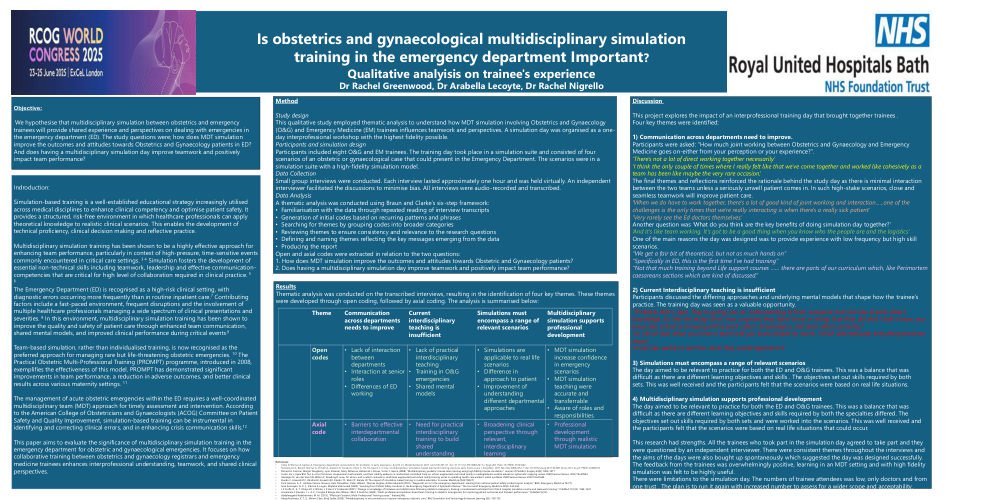
Is obstetrics and gynaecological multidisciplinary simulation training in the emergency department important?
Part of Topic
Medical education
We hypothesise that multidisciplinary simulation between obstetrics and emergency
trainees will provide shared experience and perspectives on dealing with emergencies in
the emergency department (ED). The study questions were; how does MDT simulation
improve the outcomes and attitudes towards Obstetrics and Gynaecology patients in ED?
And does having a multidisciplinary simulation day improve teamwork and positively
impact team performance?
Indroduction:
Simulation-based training is a well-established educational strategy increasingly utilised
across medical disciplines to enhance clinical competency and optimise patient safety. It
provides a structured, risk-free environment in which healthcare professionals can apply
theoretical knowledge to realistic clinical scenarios. This enables the development of
technical proficiency, clinical decision making and reflective practice.
Multidisciplinary simulation training has been shown to be a highly effective approach for
enhancing team performance, particularly in context of high-pressure, time-sensitive events
commonly encountered in critical care settings. 3 4 Simulation fosters the development of
essential non-technical skills including teamwork, leadership and effective communication-
competencies that are critical for high level of collaboration required in clinical practice. 5
6
The Emergency Department (ED) is recognised as a high-risk clinical setting, with
diagnostic errors occurring more frequently than in routine inpatient care.7 Contributing
factors include a fast-paced environment, frequent disruptions and the involvement of
multiple healthcare professionals managing a wide spectrum of clinical presentations and
severities. 8
In this environment, multidisciplinary simulation training has been shown to
improve the quality and safety of patient care through enhanced team communication,
shared mental models, and improved clinical performance during critical events.9
Team-based simulation, rather than individualised training, is now recognised as the
preferred approach for managing rare but life-threatening obstetric emergencies. 10 The
Practical Obstetric Multi-Professional Training (PROMPT) programme, introduced in 2008,
exemplifies the effectiveness of this model. PROMPT has demonstrated significant
improvements in team performance, a reduction in adverse outcomes, and better clinical
results across various maternity settings. 11
The management of acute obstetric emergencies within the ED requires a well-coordinated
multidisciplinary team (MDT) approach for timely assessment and intervention. According
to the American College of Obstetricians and Gynaecologists (ACOG) Committee on Patient
Safety and Quality Improvement, simulation-based training can be instrumental in
identifying and correcting clinical errors, and in enhancing crisis communication skills.12
This paper aims to evaluate the significance of multidisciplinary simulation training in the
emergency department for obstetric and gynaecological emergencies. It focuses on how
collaborative training between obstetrics and gynaecology registrars and emergency
medicine trainees enhances interprofessional understanding, teamwork, and shared clinical
perspectives.
Results
Thematic analysis was conducted on the transcribed interviews, resulting in the identification of four key themes. These themes
were developed through open coding, followed by axial coding. The analysis is summarised below:
This project explores the impact of an interprofessional training day that brought together trainees .
Four key themes were identified:
1) Communication across departments need to improve.
Participants were asked: “How much joint working between Obstetrics and Gynaecology and Emergency
Medicine goes on-either from your perception or your experience?”.
‘There's not a lot of direct working together necessarily’
‘I think the only couple of times where I really felt like that we've come together and worked like cohesively as a
team has been like maybe the very rare occasion.’
The final themes and reflections reinforced the rationale behind the study day as there is minimal interaction
between the two teams unless a seriously unwell patient comes in. In such high-stake scenarios, close and
seamless teamwork will improve patient care.
‘When we do have to work together, there's a lot of good kind of joint working and interaction......one of the
challenges is the only times that we're really interacting is when there's a really sick patient’
‘Very rarely see the Ed doctors themselves.’
Another question was ‘What do you think are the key benefits of doing simulation day together?’
‘And it's like team working. It's got to be a good thing when you know who the people are and the logistics’
One of the main reasons the day was designed was to provide experience with low frequency but high skill
scenarios.
“We get a fair bit of theoretical, but not as much hands on”
“Specifically in ED, this is the first time I’ve had training”
“Not that much training beyond Life support courses ...... there are parts of our curriculum which, like Perimortem
caesareans sections which are kind of discussed.”
2) Current Interdisciplinary teaching is insufficient
Participants discussed the differing approaches and underlying mental models that shape how the trainee’s
practice. The training day was seen as a valuable opportunity.
“Probably that's right. They're giving you an understanding of their viewpoint and also like of each other's
knowledge. So, like the things that I was surprised they didn't know or things that they did that I didn't know, you
know, like I think so knowing where each other's knowledge is and each other's priorities”
‘So I think that when you know a team and you know people by name, I think automatically everything becomes
easier.’
‘It was like useful to see how much they would approach it’
3) Simulations must encompass a range of relevant scenarios
The day aimed to be relevant to practice for both the ED and O&G trainees. This was a balance that was
difficult as there are different learning objectives and skills . The objectives set out skills required by both
sets. This was well received and the participants felt that the scenarios were based on real life situations.
4) Multidisciplinary simulation supports professional development
The day aimed to be relevant to practice for both the ED and O&G trainees. This was a balance that was
difficult as there are different learning objectives and skills required by both the specialties differed. The
objectives set out skills required by both sets and were worked into the scenarios. This was well received and
the participants felt that the scenarios were based on real life situations that could occur.
This research had strengths. All the trainees who took part in the simulation day agreed to take part and they
were questioned by an independent interviewer. There were consistent themes throughout the interviews and
the aims of the days were also bought up spontaneously which suggested the day was designed successfully.
The feedback from the trainees was overwhelmingly positive, learning in an MDT setting and with high fidelity
simulation was felt to be highly useful.
There were limitations to the simulation day. The numbers of trainee attendees was low, only doctors and from
one trust . The plan is to run it again with increased number to assess for a wider scope and acceptability.