2,281 posters, 63 videos, 56 audios, 43 topics, 18 sessions, 6,174 authors, 2,323 institutions
ePostersLive by SciGen Technologies S.A. All rights reserved.
RCOG World Congress 2025
June 23 - 25, 2025 | ExCeL London, UK
EP.1718
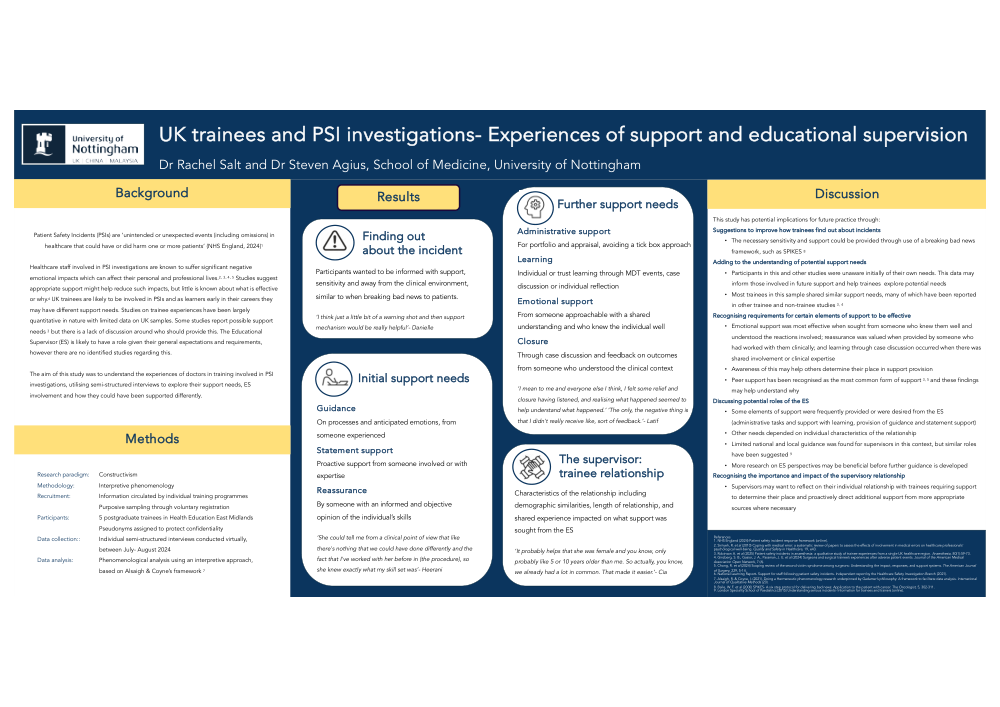
UK trainees and PSI Investigations- Experiences of support and educational supervision
Poster Presenter
Authors
Affiliations
Part of Topic
Medical education
UK trainees and PSI investigations- Experiences of support and educational supervision Dr Rachel Salt and Dr Steven Agius, School of Medicine, University of Nottingham Background Results
Finding out
about the incident
Participants wanted to be informed with support, sensitivity and away from the clinical environment, similar to when breaking bad news to patients.
‘I think just a little bit of a warning shot and then support mechanism would be really helpful’- Danielle
Initial support needs
On processes and anticipated emotions, from
someone experienced
Statement support
Proactive support from someone involved or with expertise
Reassurance
By someone with an informed and objective opinion of the individual’s skills
‘She could tell me from a clinical point of view that like there's nothing that we could have done differently and the fact that I've worked with her before in (the procedure), so she knew exactly what my skill set was’- Heerani
Further support needs
Administrative support
For portfolio and appraisal, avoiding a tick box approach
Learning
Individual or trust learning through MDT events, case
discussion or individual reflection
Emotional support
From someone approachable with a shared understanding and who knew the individual well
Closure
Through case discussion and feedback on outcomes from someone who understood the clinical context
‘I mean to me and everyone else I think, I felt some relief and closure having listened, and realising what happened seemed to help understand what happened.’ ‘The only, the negative thing is that I didn't really receive like, sort of feedback.’- Latif
The supervisor: trainee relationship
Characteristics of the relationship including demographic similarities, length of relationship, and shared experience impacted on what support was sought from the ES
‘It probably helps that she was female and you know, only probably like 5 or 10 years older than me. So actually, you know, we already had a lot in common. That made it easier.’- Cia Guidance Discussion
Patient Safety Incidents (PSIs) are ‘unintended or unexpected events (including omissions) in healthcare that could have or did harm one or more patients’ (NHS England, 2024)1
Healthcare staff involved in PSI investigations are known to suffer significant negative emotional impacts which can affect their personal and professional lives.2, 3, 4, 5 Studies suggest appropriate support might help reduce such impacts, but little is known about what is effective or why.6 UK trainees are likely to be involved in PSIs and as learners early in their careers they may have different support needs. Studies on trainee experiences have been largely quantitative in nature with limited data on UK samples. Some studies report possible support needs 3 but there is a lack of discussion around who should provide this. The Educational Supervisor (ES) is likely to have a role given their general expectations and requirements, however there are no identified studies regarding this.
The aim of this study was to understand the experiences of doctors in training involved in PSI investigations, utilising semi-structured interviews to explore their support needs, ES involvement and how they could have been supported differently.
This study has potential implications for future practice through:
Suggestions to improve how trainees find out about incidents
• The necessary sensitivity and support could be provided through use of a breaking bad news framework, such as SPIKES 8
Adding to the understanding of potential support needs
• Participants in this and other studies were unaware initially of their own needs. This data may inform those involved in future support and help trainees explore potential needs
• Most trainees in this sample shared similar support needs, many of which have been reported in other trainee and non-trainee studies 3, 4
Recognising requir
|
UK trainees and PSI investigations- Experiences of support and educational supervision Dr Rachel Salt and Dr Steven Agius, School of Medicine, University of Nottingham |
||
|
Background |
Results Finding out Participants wanted to be informed with support, sensitivity and away from the clinical environment, similar to when breaking bad news to patients. ‘I think just a little bit of a warning shot and then support mechanism would be really helpful’- Danielle Initial support needs On processes and anticipated emotions, from someone experienced Statement support Proactive support from someone involved or with expertise Reassurance By someone with an informed and objective opinion of the individual’s skills ‘She could tell me from a clinical point of view that like there's nothing that we could have done differently and the fact that I've worked with her before in (the procedure), so she knew exactly what my skill set was’- Heerani Further support needs Administrative support For portfolio and appraisal, avoiding a tick box approach Learning Individual or trust learning through MDT events, case discussion or individual reflection Emotional support From someone approachable with a shared understanding and who knew the individual well Closure Through case discussion and feedback on outcomes from someone who understood the clinical context ‘I mean to me and everyone else I think, I felt some relief and closure having listened, and realising what happened seemed to help understand what happened.’ ‘The only, the negative thing is that I didn't really receive like, sort of feedback.’- Latif The supervisor: trainee relationship Characteristics of the relationship including demographic similarities, length of relationship, and shared experience impacted on what support was sought from the ES ‘It probably helps that she was female and you know, only probably like 5 or 10 years older than me. So actually, you know, we already had a lot in common. That made it easier.’- Cia Guidance |
Discussion |
|
Patient Safety Incidents (PSIs) are ‘unintended or unexpected events (including omissions) in healthcare that could have or did harm one or more patients’ (NHS England, 2024)1 Healthcare staff involved in PSI investigations are known to suffer significant negative emotional impacts which can affect their personal and professional lives.2, 3, 4, 5 Studies suggest appropriate support might help reduce such impacts, but little is known about what is effective or why.6 UK trainees are likely to be involved in PSIs and as learners early in their careers they may have different support needs. Studies on trainee experiences have been largely quantitative in nature with limited data on UK samples. Some studies report possible support needs 3 but there is a lack of discussion around who should provide this. The Educational Supervisor (ES) is likely to have a role given their general expectations and requirements, however there are no identified studies regarding this. The aim of this study was to understand the experiences of doctors in training involved in PSI investigations, utilising semi-structured interviews to explore their support needs, ES involvement and how they could have been supported differently. |
This study has potential implications for future practice through: Suggestions to improve how trainees find out about incidents • The necessary sensitivity and support could be provided through use of a breaking bad news framework, such as SPIKES 8 Adding to the understanding of potential support needs
• Supervisors may want to reflect on their individual relationship with trainees requiring support to determine their place and proactively direct additional support from more appropriate sources where necessary |
|
|
Methods |
||
|
Research paradigm: Methodology: Recruitment: Participants: Data collection:: Data analysis: Constructivism |
||
ements for certain elements of support to be effective
• Emotional support was most effective when sought from someone who knew them well and understood the reactions involved; reassurance was valued when provided by someone who had worked with them clinically; and learning through case discussion occurred when there was shared involvement or clinical expertise
• Awareness of this may help others determine their place in support provision
• Peer support has been recognised as the most common form of support 3, 5 and these findings
may help understand why
Discussing potential roles of the ES
• Some elements of support were frequently provided or were desired from the ES (administrative tasks and support with learning, provision of guidance and statement support)
• Other needs depended on individual characteristics of the relationship
• Limited national and local guidance was found for supervisors in this context, but similar roles
have been suggested 9
• More research on ES perspectives may be beneficial before further guidance is developed
Recognising the importance and impact of the supervisory relationship
• Supervisors may want to reflect on their individual relationship with trainees requiring support to determine their place and proactively direct additional support from more appropriate sources where necessary Methods
Research paradigm:
Methodology:
Recruitment:
Participants:
Data collection:: Data analysis:
Constructivism
Interpretive phenomenology
Information circulated by individual training programmes Purposive sampling through voluntary registration
5 postgraduate trainees in Health Education East Midlands Pseudonyms assigned to protect confidentiality
Individual semi-structured interviews conducted virtually, between July- August 2024
Phenomenological analysis using an interpretive approach, based on Alsaigh & Coyne’s framework 7