2,281 posters, 63 videos, 56 audios, 43 topics, 18 sessions, 6,174 authors, 2,323 institutions
ePostersLive by SciGen Technologies S.A. All rights reserved.
RCOG World Congress 2025
June 23 - 25, 2025 | ExCeL London, UK
EP.1710
Enhancing laparoscopic competency in gynaecology: A survey-driven laparoscopic suturing course
Poster Presenter
Part of Topic
Medical education
Enhancing laparoscopic competency in gynaecology: A survey-driven laparoscopic suturing course
Objective
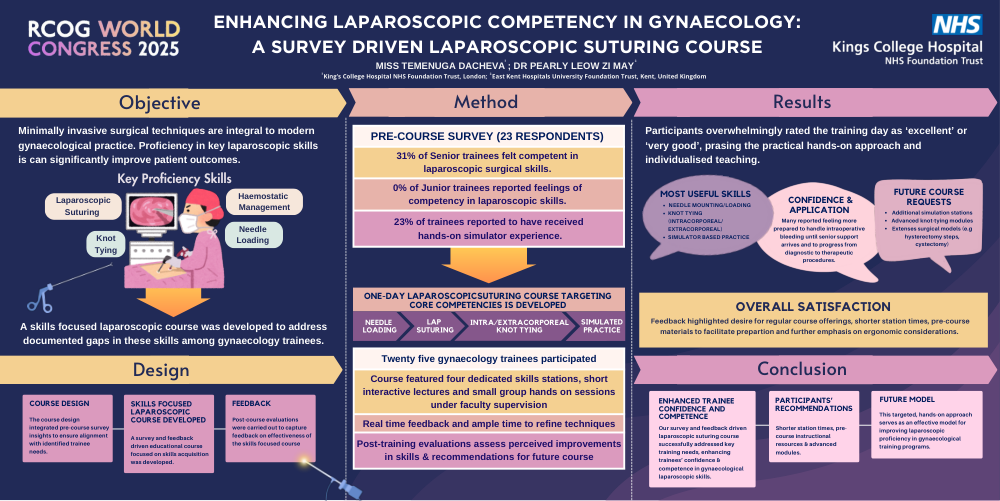
Minimally invasive surgical techniques are increasingly integral to modern gynaecological practice. Proficiency in laparoscopic suturing, particularly needle loading, knot tying, and haemostatic management, can significantly improve patient outcomes. To address documented gaps in laparoscopic suturing skills among gynaecology trainees and thereby enhance overall surgical competency in minimally invasive procedures.
Design
A survey- and feedback-driven educational intervention was developed, focusing on practical skill acquisition through a structured training day. The course design integrated pre-course survey insights to ensure alignment with identified trainee needs, and post-course evaluations to capture feedback on content effectiveness.
Method
A pre-course survey (23 respondents) revealed that only 31% of senior trainees and none of the junior trainees felt confident in essential laparoscopic skills, while only 23% had any hands-on simulator experience. Drawing on these data, a one-day laparoscopic suturing course was created to target core competencies in laparoscopic suturing: needle loading, intracorporeal/extracorporeal knot tying, and simulated practice. Twenty-five gynaecology trainees participated in the event, which featured four dedicated skills stations, short interactive lectures, and small-group, hands-on sessions under expert faculty supervision. Virtual simulation supplemented box trainer exercises, providing an immersive environment for repeated practice. Real-time feedback and ample time to refine techniques were prioritised. Post-training evaluations assessed perceived improvements in skills and recommendations for future courses.
Results
Participants overwhelmingly rated the training day as “excellent” or “very good,” praising the practical, hands-on approach and individualised teaching:
Most Useful Skills: Needle mounting/loading, knot tying (intracorporeal and extracorporeal), and simulator-based practice.
Confidence & Application: Many reported feeling more prepared to handle intraoperative bleeding until senior support arrives and to progress from diagnostic to therapeutic procedures.
Future Course Requests: Additional simulation stations, advanced knot-tying modules, and extended surgical models (e.g., hysterectomy steps, cystectomy).
Overall Satisfaction: Feedback highlighted a desire for regular course offerings, shorter station times for more rotation, pre-course materials to facilitate preparation, and further emphasis on ergonomic considerations.
Conclusion
Our survey- and feedback-driven laparoscopic suturing course successfully addressed key training needs, enhancing trainees’ confidence and competence in gynaecological laparoscopic skills. Participants’ recommendations—such as shorter station times, pre-course instructional resources, and more advanced modules—will inform future curricula. This targeted, hands-on approach serves as an effective model for improving laparoscopic proficiency in gynaecological training programs.