2,281 posters, 63 videos, 56 audios, 43 topics, 18 sessions, 6,174 authors, 2,323 institutions
ePostersLive by SciGen Technologies S.A. All rights reserved.
RCOG World Congress 2025
June 23 - 25, 2025 | ExCeL London, UK
EP.0015
Measuring abortion stigma and associated factors in the Congolese context: cross-sectional study
Poster Presenter
Authors
Jean-Claude Mulunda, Mike Mpoyi, Nadia Lobo, Grace Sheehy, Eric Mafuta
Affiliations
Part of Topic
Abortion care
Exploring abortion stigma in the Congolesecontext: A cross-sectional study
Background and objectives
While abortion is a common experience and very safe when performed according to recommended guidelines, anti-abortion sentiment remains pervasive around the world. In the Democratic Republic of Congo (DRC), access to legal abortion care has been greatly expanded since the country ratified the Maputo Protocol and it became law in 2018, yet many people continue to view abortion as moral wrong or unacceptable. Evidence suggests that people often hold nuanced views on the acceptability of abortion, and understanding the dimensions of abortion stigma is important for informing efforts to address it.
This study was undertaken to measure stigmatizing attitudes, beliefs and actions towards women who have abortions in Congolese communities in two provinces of the DRC, as well as sociodemographic factors contributing to abortion stigma.
Method
Between February and March 2024, we administered a cross-sectional survey to 1,516 women and men in two provinces in the Democratic Republic of Congo (Goma/Nord-Kivu n=800 and Kinshasa n=716). We measured abortion stigma using the Stigmatizing Attitudes, Beliefs and Actions Scale (SABAS) developed by Ipas, which includes 18 items under three components: negative stereotypes (8 items), exclusion & discrimination (7 items), and fear of contagion (3 items). A five-level Likert scale was used where 1 represents no/low level of stigma and 5 is the highest level of stigma for 17 statements, and the reverse for one statement which is framed positively. Total scores range from 18 to 90, with higher scores indicating stronger stigma.: Data were collected through face-to-face interviews using structured questionnaires on Survey CTO collect. Stata 17.0 softwarewasused for data analysis. Univariate analysis was conducted to determine the frequency distributions of demographic characteristics and SABAS statements. Additionally, the mean and standard deviation were computed for the total SABAS scores as well as for each of the three subscales. Associations were measured with chi square. Further, logistic regression was conducted and results are presented with a 5% confidence level.
Results
The mean SABAS score was 52.16 out of 90, indicating moderate abortion stigma in Kinshasa and Goma/North Kivu.
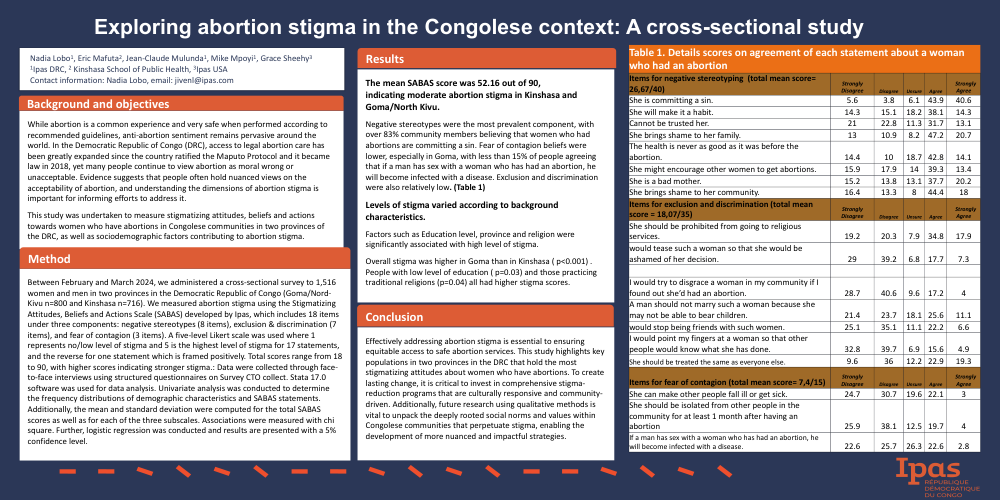
Negative stereotypes were the most prevalent component, with over 83% community members believing that women who had abortions are committing a sin. Fear of contagion beliefs were lower, especially in Goma, with less than 15% of people agreeing that if a man has sex with a woman who has had an abortion, he will become infected with a disease. Exclusion and discrimination were also relatively low. (Table 1)
Levels of stigma varied according to background characteristics.
Factors such as Education level, province and religion were significantly associated with high level of stigma.
Overall stigma was higher in Goma than in Kinshasa ( p<0.001) . People with low level of education ( p=0.03) and those practicing traditional religions (p=0.04) all had higher stigma scores.
Conclusion
Effectively addressing abortion stigma is essential to ensuring equitable access to safe abortion services. This study highlights key populations in two provinces in the DRC that hold the most stigmatizing attitudes about women who have abortions. To create lasting change, it is critical to invest in comprehensive stigma-reduction programs that are culturally responsive and community-driven. Additionally, future research using qualitative methods is vital to unpack the deeply rooted social norms and values within Congolese communities that perpetuate stigma, enabling the development of more nuanced and impactful strategies.