2,281 posters, 63 videos, 56 audios, 43 topics, 18 sessions, 6,174 authors, 2,323 institutions
ePostersLive by SciGen Technologies S.A. All rights reserved.
RCOG World Congress 2025
June 23 - 25, 2025 | ExCeL London, UK
EP.1486
A case of a post Caesarean Section Rectus sheath haematoma
Poster Presenter
Part of Topic
Labour ward management
A case of a post Caesarean Section Rectus sheath haematoma
Case report
Objective:
Rectus sheath hematoma( RSH) is a rare complication of Caesarean sections (CS) and has been reported as one of the common causes of return to theatre after Caesarean Sections . This is a case of a large RSH which developed after a Category 1 CS and intraoperative surgical Transversus Abdominis Plane (TAP) block which are reported as risk factors of post Caesarean section RSH .
Case Report:
34 year old primipara had a category 1 CS and received surgical TAP block intraoperatively.
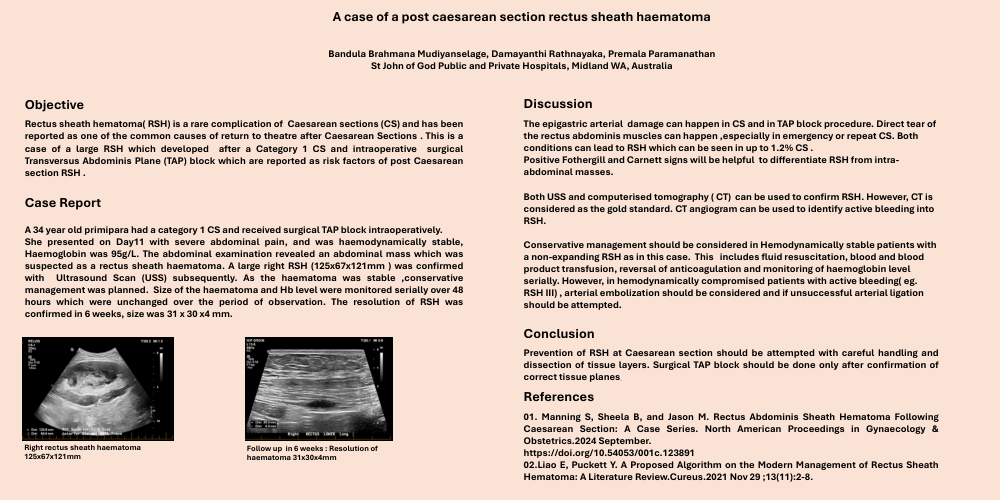
She presented on Day11 with severe abdominal pain, and was haemodynamically stable, Haemoglobin was 95g/L. The abdominal examination revealed an abdominal mass which was suspected as a rectus sheath haematoma. A large right RSH (125x67x121mm ) was confirmed with Ultrasound Scan (USS) subsequently. As the haematoma was stable ,conservative management was planned. Size of the haematoma and Hb level were monitored serially over 48 hours which were unchanged over the period of observation. The resolution of RSH was confirmed in 6 weeks, size was 31 x 30 x4 mm.
Discussion:
The epigastric arterial damage can happen in CS and in TAP block procedure. Direct tear of the rectus abdominis muscles can happen ,especially in emergency or repeat CS. Both conditions can lead to RSH which can be seen in up to 1.2% CS .
Positive Fothergill and Carnett signs will be helpful to differentiate RSH from intra-abdominal masses.
Both USS and computerised tomography ( CT) can be used to confirm RSH. However, CT is considered as the gold standard. CT angiogram can be used to identify active bleeding into RSH.
Conservative management should be considered in Hemodynamically stable patients with a non-expanding RSH as in this case. This includes fluid resuscitation, blood and blood product transfusion, reversal of anticoagulation and monitoring of haemoglobin level serially. However, in hemodynamically compromised patients with active bleeding( eg. RSH III) , arterial embolization should be considered and if unsuccessful arterial ligation should be attempted.
Conclusion:
Prevention of RSH at Caesarean section should be attempted with careful handling and dissection of tissue layers. Surgical TAP block should be done only after confirmation of correct tissue planes.
References:
01. Manning S, Sheela B, and Jason M. Rectus Abdominis Sheath Hematoma Following Caesarean Section: A Case Series. North American Proceedings in Gynaecology & Obstetrics.2024 September.
https://doi.org/10.54053/001c.123891
02.Liao E, Puckett Y. A Proposed Algorithm on the Modern Management of Rectus Sheath Hematoma: A Literature Review.Cureus.2021 Nov 29 ;13(11):2-8.