2,281 posters, 63 videos, 56 audios, 43 topics, 18 sessions, 6,174 authors, 2,323 institutions
ePostersLive by SciGen Technologies S.A. All rights reserved.
RCOG World Congress 2025
June 23 - 25, 2025 | ExCeL London, UK
EP.1485
A case of lower limb Compartment syndrome after an emergency Caesarean Section
Poster Presenter
Part of Topic
Labour ward management
A case of lower limb Compartment syndrome after an emergency Caesarean Section
Case report
Objective:
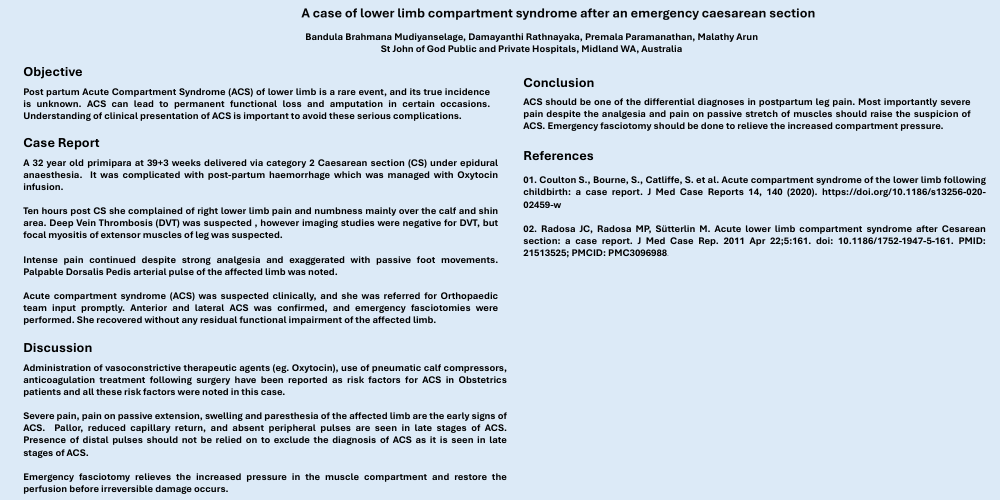
Post partum Acute Compartment Syndrome (ACS) of lower limb is a rare event, and its true incidence is unknown. ACS can lead to permanent functional loss and amputation in certain occasions. Understanding of clinical presentation of ACS is important to avoid these serious complications.
Case Report:
32 year old primipara at 39+3 weeks delivered via category 2 Caesarean section (CS) under epidural anaesthesia. It was complicated with post-partum haemorrhage which was managed with Oxytocin infusion.
Ten hours post CS she complained of right lower limb pain and numbness mainly over the calf and shin area. Deep Vein Thrombosis (DVT) was suspected , however imaging studies were negative for DVT, but focal myositis of extensor muscles of leg was suspected.
Intense pain continued despite strong analgesia and exaggerated with passive foot movements. Palpable Dorsalis Pedis arterial pulse of the affected limb was noted.
Acute compartment syndrome (ACS) was suspected clinically and she was referred for Orthopaedic team input promptly. Anterior and lateral ACS was confirmed, and emergency fasciotomies were performed. She recovered without any residual functional impairment of the affected limb.
Discussion:
Administration of vasoconstrictive therapeutic agents (e.g. Oxytocin), use of pneumatic calf compressors, anticoagulation treatment following surgery have been reported as risk factors for ACS in Obstetrics patients and all these risk factors were noted in this case.
Severe pain, pain on passive extension, swelling and paresthesia of the affected limb are the early signs of ACS. Pallor, reduced capillary return, and absent peripheral pulses are seen in late stages of ACS. Presence of distal pulses should not be relied on to exclude the diagnosis of ACS as it is seen in late stages of ACS.
Emergency fasciotomy relieves the increased pressure in the muscle compartment and restore the perfusion before irreversible damage occurs.
Conclusion:
ACS should be one of the differential diagnoses in postpartum leg pain. Most importantly severe pain despite the analgesia and pain on passive stretch of muscles should raise the suspicion of ACS. Emergency fasciotomy should be done to relieve the increased compartment pressure.
01. Coulton S., Bourne, S., Catliffe, S. et al. Acute compartment syndrome of the lower limb following childbirth: a case report. J Med Case Reports 14, 140 (2020). https://doi.org/10.1186/s13256-020-02459-w
02. Radosa JC, Radosa MP, Sütterlin M. Acute lower limb compartment syndrome after Cesarean section: a case report. J Med Case Rep. 2011 Apr 22;5:161. doi: 10.1186/1752-1947-5-161. PMID: 21513525; PMCID: PMC3096988.