2,281 posters, 63 videos, 56 audios, 43 topics, 18 sessions, 6,174 authors, 2,323 institutions
ePostersLive by SciGen Technologies S.A. All rights reserved.
RCOG World Congress 2025
June 23 - 25, 2025 | ExCeL London, UK
EP.1483
Novel transabdominal drainage of Bakri balloon: Case series of three patients
Poster Presenter
Part of Topic
Labour ward management
Novel Transabdominal Drainage of Bakri Balloon Following Caesarean Section: A Case Series of Three Patients
Background
Atonic postpartum haemorrhage (PPH) is the leading cause of maternal mortality.
Intrauterine balloon tamponade (IUBT), especially using the Bakri balloon, is the recommended 'surgical' intervention if uterine atony is the primary source of haemorrhage.
Normally, the Bakri balloon is introduced into the uterus following vaginal birth or caesarean section (CS), exerting a tamponade pressure to control bleeding.
Conventionally, the Bakri balloon drains via the cervix and vagina.
In rare scenarios, cervical stenosis or surgical obstruction prevent transvaginal drainage.
Objective
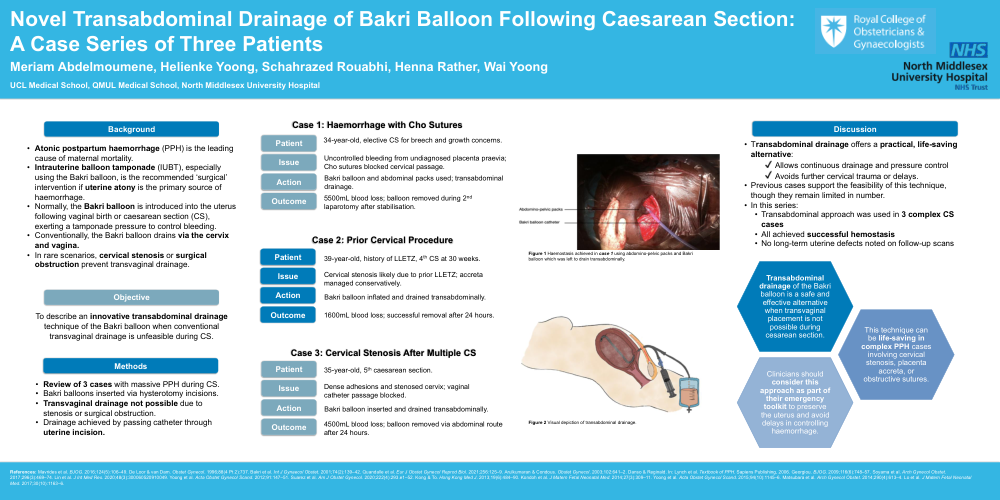
To describe an innovative transabdominal drainage technique of the Bakri balloon when conventional transvaginal drainage is unfeasible during CS.
Methods
✔ Allows continuous drainage and pressure control
✔ Avoids further cervical trauma or delays.
Transabdominal drainage of the Bakri balloon is a safe and effective alternative when transvaginal placement is not possible during cesarean section.
This technique can be life-saving in complex PPH cases involving cervical stenosis, placenta accreta, or obstructive sutures.
Clinicians should consider this approach as part of their emergency toolkit to preserve the uterus and avoid delays in controlling haemorrhage.