2,281 posters, 63 videos, 56 audios, 43 topics, 18 sessions, 6,174 authors, 2,323 institutions
ePostersLive by SciGen Technologies S.A. All rights reserved.
RCOG World Congress 2025
June 23 - 25, 2025 | ExCeL London, UK
PP.0042
Mifepristone Versus Transcervical Foley Catheter for Pre-induction Cervical Ripening – Randomised Controlled Trial
Poster Presenter
Part of Topic
Labour ward management
RCOG 2025
[CTRI/2021/07/034943]
METHODOLOGY
All women planned for IOL from December 2021 to April
2023 at a tertiary care centre in South India, fulfilling the
eligibility criteria, were recruited. The participants were
equally randomized into two groups:
OBJECTIVE
▪ Induction of labour (IOL) at term and late-term is the most commonly performed procedure
worldwide, with an incidence of 25%. It is indicated either for maternal or foetal indications. The
success of IOL depends on the degree of ripening of the cervix.
▪ The aim of the study was to determine and compare the EFFICACY i.e., change in Bishop score and the
SAFETY of oral Mifepristone with transcervical Foley catheter in women with singleton term and late
term pregnancy undergoing pre-induction cervical ripening.
STUDY DESIGN
Open-label | Randomized Controlled | Non-inferiority Trail
Group B (n=133)
Transcervical Foley for
24 hours.
Group A (n=133)
Single Oral Mifepristone
400mg
Mifepristone Versus Transcervical Foley Catheter for Pre-induction Cervical Ripening – Randomised Controlled Trial
Presenting Author: Dr. Yarlagadda Jane Jasmine, Senior Resident
Co-Authors: Dr. T. Parvathi, Associate Professor; Dr. Haritha Sagili, Professor
(Department of Obstetrics and Gyanecology, JIPMER, Puducherry, India)
Inclusion Criteria:
▪ Age > 18 years
▪ Period of gestation
39⁰/⁷ to 42 weeks
▪ Single live foetus with
cephalic presentation
with reactive Non
stress test
▪ Bishop score ≤ 6
▪ Intact membranes
▪ Unscarred uterus
▪ Planned for IOL
Exclusion Criteria:
▪ Absolute
contraindications for
vaginal delivery
▪ Patients requiring
imminent delivery
▪ Evidence of
chorioamnionitis
▪ Participants with
known
contraindications to
Mifepristone
Statistical Analysis:
Using STATA Software, Intention-To-Treat (ITT) and Per
Protocol analysis (PPA) were performed; p < 0.05
considered significant
RESULTS
REFERENCES
1. Leppert PC.Anatomy and physiology of cervical ripening.Clin Obstet Gynecol.1995 Jun;38(2):267-79. 00009.PMID: 7554594. doi: 10.1097/00003081-199506000
2. WHO recommendations: induction of labour at or beyond term.Geneva: World Health Organization; 2018.
3. Vogel JP, Osoti AO, Kelly A J, Livio S, Norman JE, Alfirevic Z. Pharmacological and mechanical interventions for labor induction in outpatient settings.Cochrane Database Syst Rev. 2017 Sep 13;9(9):CD007701.doi:10.1002/14651858.CD007701.pub3. PMID:
28901007; PMCID: PMC6483740 Myers KM, Feltovich H, Mazza E, Vink J, Bajka M, Wapner RJ, Hall TJ, House M. The mechanical role of the cervix in pregnancy.JBiomech.2015 Jun 25;48(9):1511-23.doi: 10.1016/j.jbiomech.2015.02.065.Epub 2015 Mar
11.PMID: 25841293; PMCID: PMC4459908.
4. Wing DA, Fassett MJ, Mishell DR. Mifepristone for preinduction cervical ripening beyond 41 weeks’ gestation: a randomized controlled trial. Obstet Gynecol.2000 Oct;96(4):543-8. doi: 10.1016/s0029-7844(00)00947-9. PMID: 11004356.
5. Sharma C, Soni A, Gupta A, Verma A, Verma S. Mifepristone vs balloon catheter for labor induction in previous cesarean: a randomized controlled trial.Arch Gynecol Obstet.2017 Aug;296(2):241-248.doi: 10.1007/s00404-017-4431-8.Epub 2017 Jun
17.PMID: 28624988.
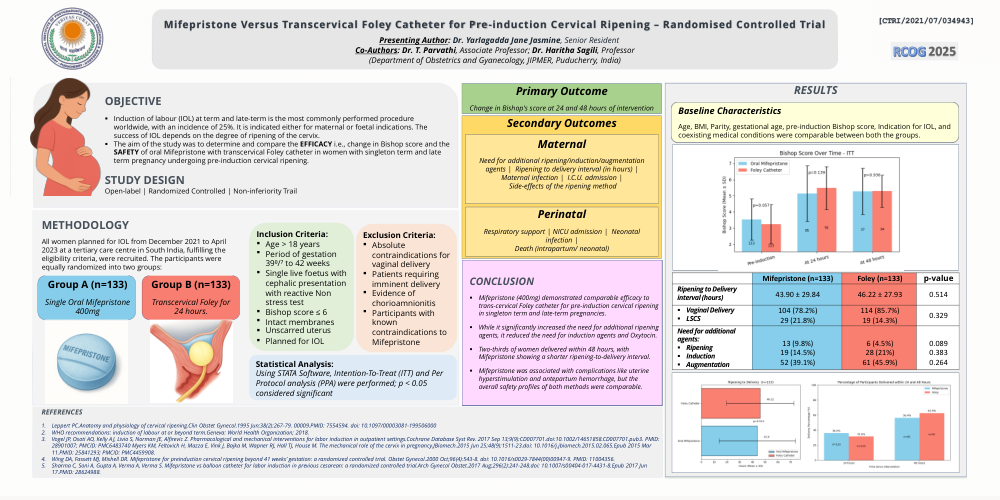
Primary Outcome
Change in Bishop's score at 24 and 48 hours of intervention
Secondary Outcomes
Maternal
Need for additional ripening/induction/augmentation
agents | Ripening to delivery interval (in hours) |
Maternal infection | I.C.U. admission |
Side-effects of the ripening method
Perinatal
Respiratory support | NICU admission | Neonatal
infection |
Death (intrapartum/ neonatal)
Mifepristone (n=133) Foley (n=133) p-value
Ripening to Delivery
interval (hours)
43.90 ± 29.84 46.22 ± 27.93 0.514
▪ Vaginal Delivery
▪ LSCS
104 (78.2%)
29 (21.8%)
114 (85.7%)
19 (14.3%)
0.329
Need for additional
agents:
▪ Ripening
▪ Induction
▪ Augmentation
13 (9.8%)
19 (14.5%)
52 (39.1%)
6 (4.5%)
28 (21%)
61 (45.9%)
0.089
0.383
0.264
Baseline Characteristics
Age, BMI, Parity, gestational age, pre-induction Bishop score, Indication for IOL, and
coexisting medical conditions were comparable between both the groups.
CONCLUSION
▪ Mifepristone (400mg) demonstrated comparable efficacy to
trans-cervical Foley catheter for pre-induction cervical ripening
in singleton term and late-term pregnancies.
▪ While it significantly increased the need for additional ripening
agents, it reduced the need for induction agents and Oxytocin.
▪ Two-thirds of women delivered within 48 hours, with
Mifepristone showing a shorter ripening-to-delivery interval.
▪ Mifepristone was associated with complications like uterine
hyperstimulation and antepartum hemorrhage, but the
overall safety profiles of both methods were comparable.