2,281 posters, 63 videos, 56 audios, 43 topics, 18 sessions, 6,174 authors, 2,323 institutions
ePostersLive by SciGen Technologies S.A. All rights reserved.
RCOG World Congress 2025
June 23 - 25, 2025 | ExCeL London, UK
EP.1478
Is vaginal Misoprostol good option for labour induction in low resource countries
Poster Presenter
Authors
Affiliations
Part of Topic
Labour ward management
Title-Retrospective analysis of use of vaginal Misoprostol for Induction of Labour in a tertiary care institute in India.
Authors- Dr Kshama Uplenchwar, Dr Rachana Jagade
Institute- Deenanath Mangeshkar Hospital and Research Center, Pune, Maharashtra, India
INTRODUCTION
Induction of labour is the most commonly performed obstetric intervention.
Prevalence of induction of labour is reported from 10 to 25%. It is increasing in
recent times due to various factors including lifestyle.
Various methods for induction of labour are described in literature and
practiced widely across the world including PGE2 gel, and oral or vaginal
Misoprostol (PGE1 ), mechanical methods and membrane sweeping.
Misoprostol is a safe, effective, cheap induction agent which is stable at room
temperature and therefore important in day-to-day obstetric practice.
We hereby present a retrospective study of 500 cases of induction of labour
using low-dose vaginal Misoprostol 25 mcg 4 hourly in a tertiary healthcare
institute in India in urban population.
AIMS AND OBJECTIVES-
To determine the safety and efficacy of use of low dose vaginal Misoprostol 25
mcg for induction of labour.
MATERIALS AND METHODS
A retrospective analysis of 500 cases of Induction of labour with vaginal
Misoprostol 25 mcg 4 hourly administered, upto maximum 6 doses. All
women who required induction of labour were studied including those with
high risk factors like GDM, PIH, FGR.
The induction to delivery interval, percentage of women requiring
caesarean section, incidence of fetal distress, meconium staining and
failure of induction was studied.
DISCUSSION
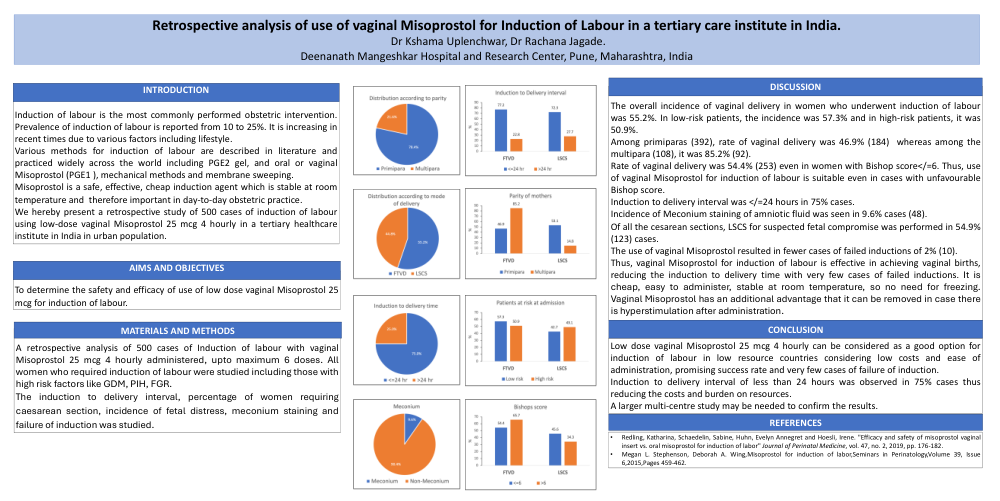
The overall incidence of vaginal delivery in women who underwent induction of labour
was 55.2%. In low-risk patients, the incidence was 57.3% and in high-risk patients, it was
50.9%.
Among primiparas (392), rate of vaginal delivery was 46.9% (184) whereas among the
multipara (108), it was 85.2% (92).
Rate of vaginal delivery was 54.4% (253) even in women with Bishop score</=6. Thus, use
of vaginal Misoprostol for induction of labour is suitable even in cases with unfavourable
Bishop score.
Induction to delivery interval was </=24 hours in 75% cases.
Incidence of Meconium staining of amniotic fluid was seen in 9.6% cases (48).
Of all the cesarean sections, LSCS for suspected fetal compromise was performed in 54.9%
(123) cases.
The use of vaginal Misoprostol resulted in fewer cases of failed inductions of 2% (10).
Thus, vaginal Misoprostol for induction of labour is effective in achieving vaginal births,
reducing the induction to delivery time with very few cases of failed inductions. It is
cheap, easy to administer, stable at room temperature, so no need for freezing.
Vaginal Misoprostol has an additional advantage that it can be removed in case there
is hyperstimulation after administration.
CONCLUSION
Low dose vaginal Misoprostol 25 mcg 4 hourly can be considered as a good option for
induction of labour in low resource countries considering low costs and ease of
administration, promising success rate and very few cases of failure of induction.
Induction to delivery interval of less than 24 hours was observed in 75% cases thus
reducing the costs and burden on resources.
A larger multi-centre study may be needed to confirm the results.
REFERENCES
• Redling, Katharina, Schaedelin, Sabine, Huhn, Evelyn Annegret and Hoesli, Irene. "Efficacy and safety of misoprostol vaginal
insert vs. oral misoprostol for induction of labor" Journal of Perinatal Medicine, vol. 47, no. 2, 2019, pp. 176-182.
• Megan L. Stephenson, Deborah A. Wing,Misoprostol for induction of labor,Seminars in Perinatology,Volume 39, Issue
6,2015,Pages 459-462.