2,281 posters, 63 videos, 56 audios, 43 topics, 18 sessions, 6,174 authors, 2,323 institutions
ePostersLive by SciGen Technologies S.A. All rights reserved.
RCOG World Congress 2025
June 23 - 25, 2025 | ExCeL London, UK
EP.1476
Misoprostol usage for Postpartum Haemorrhage at Referral Secondary care center, Nizwa Hospital
Poster Presenter
Part of Topic
Labour ward management
Audio
INTRODUCTION/BACKGROUND
Postpartum haemorrhage (PPH) remains the leading cause of maternal mortality worldwide, accounting for approximately 70,000 deaths annually1. Defined as blood loss ≥500 mL within 24 hours after delivery, or ≥1000 mL in severe cases, PPH is primarily caused by uterine atony and complicates 1–10% of all deliveries2-3. While significant reductions in maternal mortality have been achieved globally, PPH persists in low-income countries due to the prevalence of home births and limited access to lifesaving interventions4-6. Even in high-income settings, trends in retained placenta and PPH are reportedly rising7-8.
Misoprostol, a prostaglandin E1 analogue, has become a critical uterotonic in the management of PPH, especially where oxytocin—the preferred first-line treatment—is not available or feasible due to cold-chain storage requirements9-10. Its benefits include heat stability, long shelf life, and multiple routes of administration (sublingual, oral, rectal, vaginal), which enhance its applicability in resource-constrained environments11-14. Although globally used, misoprostol is not approved by the U.S. Food and Drug Administration (FDA) for PPH treatment6. Despite this, authoritative bodies including the World Health Organization (WHO), International Federation of Gynaecology and Obstetrics (FIGO), Royal College of Obstetrics and Gynaecology (RCOG) and American College of Obstetricians and Gynaecologists (ACOG) have endorsed its use as a standalone or adjunct treatment for PPH in low-resource settings15-18. In 2015, misoprostol was added to the WHO Essential Medicines List specifically for the prevention and treatment of PPH where oxytocin is unavailable19. Adverse effects such as shivering, fever, nausea, vomiting, and diarrhoea are commonly reported but are usually transient and manageable20-24. Pooled data from Cochrane reviews show elevated risks of shivering (RR: 2.25), pyrexia ≥38°C (RR: 3.12), and vomiting (RR: 1.84) with misoprostol, particularly at higher doses20.
While misoprostol is widely used globally, its real-world application patterns in Oman remain under-documented. Previous research, such as the five-year cross-sectional study by Fenn et al. at a tertiary hospital in Oman, described overall PPH incidence but did not focus on uterotonic trends25. There remains a critical evidence gap regarding how misoprostol is being utilized in secondary care contexts—such as Nizwa Hospital—for both prevention and treatment of PPH.
OBJECTIVES/AIMS
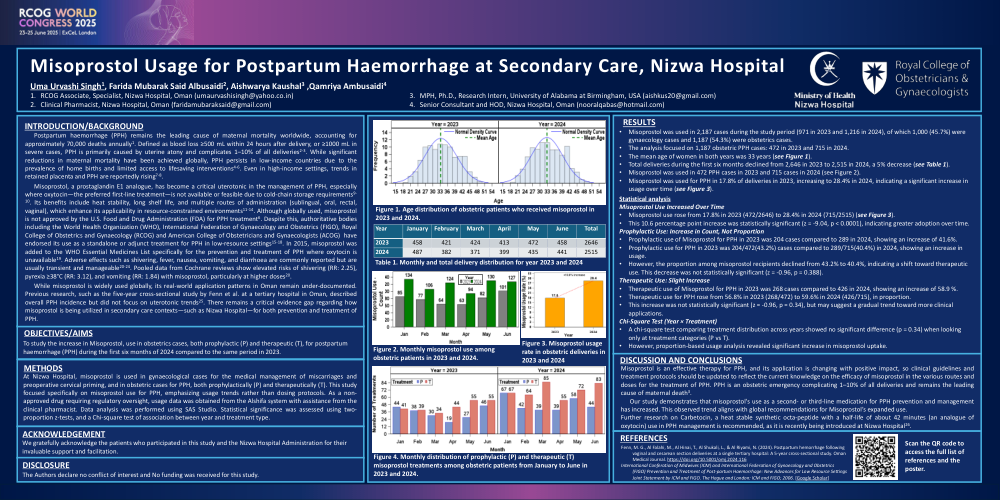
To study the increase in Misoprostol, use in obstetrics cases, both prophylactic (P) and therapeutic (T), for postpartum haemorrhage (PPH) during the first six months of 2024 compared to the same period in 2023.
METHODS
At Nizwa Hospital, misoprostol is used in gynaecological cases for the medical management of miscarriages and preoperative cervical priming, and in obstetric cases for PPH, both prophylactically (P) and therapeutically (T). This study focused specifically on misoprostol use for PPH, emphasizing usage trends rather than dosing protocols. As a non-approved drug requiring regulatory oversight, usage data was obtained from the Alshifa system with assistance from the clinical pharmacist. Data analysis was performed using SAS Studio. Statistical significance was assessed using two-proportion z-tests, and a Chi-square test of association between year and treatment type.
RESULTS
Statistical analysis
Misoprostol Use Increased Over Time
Prophylactic Use: Increase in Count, Not Proportion
Therapeutic Use: Slight Increase
Chi-Square Test (Year × Treatment)
DISCUSSION AND CONCLUSIONS
Misoprostol is an effective therapy for PPH, and its application is changing with positive impact, so clinical guidelines and treatment protocols should be updated to reflect the current knowledge on the efficacy of misoprostol in the various routes and doses for the treatment of PPH. PPH is an obstetric emergency complicating 1–10% of all deliveries and remains the leading cause of maternal death3.
Our study demonstrates that misoprostol's use as a second- or third-line medication for PPH prevention and management has increased. This observed trend aligns with global recommendations for Misoprostol’s expanded use.
Further research on Carbetocin, a heat stable synthetic octa-peptide with a half-life of about 42 minutes (an analogue of oxytocin) use in PPH management is recommended, as it is recently being introduced at Nizwa Hospital26.
DISCLOSURE
The Authors declare no conflict of interest and No funding was received for this study.
ACKNOWLEDGEMENT
We gratefully acknowledge the patients who participated in this study and the Nizwa Hospital Administration for their invaluable support and facilitation.
REFERENCES
Fenn, M. G., Al Falahi, M., Al Hinai, T., Al Shukali, L., & Al Riyami, N. (2024). Postpartum hemorrhage following vaginal and cesarean section deliveries at a single tertiary hospital: A 5-year cross-sectional study. Oman Medical Journal. https://doi.org/10.5001/omj.2024.116
International Conferation of Midwives (ICM) and International Federation of Gynaecology and Obstetrics (FIGO) Prevention and Treatment of Post-partum Haemorrhage: New Advances for Low Resource Settings Joint Statement by ICM and FIGO. The Hague and London: ICM and FIGO; 2006. [Google Scholar]