2,281 posters, 63 videos, 56 audios, 43 topics, 18 sessions, 6,174 authors, 2,323 institutions
ePostersLive by SciGen Technologies S.A. All rights reserved.
RCOG World Congress 2025
June 23 - 25, 2025 | ExCeL London, UK
EP.1475
Robson classification of Caesarean: Outcome in a private tertiary hospital in India.
Poster Presenter
Authors
Affiliations
Part of Topic
Labour ward management
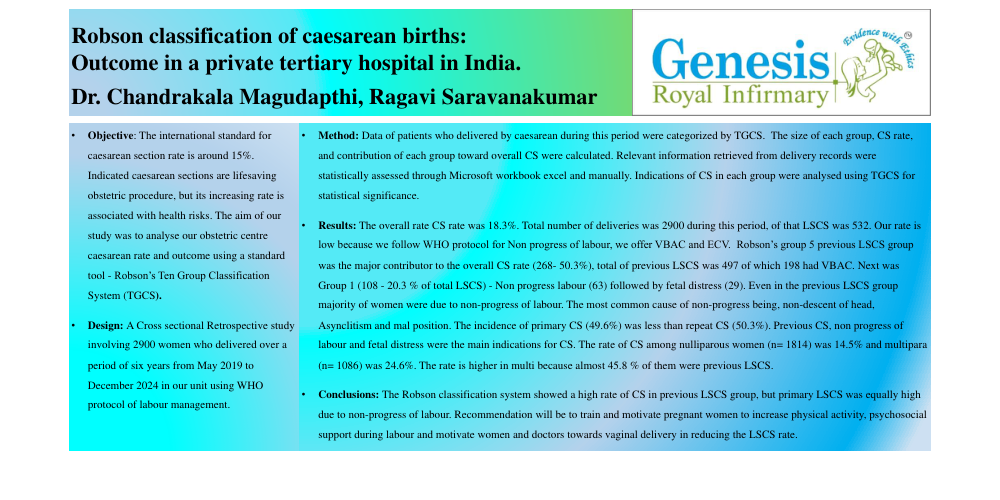
Robson classification of caesarean births: Outcome in a private tertiary hospital in India.
Dr.Chandrakala Magudapathi, Staff Ragavi Saravanakumar
Genesis Royal Infirmary, Coimbatore, India.
Objective: The international standard for caesarean section rate is around 15%. Indicated caesarean sections are lifesaving obstetric procedure, but its increasing rate is associated with health risks. The aim of our study was to analyse our obstetric centre caesarean rate and outcome using a standard tool - Robson’s Ten Group Classification System (TGCS).
Design: A Cross sectional Retrospective study involving 2900 women who delivered over a period of six years from May 2019 to December 2024 in our unit using WHO protocol of labour management.
Method: Data of patients who delivered by caesarean during this period were categorized by TGCS. The size of each group, CS rate, and contribution of each group toward overall CS were calculated. Relevant information retrieved from delivery records were statistically assessed through Microsoft workbook excel and manually. Indications of CS in each group were analysed using TGCS for statistical significance.
Results: The overall rate CS rate was 18.3%. Total number of deliveries was 2900 during this period, of that LSCS was 532. Our rate is low because we follow WHO protocol for Non progress of labour, we offer VBAC and ECV.
Robson’s group 5 previous LSCS group was the major contributor to the overall CS rate (268- 50.3%), total of previous LSCS was 497 of which 198 had VBAC. Next was Group 1 (108 - 20.3 % of total LSCS) - Non progress labour (63) followed by fetal distress (29). Even in the previous LSCS group majority of women were due to non-progress of labour. The most common cause of non-progress being, non-descent of head, Asynclitism and mal position.
The incidence of primary CS (49.6%) was less than repeat CS (50.3%). Previous CS, non progress of labour and fetal distress were the main indications for CS. The rate of CS among nulliparous women (n= 1814) was 14.5% and multipara (n= 1086) was 24.6%. The rate is higher in multi because almost 45.8 % of them were previous LSCS.
Conclusions: The Robson classification system showed a high rate of CS in previous LSCS group, but primary LSCS was equally high due to non-progress of labour. Recommendation will be to train and motivate pregnant women to increase physical activity, psychosocial support during labour and motivate women and doctors towards vaginal delivery in reducing the LSCS rate.