2,281 posters, 63 videos, 56 audios, 43 topics, 18 sessions, 6,174 authors, 2,323 institutions
ePostersLive by SciGen Technologies S.A. All rights reserved.
RCOG World Congress 2025
June 23 - 25, 2025 | ExCeL London, UK
EP.1474
Audit of the Management of Postnatal Care for Third-Degree Tears
Poster Presenter
Authors
Affiliations
Part of Topic
Labour ward management
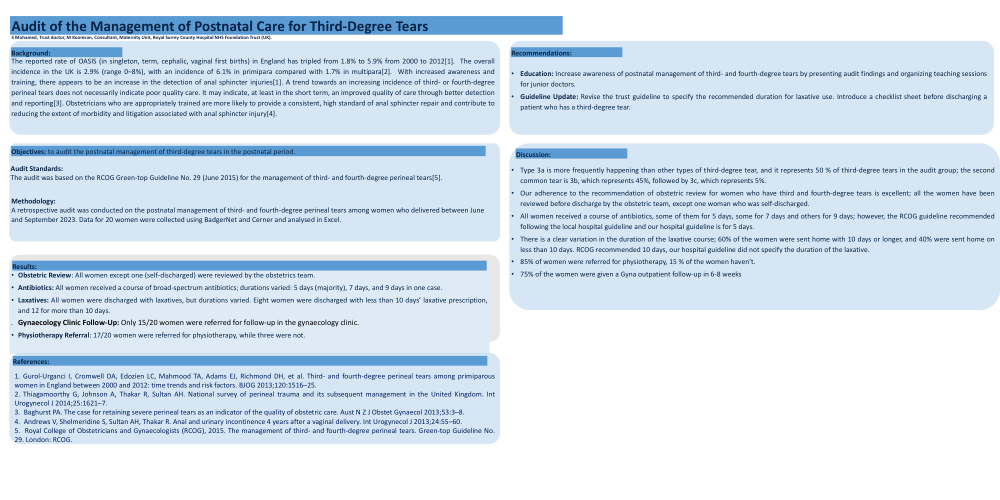
Audit of the Management of Postnatal Care for Third-Degree Tears S Mohamed, Trust doctor, M Koomson, Consultant, Maternity Unit, Royal Surrey County Hospital NHS Foundation Trust (UK). Background: The reported rate of OASIS (in singleton, term, cephalic, vaginal first births) in England has tripled from 1.8% to 5.9% from 2000 to 2012[1]. The overall incidence in the UK is 2.9% (range 0–8%), with an incidence of 6.1% in primipara compared with 1.7% in multipara[2]. With increased awareness and training, there appears to be an increase in the detection of anal sphincter injuries[1]. A trend towards an increasing incidence of third- or fourth-degree perineal tears does not necessarily indicate poor quality care. It may indicate, at least in the short term, an improved quality of care through better detection and reporting[3]. Obstetricians who are appropriately trained are more likely to provide a consistent, high standard of anal sphincter repair and contribute to reducing the extent of morbidity and litigation associated with anal sphincter injury[4]. Objectives: to audit the postnatal management of third-degree tears in the postnatal period. Audit Standards: The audit was based on the RCOG Green-top Guideline No. 29 (June 2015) for the management of third- and fourth-degree perineal tears[5]. Methodology: A retrospective audit was conducted on the postnatal management of third- and fourth-degree perineal tears among women who delivered between June and September 2023. Data for 20 women were collected using BadgerNet and Cerner and analysed in Excel. Results: • Obstetric Review: All women except one (self-discharged) were reviewed by the obstetrics team. • Antibiotics: All women received a course of broad-spectrum antibiotics; durations varied: 5 days (majority), 7 days, and 9 days in one case. • • Laxatives: All women were discharged with laxatives, but durations varied. Eight women were discharged with less than 10 days’ laxative prescription, and 12 for more than 10 days. Gynaecology Clinic Follow-Up: Only 15/20 women were referred for follow-up in the gynaecology clinic. • Physiotherapy Referral: 17/20 women were referred for physiotherapy, while three were not. References: 1. Gurol-Urganci I, Cromwell DA, Edozien LC, Mahmood TA, Adams EJ, Richmond DH, et al. Third- and fourth-degree perineal tears among primiparous women in England between 2000 and 2012: time trends and risk factors. BJOG 2013;120:1516–25. 2. Thiagamoorthy G, Johnson A, Thakar R, Sultan AH. National survey of perineal trauma and its subsequent management in the United Kingdom. Int Urogynecol J 2014;25:1621–7. 3. Baghurst PA. The case for retaining severe perineal tears as an indicator of the quality of obstetric care. Aust N Z J Obstet Gynaecol 2013;53:3–8. 4. Andrews V, Shelmeridine S, Sultan AH, Thakar R. Anal and urinary incontinence 4 years after a vaginal delivery. Int Urogynecol J 2013;24:55–60. 5. Royal College of Obstetricians and Gynaecologists (RCOG), 2015. The management of third- and fourth-degree perineal tears. Green-top Guideline No. 29. London: RCOG. Recommendations: • Education: Increase awareness of postnatal management of third- and fourth-degree tears by presenting audit findings and organizing teaching sessions for junior doctors. • Guideline Update: Revise the trust guideline to specify the recommended duration for laxative use. Introduce a checklist sheet before discharging a patient who has a third-degree tear. Discussion: • Type 3a is more frequently happening than other types of third-degree tear, and it represents 50 % of third-degree tears in the audit group; the second common tear is 3b, which represents 45%, followed by 3c, which represents 5%. • Our adherence to the recommendation of obstetric review for women who have third and fourth-degree tears is excellent; all the women have been reviewed before discharge by the obstetric team, except one woman who was self-discharged. • All women received a course of antibiotics, some of them for 5 days, some for 7 days and others for 9 days; however, the RCOG guideline recommended following the local hospital guideline and our hospital guideline is for 5 days. • There is a clear variation in the duration of the laxative course; 60% of the women were sent home with 10 days or longer, and 40% were sent home on less than 10 days. RCOG recommended 10 days, our hospital guideline did not specify the duration of the laxative. • 85% of women were referred for physiotherapy, 15 % of the women haven’t. • 75% of the women were given a Gyna outpatient follow-up in 6-8 weeks.