2,281 posters, 63 videos, 56 audios, 43 topics, 18 sessions, 6,174 authors, 2,323 institutions
ePostersLive by SciGen Technologies S.A. All rights reserved.
RCOG World Congress 2025
June 23 - 25, 2025 | ExCeL London, UK
EP.1470
Frequency of Fetomaternal Complications among Instrumental Vaginal Deliveries
Poster Presenter
Authors
Affiliations
Part of Topic
Labour ward management
Video
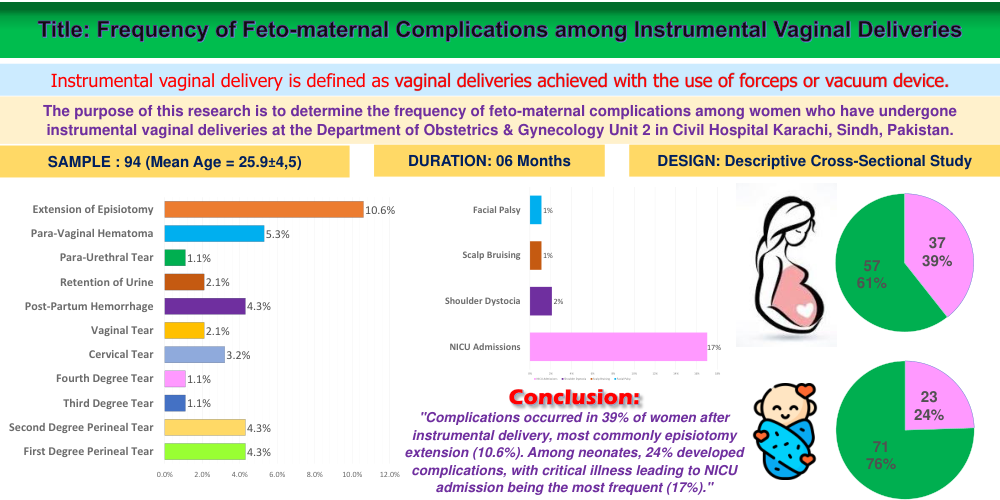
Frequency of Feto-maternal Complications among Instrumental Vaginal Deliveries
ABSTRACT:
Introduction: Instrumental vaginal delivery is defined as vaginal deliveries achieved with the use of forceps or vacuum device.
Objective: To see the frequency of feto-maternal complications among women who have undergone instrumental vaginal delivery.
Setting: Department of Obstetrics and Gynecology Unit 2 in Civil Hospital Karachi
Duration: Six months from 1st October 2020 to 30th March 2021
Design: Descriptive Cross-sectional study
Results: A total of 94 patients underwent instrumental vaginal deliveries. The average age of the patients was 25.98±4.52 years. The frequency of first-degree perineal tear was found to be 4.3% and second-degree perineal tear were also seen in 4.3% cases, while 3rd degree perineal tears were seen in 1.1% cases, and fourth degree tears were also found in 1.1% cases. The frequency of vaginal tears was 2.1% and cervical tears were seen in 3.2% cases. Retention of urine was observed in 2.1% of cases and postpartum hemorrhage was found in 4.3% cases. Paraurethral tears were observed in 1.1% cases, paravaginal hematoma and extension of episiotomy was observed in 0.3% and 10.6% respectively. As for the foetal complications, shoulder dystocia had occurred in 2.1%, cephalhematoma was seen in 3.2% babies and facial palsy in 1.1% however 17% babies were admitted to NICU.
Conclusion: Complications occurred in 39% of women after instrumental delivery, most commonly episiotomy extension (10.6%). Among neonates, 24% developed complications, with critical illness leading to NICU admission being the most frequent (17%).