2,281 posters, 63 videos, 56 audios, 43 topics, 18 sessions, 6,174 authors, 2,323 institutions
ePostersLive by SciGen Technologies S.A. All rights reserved.
RCOG World Congress 2025
June 23 - 25, 2025 | ExCeL London, UK
EP.1467
Faster ,safer , Cost-Effective? Comparison of Propess vs. Prostin for Induction of Labour
Poster Presenter
Authors
Tulika Sinha, Shilpa Manmathan, Enida Hoxha, Charru Pooja Srinivasan, Gayathri Rana, Sharmila Sivarajan
Affiliations
Part of Topic
Labour ward management
Faster, Safer, Cost-Effective? A Comparison of Propess vs. Prostin for Induction of Labour
Introduction:
Prostaglandin analogues like Propess and Prostin are widely used for labour induction, yet their relative effectiveness remains debated. Key considerations include induction-to-delivery interval, mode of delivery, neonatal outcomes, and cost-effectiveness. Propess may extend induction duration due to its prolonged release, while Prostin’s faster onset could shorten labour. However, their impacts on cesarean section rates, instrumental deliveries, neonatal admissions, and healthcare costs are uncertain. This study compares Propess and Prostin in terms of clinical outcomes and economic efficiency.
Methods:
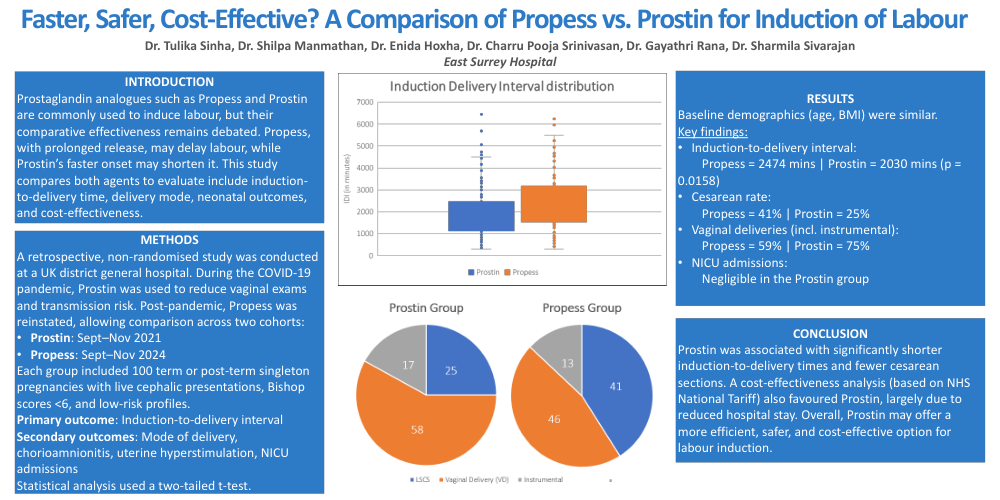
A retrospective, non-randomised study was conducted using data from a district general hospital in the United Kingdom. During the COVID-19 pandemic, Prostin was implemented as the first-line agent for labour induction to minimize the need for vaginal examinations and reduce the risk of viral transmission. Following the pandemic, Propess was reinstated as the primary agent, allowing for a comparative analysis of clinical outcomes. Data were collected over two distinct periods: from September to November 2021 for the Prostin cohort and from September to November 2024 for the Propess cohort. A total of 100 consecutive pregnancies were assessed in each group. Eligible cases included term or post-term singleton pregnancies with live cephalic presentations, Bishop scores <6, and low-risk profiles. The primary outcome measure was the induction-to-delivery interval, while secondary outcomes included mode of delivery, rates of chorioamnionitis, uterine hyperstimulation, neonatal intensive care unit (NICU) admissions. Statistical analyses were performed using a two-tailed t-test.
Results:
Demographic factors such as age and BMI were similar between the two cohorts. The average induction-to-delivery interval was significantly longer in the Propess group (2474 minutes) compared to the Prostin group (2030 minutes), with a p-value of 0.0158 (t=2.434). Additionally, a significantly lower rate of cesarean sections was observed in the Prostin group (25% vs 41%), and a higher rate of successful vaginal (including instrumental) deliveries was seen in the Prostin group (75% vs 59%). NICU admissions were negligible in the Prostin group, suggesting better neonatal outcomes.
Conclusion:
This study found Prostin was associated with a significantly shorter induction-to-delivery interval with fewer cesarean sections. Furthermore, a cost-effectiveness analysis based on the National Tariff Payment Scheme indicated that Prostin is more cost-effective than Propess. The reduced hospital stay associated with Prostin may not only improve maternal and fetal outcomes but also alleviates economic pressures on healthcare systems by reducing strain on resources. These findings suggest that Prostin may offer a more efficient and cost-effective choice for labour induction.