2,281 posters, 63 videos, 56 audios, 43 topics, 18 sessions, 6,174 authors, 2,323 institutions
ePostersLive by SciGen Technologies S.A. All rights reserved.
RCOG World Congress 2025
June 23 - 25, 2025 | ExCeL London, UK
EP.1458
Double Instrumental Vaginal Deliveries in Wexford General Hospital Jan 2022 - Apr 2024
Poster Presenter
Authors
Affiliations
Part of Topic
Labour ward management
Double Instrumental Vaginal Deliveries in Wexford General Hospital Jan 2022 - Apr 2024
Authors: Hani Bashir, Baba Patrice, Sandhya Babu
Obstetric and Gynecology Department, Wexford General Hospital, Wexford, Co. Wexford , Ireland
Background
Instrumental vaginal deliveries, including vacuum cup (ventouse) or forceps-assisted births, are vital and recommended interventions in obstetric practice. Double instrumental vaginal deliveries (DIVDs), which involve the sequential use of these instruments, are resorted to when there is failure to complete delivery using one instrument, but safe vaginal delivery is still feasible and desirable with the use of second instrument. While DIVDs can prevent emergency caesarean sections and their associated risks, they carry some challenges, including higher rates of maternal trauma, prolonged procedures, and fetal distress. For this reason, the benefits and risks of instrumental vaginal birth need to be weighed up in each case.
Aims
To evaluate clinical practices, adherence to guidelines, and outcomes associated with double instrumental vaginal deliveries (DIVDs) at Wexford General Hospital from January 2022 to April 2024. The primary goal is to identify areas for improvement to optimize patient safety and care, particularly in high-risk cases where complications are more likely to arise.
Methodology
Design: A retrospective review of incident reports and case records was conducted. The audit was benchmarked against RCOG Green-top Guideline No. 26, RANZCOG Instrumental Vaginal Birth (C-Obs 16, March 2023), and local protocols to ensure comprehensive evaluation and identification of practice gaps.
Method: Data were extracted from the delivery book and incident report registry, focusing on critical aspects of care. Key data points included indications for DIVDs, operator experience, outcomes, complications, and documentation quality. Quantitative and qualitative analyses were performed to identify trends, assess adherence to guidelines, and determine areas requiring targeted interventions.
Results
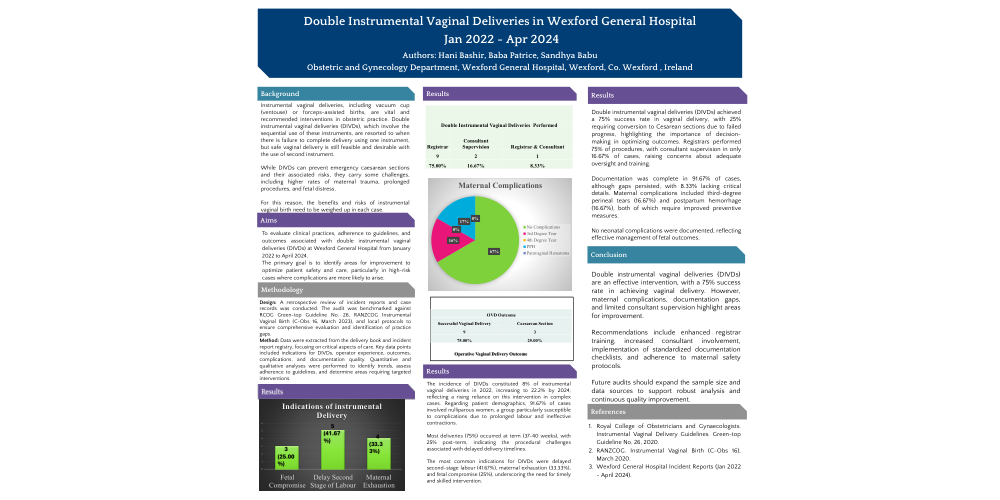
The incidence of DIVDs constituted 8% of instrumental vaginal deliveries in 2022, increasing to 22.2% by 2024, reflecting a rising reliance on this intervention in complex cases. Regarding patient demographics, 91.67% of cases involved nulliparous women, a group particularly susceptible to complications due to prolonged labour and ineffective contractions.
Most deliveries (75%) occurred at term (37-40 weeks), with 25% post-term, indicating the procedural challenges associated with delayed delivery timelines.
The most common indications for DIVDs were delayed second-stage labour (41.67%), maternal exhaustion (33.33%), and fetal compromise (25%), underscoring the need for timely and skilled intervention.
Double instrumental vaginal deliveries (DIVDs) achieved a 75% success rate in vaginal delivery, with 25% requiring conversion to Cesarean sections due to failed progress, highlighting the importance of decisionmaking in optimizing outcomes. Registrars performed 75% of procedures, with consultant supervision in only 16.67% of cases, raising concerns about adequate oversight and training. Documentation was complete in 91.67% of cases, although gaps persisted, with 8.33% lacking critical details. Maternal complications included third-degree perineal tears (16.67%) and postpartum hemorrhage (16.67%), both of which require improved preventive measures. No neonatal complications were documented, reflecting effective management of fetal outcomes.
Conclusion
Double instrumental vaginal deliveries (DIVDs) are an effective intervention, with a 75% success rate in achieving vaginal delivery. However, maternal complications, documentation gaps, and limited consultant supervision highlight areas for improvement. Recommendations include enhanced registrar training, increased consultant involvement, implementation of standardized documentation checklists, and adherence to maternal safety protocols. Future audits should expand the sample size and data sources to support robust analysis and continuous quality improvement.
References
1. Royal College of Obstetricians and Gynaecologists.Instrumental Vaginal Delivery Guidelines. Green-top Guideline No. 26, 2020.
2. RANZCOG. Instrumental Vaginal Birth (C-Obs 16), March 2020.
3. Wexford General Hospital Incident Reports (Jan 2022 - April 2024).