2,281 posters, 63 videos, 56 audios, 43 topics, 18 sessions, 6,174 authors, 2,323 institutions
ePostersLive by SciGen Technologies S.A. All rights reserved.
RCOG World Congress 2025
June 23 - 25, 2025 | ExCeL London, UK
EP.1457
Decision Delivery interval of caesarean section and neonatal outcomes at EFSTH Banjul.
Poster Presenter
Part of Topic
Labour ward management
DECISION DELIVERY INTERVAL OF CAESAREAN SECTION AND NEONATAL OUTCOMES AT A TERTIARY HOSPITAL IN THE GAMBIA.
Authors: M. Anyanwu1, 2, A. Coker1, 2, S. Donkor 3 : 1. Edward Francis Small Teaching Hospital Banjul The Gambia 2. School of Medicine and Allied Health Sciences University of The Gambia. 3. Medical Research Laboratories The Gambia.
INTRODUCTION: Following a caesarean section performed under spinal or general anaesthesia, a common implication is the association of neonatal outcome and decision delivery interval (DDI). The common assumption is the longer the decision delivery interval time is the poorer the neonatal outcome.
Therefore, knowing this in our setting will inform practice and add value in our obstetrics practice. The aims of the study was to determine the relationship of decision delivery interval and Apgar score; perinatal/neonatal mortality; admission into neonatal intensive care unit.
METHODOLOGY: A prospective cross-sectional study at EFSTH July to September 2023. Sample size was calculated with G power 3.1 software. A sample size of 100 with effect size at 25% = 0.25, Power at 85 , t-test at 0.05
Inclusion and Exclusion criteria: Women who were scheduled for either emergency or elective caesarean section with the ages of 15 – 49yrs. The women who had elective CS was later excluded from the final analysis. Data was analyzed with SPSS 26.
DISCUSSION
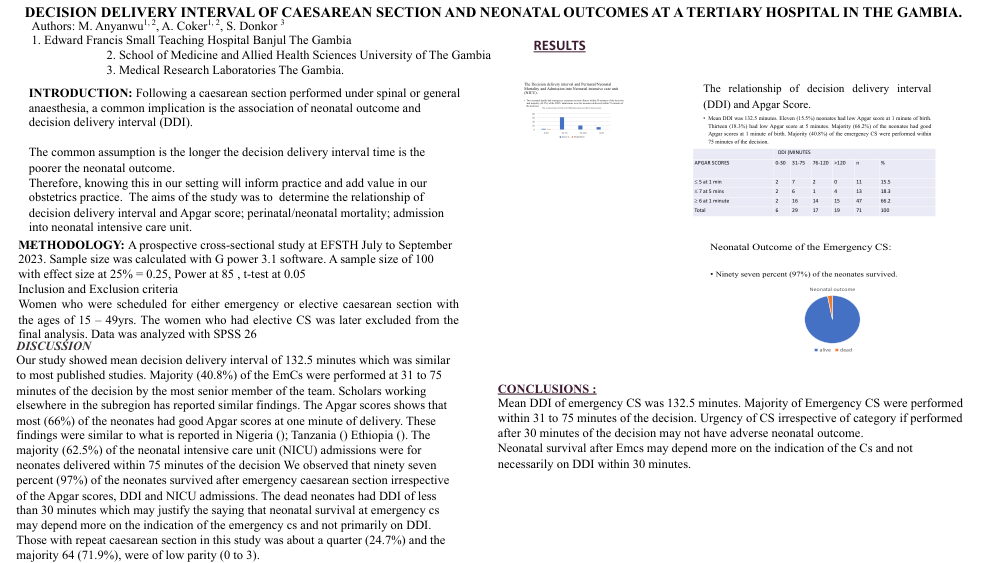
Our study showed mean decision delivery interval of 132.5 minutes which was similar to most published studies. Majority (40.8%) of the EmCs were performed at 31 to 75 minutes of the decision by the most senior member of the team. Scholars working elsewhere in the subregion has reported similar findings. The Apgar scores shows that most (66%) of the neonates had good Apgar scores at one minute of delivery. These findings were similar to what is reported in Nigeria (); Tanzania () Ethiopia (). The majority (62.5%) of the neonatal intensive care unit (NICU) admissions were for neonates delivered within 75 minutes of the decision We observed that ninety seven percent (97%) of the neonates survived after emergency caesarean section irrespective of the Apgar scores, DDI and NICU admissions. The dead neonates had DDI of less than 30 minutes which may justify the saying that neonatal survival at emergency cs may depend more on the indication of the emergency cs and not primarily on DDI.
Those with repeat caesarean section in this study was about a quarter (24.7%) and the majority 64 (71.9%), were of low parity (0 to 3).
CONCLUSIONS :
Mean DDI of emergency CS was 132.5 minutes. Majority of Emergency CS were performed within 31 to 75 minutes of the decision. Urgency of CS irrespective of category if performed after 30 minutes of the decision may not have adverse neonatal outcome.
Neonatal survival after Emcs may depend more on the indication of the Cs and not necessarily on DDI within 30 minutes