2,281 posters, 63 videos, 56 audios, 43 topics, 18 sessions, 6,174 authors, 2,323 institutions
ePostersLive by SciGen Technologies S.A. All rights reserved.
RCOG World Congress 2025
June 23 - 25, 2025 | ExCeL London, UK
EP.1449
Antenatal Exercise and Labor Outcomes: Insights from a Cohort Study
Poster Presenter
Part of Topic
Labour ward management
POSTER ID EP.1449
Title
Antenatal Exercise and Labor Outcomes: Insights from a Cohort Study
Objective
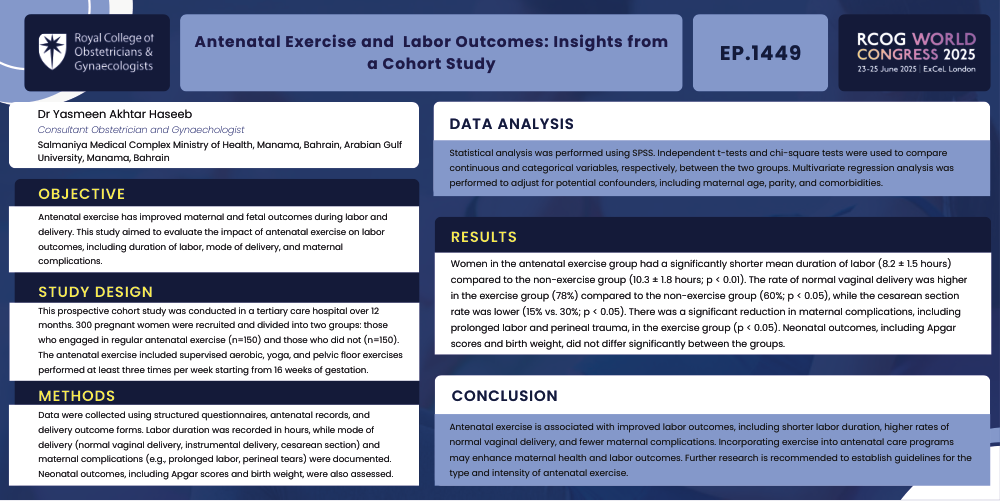
Antenatal exercise has improved maternal and fetal outcomes during labor and delivery. This study aimed to evaluate the impact of antenatal exercise on labor outcomes, including duration of labor, mode of delivery, and maternal complications.
Study Design:
This prospective cohort study was conducted in a tertiary care hospital over 12 months. 300 pregnant women were recruited and divided into two groups: those who engaged in regular antenatal exercise (n=150) and those who did not (n=150). The antenatal exercise included supervised aerobic, yoga, and pelvic floor exercises performed at least three times per week starting from 16 weeks of gestation.
Methods:
Data were collected using structured questionnaires, antenatal records, and delivery outcome forms. Labor duration was recorded in hours, while mode of delivery (normal vaginal delivery, instrumental delivery, cesarean section) and maternal complications (e.g., prolonged labor, perineal tears) were documented. Neonatal outcomes, including Apgar scores and birth weight, were also assessed.
Data Analysis:
Statistical analysis was performed using SPSS. Independent t-tests and chi-square tests were used to compare continuous and categorical variables, respectively, between the two groups. Multivariate regression analysis was performed to adjust for potential confounders, including maternal age, parity, and comorbidities.
Results:
Women in the antenatal exercise group had a significantly shorter mean duration of labor (8.2 ± 1.5 hours) compared to the non-exercise group (10.3 ± 1.8 hours; p < 0.01). The rate of normal vaginal delivery was higher in the exercise group (78%) compared to the non-exercise group (60%; p < 0.05), while the cesarean section rate was lower (15% vs. 30%; p < 0.05). There was a significant reduction in maternal complications, including prolonged labor and perineal trauma, in the exercise group (p < 0.05). Neonatal outcomes, including Apgar scores and birth weight, did not differ significantly between the groups.
Conclusion:
Antenatal exercise is associated with improved labor outcomes, including shorter labor duration, higher rates of normal vaginal delivery, and fewer maternal complications. Incorporating exercise into antenatal care programs may enhance maternal health and labor outcomes. Further research is recommended to establish guidelines for the type and intensity of antenatal exercise.
Categories
Labour ward management
Authors and affiliations
Dr Yasmeen Akhtar Haseeb (Presenting) dryasmeenhaseeb@yahoo.com
Salmaniya Medical Complex Ministry of Health, Manama, Bahrain
Arabian Gulf University, Manama, Bahrain