2,281 posters, 63 videos, 56 audios, 43 topics, 18 sessions, 6,174 authors, 2,323 institutions
ePostersLive by SciGen Technologies S.A. All rights reserved.
RCOG World Congress 2025
June 23 - 25, 2025 | ExCeL London, UK
EP.1447
Recent Advances in the Management of Postpartum Hemorrhage (PPH)
Poster Presenter
Part of Topic
Labour ward management
Poster ID EP.1447
Title
Recent Advances in the Management of Postpartum Hemorrhage (PPH)
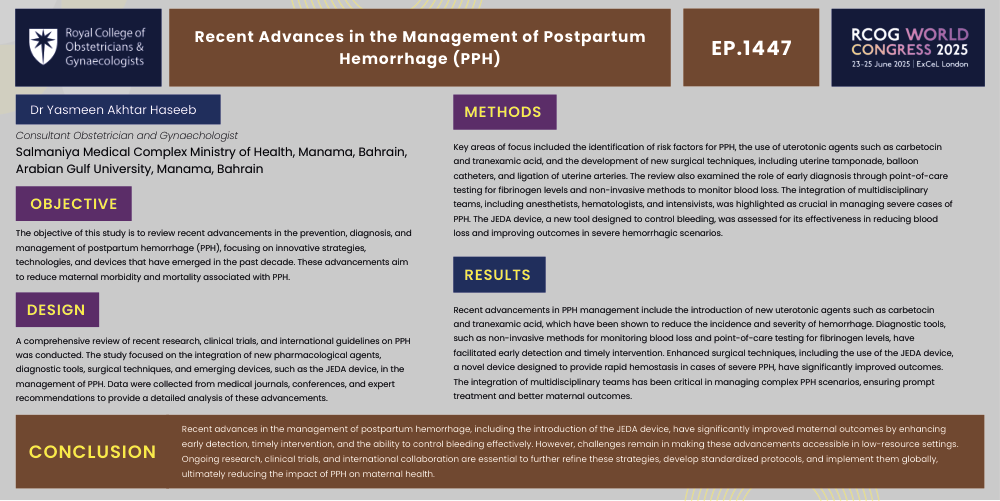
Objective: The objective of this study is to review recent advancements in the prevention, diagnosis, and management of postpartum hemorrhage (PPH), focusing on innovative strategies, technologies, and devices that have emerged in the past decade. These advancements aim to reduce maternal morbidity and mortality associated with PPH.
Design: A comprehensive review of recent research, clinical trials, and international guidelines on PPH was conducted. The study focused on the integration of new pharmacological agents, diagnostic tools, surgical techniques, and emerging devices, such as the JEDA device, in the management of PPH. Data were collected from medical journals, conferences, and expert recommendations to provide a detailed analysis of these advancements.
Methods: Key areas of focus included the identification of risk factors for PPH, the use of uterotonic agents such as carbetocin and tranexamic acid, and the development of new surgical techniques, including uterine tamponade, balloon catheters, and ligation of uterine arteries. The review also examined the role of early diagnosis through point-of-care testing for fibrinogen levels and non-invasive methods to monitor blood loss. The integration of multidisciplinary teams, including anesthetists, hematologists, and intensivists, was highlighted as crucial in managing severe cases of PPH. The JEDA device, a new tool designed to control bleeding, was assessed for its effectiveness in reducing blood loss and improving outcomes in severe hemorrhagic scenarios.
Results: Recent advancements in PPH management include the introduction of new uterotonic agents such as carbetocin and tranexamic acid, which have been shown to reduce the incidence and severity of hemorrhage. Diagnostic tools, such as non-invasive methods for monitoring blood loss and point-of-care testing for fibrinogen levels, have facilitated early detection and timely intervention. Enhanced surgical techniques, including the use of the JEDA device, a novel device designed to provide rapid hemostasis in cases of severe PPH, have significantly improved outcomes. The integration of multidisciplinary teams has been critical in managing complex PPH scenarios, ensuring prompt treatment and better maternal outcomes.
Conclusion: Recent advances in the management of postpartum hemorrhage, including the introduction of the JEDA device, have significantly improved maternal outcomes by enhancing early detection, timely intervention, and the ability to control bleeding effectively. However, challenges remain in making these advancements accessible in low-resource settings. Ongoing research, clinical trials, and international collaboration are essential to further refine these strategies, develop standardized protocols, and implement them globally, ultimately reducing the impact of PPH on maternal health.
Categories
Labour ward management
Authors and affiliations
Dr Yasmeen Akhtar Haseeb (Presenting) dryasmeenhaseeb@yahoo.com
Salmaniya Medical Complex Ministry of Health, Manama, Bahrain
Arabian Gulf University, Manama, Bahrain