2,281 posters, 63 videos, 56 audios, 43 topics, 18 sessions, 6,174 authors, 2,323 institutions
ePostersLive by SciGen Technologies S.A. All rights reserved.
RCOG World Congress 2025
June 23 - 25, 2025 | ExCeL London, UK
EP.0013
Medical management of second trimester pregnancy loss: A retrospective cohort study
Poster Presenter
Authors
Affiliations
Part of Topic
Abortion care
MEDICAL MANAGEMENT OF SECOND TRIMESTER PREGNANCY LOSS: A RETROSPECTIVE COHORT STUDY OF ELECTIVE PROCEDURES BETWEEN 12+0 – 17+6 WEEKS GESTATION
Introduction:
The management of women undergoing second-trimester medical procedures varies significantly both nationally and globally, irrespective of the specific indication for the procedure. Notably, there is limited guidance regarding appropriate timeframes for the third stage of labour in second-trimester vaginal births, as well as for the management and escalation of complications such as retained placenta or excessive vaginal bleeding.
To fully understand the complexities surrounding the third stage of labour, it is important to first consider the incidence of events resulting in second-trimester vaginal births. These births typically occur through one of three pathways: second-trimester miscarriage, termination for social or personal reasons, or termination for medical reasons or fetal abnormalities.
Methods:
We undertook a retrospective cohort study of all elective medical procedures taking place on the dedicated gynaecology unit in a tertiary referral university hospital, with an upper gestational limit of 17+6 over a 2 year period. 120 patients were identified via the gynaecology ward booking diary. We reviewed the electronic case notes of 108 women between the ages of 15 – 46, emergency admissions (n=1), incomplete electronic records (n=3) and patients outside of the gestational window 12+0 – 17+6 (n=8) were excluded.
The local guideline recommends all patients undergoing medical procedures over 10+0 weeks receive 200mg Mifepristone (a progesterone antagonist) with an Misoprostol (prostaglandin E1 analogue that causes cervical softening and dilation and uterine contractions) increasing dose regime (800mcg vaginally, followed by 400mcg orally every 4 hours with a maximum of 5 doses) commencing 48 hours later, in keeping with National guidance for abortion care.
Our primary objective was to ascertain the characteristics and incidence of retained placenta and to compare them to medical procedures where expulsion of the placenta had occurred spontaneously. In addition we sought to determine if a prolonged interval from delivery of the fetus to the placenta resulted in a higher incidence of unplanned surgical procedures and increased blood losses.
Results:
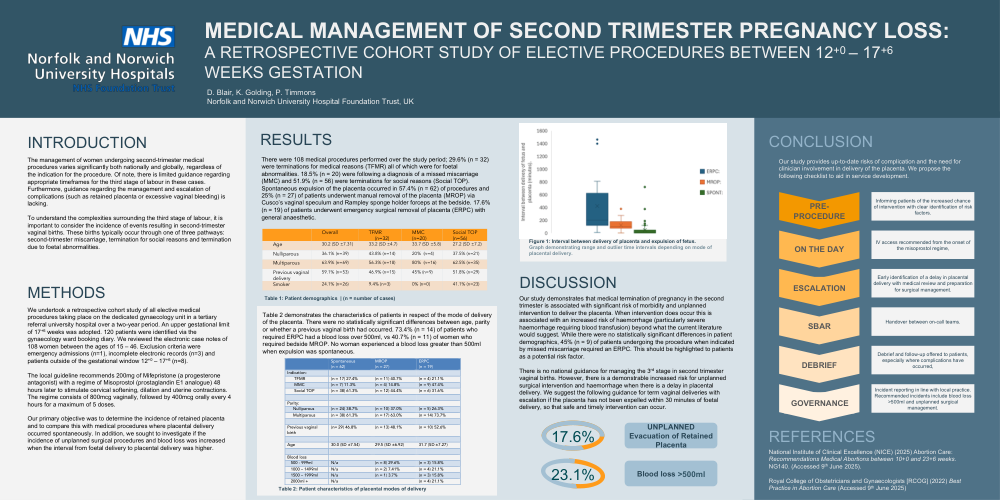
There were 108 medical procedures performed over the study period; 29.6% (n = 32) were terminations for medical reasons (TFMR) all of which were for fetal abnormalities, 18.5% (n = 20) were following a diagnosis of a missed miscarriage (MMC) and 51.9% (n = 56) were terminations for social reasons (Social TOP). Spontaneous expulsion of the placenta occurred in 57.4% (n = 62) procedures, 25% (n = 27) of patients had manual removal of the placenta (MROP) via cusco’s vaginal speculum and rampley sponge holder forceps at the bedside, and 17.6% (n = 19) of patients underwent emergency surgical removal of placenta (ERPC) under general anaesthetic.
Table 2 demonstrates the characteristics of patients in relation to the mode of delivery of the placenta. There were no statistically significant differences between age, parity or whether a previous vaginal birth had occurred. 73.4% (n = 14) of patients requiring ERPC had a blood loss of over 500ml, vs 40.7% (n = 11) of women who required bedside MROP and no women experienced a blood loss greater than 500ml when the placenta was expelled spontaneously
Discussion:
Our study has shown that medical termination of pregnancy in the second trimester is associated with significant risk of morbidity and unplanned medical intervention to deliver the placenta. When intervention does occur this is associated with an increased risk of haemorrhage (particularly severe haemorrhage requiring blood transfusion) beyond what the current literature would suggest. Whilst there were no statistically significant differences in patient demographics, 45% (n = 9) of patients undergoing the procedure because of a missed miscarriage required an ERPC, therefore this should be highlighted as a potential risk factor.
There is no national guidance on the duration or management of the 3rd stage in second trimester vaginal births, and whilst we demonstrated significant range, there is a clear trend in the increasing risk of unplanned surgical intervention and haemorrhage when there is a delay in the delivery of the placenta. We suggest following guidance for term vaginal deliveries and escalating if the placenta has not been expelled within 30 minutes of delivery of the fetus, so that safe and timely escalation can occur.
Conclusion:
Our study provides clinicians with up-to-date risks of complications and need for clinician involvement for the delivery of the placenta. We propose a brief checklist to aid with service development.
References:
National Institute of Clinical Excellence (NICE) (2025) Abortion Care: Recommendations Medical Abortions between 10+0 and 23+6 weeks. NG140. (Accessed 9th June 2025).
Royal College of Obstetricians and Gynaecologists [RCOG] (2022) Best Practice in Abortion Care (Accessed 9th June 2025)