2,281 posters, 63 videos, 56 audios, 43 topics, 18 sessions, 6,174 authors, 2,323 institutions
ePostersLive by SciGen Technologies S.A. All rights reserved.
RCOG World Congress 2025
June 23 - 25, 2025 | ExCeL London, UK
EP.0012
Perinatal outcomes of transvaginal high cervical cerclage for previous failed Mcdonald Cerclage.
Poster Presenter
Part of Topic
Abortion care
Perinatal Outcomes of Transvaginal High Cervical Cerclage Among Women with Previous Failed McDonald Cerclage
Awowole IO1,2, Adeniyi OA2, Anyabolu HC3,4, Ameen MO2, Allen OO1,2,Ugowe O3,4. Adejuyigbe EA3,4.
- Feto-Maternal Unit, Department of Obstetrics and Gynaecology, Obafemi Awolowo University, Nigeria.
- Department of Obstetrics and Gynaecology, Obafemi Awolowo University Teaching Hospitals, Nigeria.
- Department of Paediatrics and Child Health, Obafemi Awolowo University, Nigeria.
- Department of Paediatrics and Child Health, Obafemi Awolowo University Teaching Hospitals, Nigeria.
Introduction
Women who experience mid-trimester miscarriages or extreme preterm births due to cervical insufficiency, particularly after a failed McDonald cerclage (MC), are at heightened risk for repeat adverse pregnancy outcomes. Transvaginal high cervical cerclage (THCC) offers a potential solution for these women. This study investigates the effectiveness of THCC in improving perinatal outcomes among Nigerian women with previous failed MC.
Design
This is an interventional study.
Methods
Pregnant women with previous mid-trimester miscarriages due to cervical insufficiency, despite prior cervical cerclage, underwent THCC between January 2022 and December 2024. The procedure included bladder reflection and posterior colpotomy to facilitate cerclage placement. Postoperative care was provided according to departmental protocol.
Results
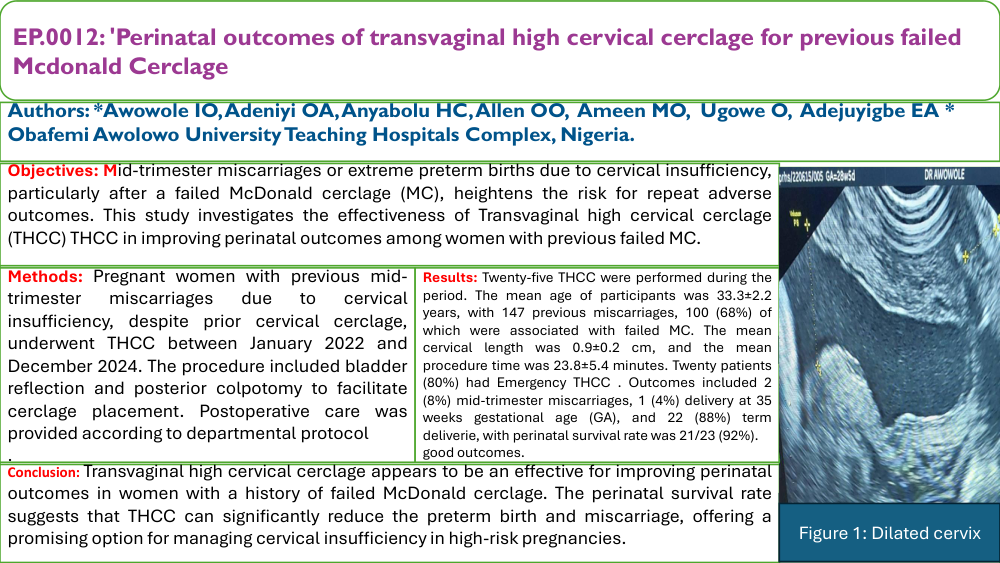
Twenty-five THCC were performed during the period. The mean age of participants was 33.3±2.2 years, with 147 previous miscarriages, 100 (68%) of which were associated with failed MC. The mean cervical length was 0.9±0.2 cm, and the mean procedure time was 23.8±5.4 minutes. Twenty patients (80%) had Emergency THCC . Outcomes included 2 (8%) mid-trimester miscarriages, 1 (4%) delivery at 35 weeks gestational age (GA), and 22 (88%) term deliverie, with perinatal survival rate was 21/23 (92%).
Conclusion
Transvaginal high cervical cerclage appears to be an effective for improving perinatal outcomes in women with a history of failed McDonald cerclage. The perinatal survival rate suggests that THCC can significantly reduce the preterm birth and miscarriage, offering a promising option for managing cervical insufficiency in high-risk pregnancies. Further studies with larger sample sizes are needed to validate these findings.