2,281 posters, 63 videos, 56 audios, 43 topics, 18 sessions, 6,174 authors, 2,323 institutions
ePostersLive by SciGen Technologies S.A. All rights reserved.
RCOG World Congress 2025
June 23 - 25, 2025 | ExCeL London, UK
EP.0011
Effectiveness of Mifepristone+ Misoprostol Versus Misoprostol Alone in the management of Miscarriage
Poster Presenter
Authors
Nazeha Ahmed Alghuzi, Reem Alawadi, Ebtehal Alramsi, fatema Alharmi, Sara Alkaabi
Affiliations
Part of Topic
Abortion care
Author : Nazeha Alghuzi
Effectiveness of Mifepristone Plus Misoprostol Versus Misoprostol Alone in the Management of Miscarriage: A Retrospective Cohort Study at Corniche Hospital, Abu Dhabi, United Arab Emirates
Objective: This study aimed to evaluate the success rate and effectiveness of mifepristone combined with misoprostol versus misoprostol alone in the management of miscarriage. It also assessed the overall outcomes of medical management for miscarriage and the impact of introducing mifepristone into the treatment protocol at Corniche Hospital.
Design: A retrospective cohort study was conducted, comparing the outcomes of two groups of patients treated for miscarriage. Group 1 received misoprostol alone, while Group 2 received mifepristone followed by misoprostol.
Patients and Methods: Patients were identified through the electronic medical record system (SEHA Cerner) at Corniche Hospital, Abu Dhabi. The study included two groups of patients:
- Group 1: 61 patients who received misoprostol alone from August 2021 to December 2021.
- Group 2: 77 patients who received mifepristone 24–48 hours prior to misoprostol from August 2022 to December 2022. The treatment outcomes, including success rates, need for surgical intervention, and length of hospital stay, were compared between the two groups.
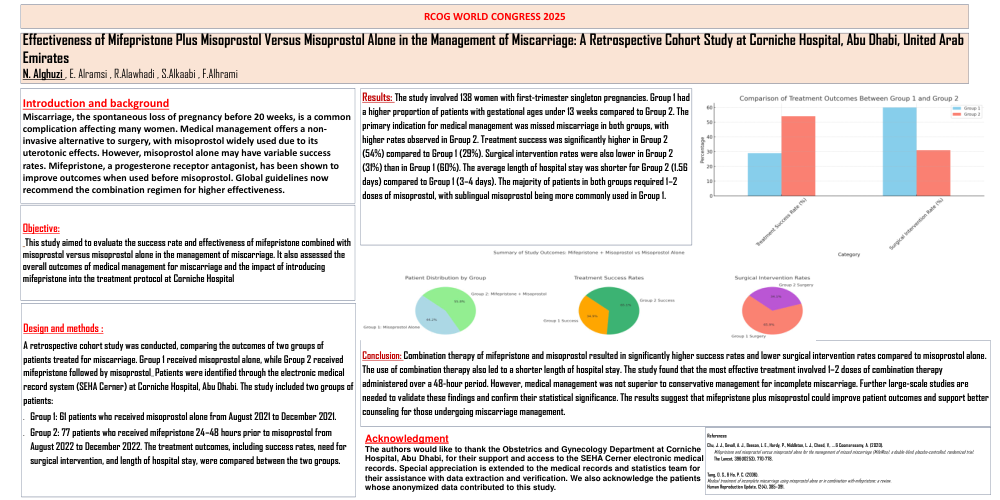
Results: The study involved 138 women with first-trimester singleton pregnancies. Group 1 had a higher proportion of patients with gestational ages under 13 weeks compared to Group 2. The primary indication for medical management was missed miscarriage in both groups, with higher rates observed in Group 2. Treatment success was significantly higher in Group 2 (54%) compared to Group 1 (29%). Surgical intervention rates were also lower in Group 2 (31%) than in Group 1 (60%). The average length of hospital stay was shorter for Group 2 (1.56 days) compared to Group 1 (3–4 days). The majority of patients in both groups required 1–2 doses of misoprostol, with sublingual misoprostol being more commonly used in Group 1.
Conclusion: Combination therapy of mifepristone and misoprostol resulted in significantly higher success rates and lower surgical intervention rates compared to misoprostol alone. The use of combination therapy also led to a shorter length of hospital stay. The study found that the most effective treatment involved 1–2 doses of combination therapy administered over a 48-hour period. However, medical management was not superior to conservative management for incomplete miscarriage. Further large-scale studies are needed to validate these findings and confirm their statistical significance. The results suggest that mifepristone plus misoprostol could improve patient outcomes and support better counseling for those undergoing miscarriage management.
Top of Form
Bottom of Form
.
References
- Chu, J. J., Devall, A. J., Beeson, L. E., Hardy, P., Middleton, L. J., Cheed, V., ... & Coomarasamy, A. (2020).
Mifepristone and misoprostol versus misoprostol alone for the management of missed miscarriage (MifeMiso): a double-blind, placebo-controlled, randomized trial.
The Lancet, 396(10253), 770-778. - Tang, O. S., & Ho, P. C. (2006).
Medical treatment of incomplete miscarriage using misoprostol alone or in combination with mifepristone: a review.
Human Reproduction Update, 12(4), 385–391.