2,281 posters, 63 videos, 56 audios, 43 topics, 18 sessions, 6,174 authors, 2,323 institutions
ePostersLive by SciGen Technologies S.A. All rights reserved.
RCOG World Congress 2025
June 23 - 25, 2025 | ExCeL London, UK
EP.0010
Understanding factors for safe medication abortion when far from emergency services
Poster Presenter
Part of Topic
Abortion care
Title: Understanding factors for safe medication abortion when far from emergency services.
Authors: Wendy V. Norman, John Reynolds-Wright, Danielle Mazza.
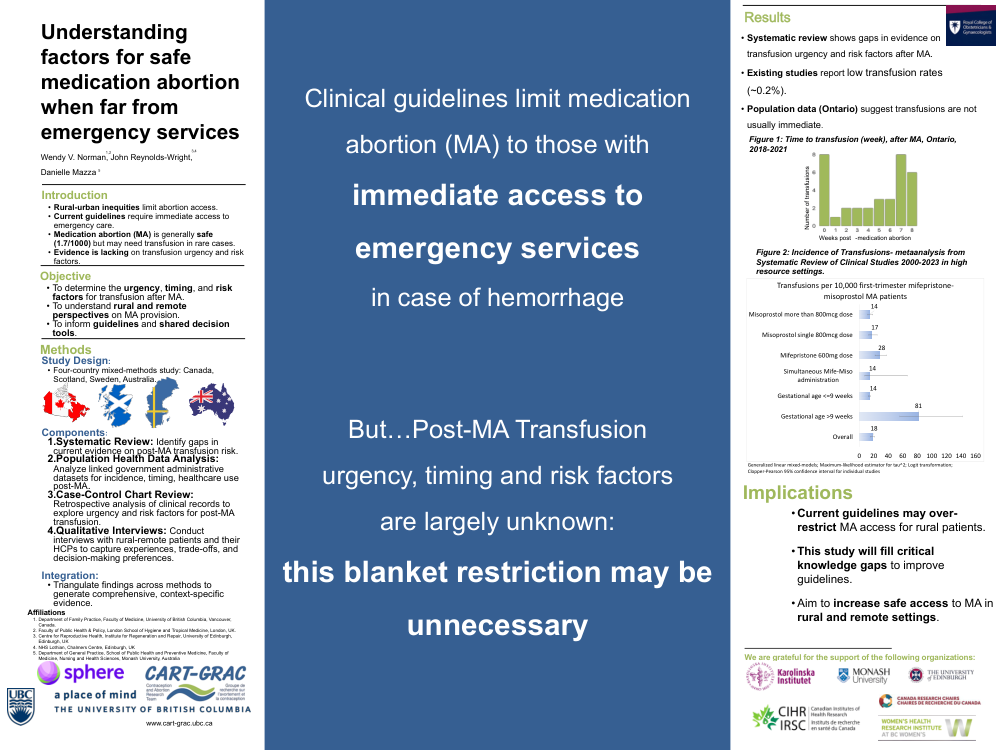
Objective: Countries with remote populations face rural-urban abortion access inequities. Rural and remote provision of medication abortion (MA) could potentially improve access and reduce inequities. Most current guidelines restrict MA to those with immediate access to emergency services such as transfusion and surgery. Although a rare MA complication (1.7/1000) the need for transfusion may be driving recommendations that limit rural-remote MA provision. Our systematic review demonstrated that the proportion of post-MA transfusions that are emergencies, the risk factors for and transfusion timing after MA are all unknown.
We will build an evidence base to address this important global gap in abortion guidelines. We will define the associated urgency, timing, and risk factors for post-MA transfusion and will engage people in rural-remote areas and their health care providers (HCP) for their context and perspectives.
Design: We designed a four-country (Canada, Scotland, Sweden and Australia) mixed methods study including a systematic review, analyses of linked government health administrative data, a retrospective case-control study, and interviews among rural and remote populations and their health care providers.
Methods: Our retrospective chart review case-control study aims to understand the urgency and risk factors for post-MA transfusion; our analysis of population-based health administrative data will contribute evidence on incidence, timing, and associated health care events, while our interviews with rural-remote patients and their HCP will aim to capture preferences and trade-offs relating to provision of abortion care among rural and remote populations. Finally, we will triangulate all findings to create an evidence base to inform guideline development and shared decision making tools.
Results: We have received funding and ethics approval. At this session we propose to discuss the project aims, activities, and progress, and to engage audience members’ opinions, suggestions and expertise to inform data collection, interpretation, and next steps to ensure high quality evidence to support clinical practice guidelines.
Conclusions: First trimester MA carries a very low risk of transfusion. To support provision of safe first trimester MA particularly among people living far from emergency services, there is an urgent need to investigate the timing of prodromal signs, degree of emergency, and risk factors for post MA transfusion.