1,830 posters, 67 videos, 75 audios, 29 topics, 22 sessions, 4,727 authors, 1,697 institutions
ePostersLive by SciGen Technologies S.A. All rights reserved.
RCOG World Congress 2023
June 12 - 14, 2023 | London, UK

EP.0097
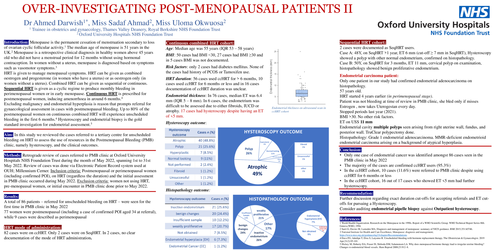
OVER-INVESTIGATING POST-MENOPAUSAL PATIENTS II
Poster Presenter
Authors
Affiliations
Part of Topic
Post Reproductive Health
OVER-INVESTIGATING POST-MENOPAUSAL PATIENTS II
Dr Ahmed Darwish1*, Miss Sadaf Ahmad2, Miss Uloma Okwuosa2
1 Trainee in obstetrics and gynaecology, Thames Valley Deanery, Royal Berkshire NHS Foundation Trust
2 Oxford University Hospitals NHS Foundation Trust
Introduction: Menopause is the permanent cessation of menstruation secondary to loss of ovarian cyclic follicular activity.1 The median age of menopause is 51 years in the UK.2 Menopause is a retrospective clinical diagnosis in healthy women above 45 years old who did not have a menstrual period for 12 months without using hormonal contraception. In women without a uterus, menopause is diagnosed based on symptoms such as vasomotor symptoms.3
HRT is given to manage menopausal symptoms. HRT can be given as combined oestrogen and progesterone (in women who have a uterus) or as oestrogen only (in women without a uterus). Combined HRT can be given as sequential or continuous.
Sequential HRT is given as a cyclic regime to produce monthly bleeding in perimenopausal women or in early menopause. Continuous HRT is prescribed for postmenopausal women, inducing amenorrhoea in around 6 months.4
Excluding malignancy and endometrial hyperplasia is reason that prompts referral for gynaecological assessment in cases with postmenopausal bleeding. Up to 80% of the postmenopausal women on continuous combined HRT will experience unscheduled bleeding in the first 6 months.4 Hysteroscopy and endometrial biopsy is the gold standard investigation for endometrial assessment.5
Aim: In this study we reviewed the cases referred to a tertiary centre for unscheduled bleeding on HRT to assess the use of resources in the Postmenopausal Bleeding (PMB) clinic, namely hysteroscopy, and the clinical outcomes.
Methods: Retrograde review of cases referred to PMB clinic at Oxford University Hospitals NHS Foundation Trust during the month of May 2022, spanning 1st to 31st May 2022. Review of cases was done via Electronic Patient Record system used at OUH; Millennium Cerner. Inclusion criteria: Postmenopausal or perimenopausal women (including confirmed POI), on HRT (regardless the duration) and the initial assessment in PMB clinic occurred during May 2022. Exclusion criteria: women not using HRT, pre-menopausal women, or initial encounter in PMB clinic done prior to May 2022.
Results:
A total of 86 patients – referred for unscheduled bleeding on HRT – were seen for the first time in PMB clinic in May 2022
77 women were postmenopausal (including a case of confirmed POI aged 34 at referral), while 9 cases were described as perimenopausal
HRT mode of administration:
82 cases were on ccHRT. Only 2 cases were on SeqHRT. In 2 cases, no clear documentation of the mode of HRT administration.
Continuous combined HRT cohort:
Age: Median age was 55 years (IQR 53 – 58 years)
BMI: 50 cases had BMI <30, 27 cases had BMI ≥30 and in 5 cases BMI was not documented.
Risk factors: only 2 cases had diabetes mellitus. None of the cases had history of PCOS or Tamoxifen use.
HRT duration: 56 cases used ccHRT for > 6 months, 10 cases used ccHRT for 6 months or less and in 16 cases documentation of ccHRT duration was unclear.
Endometrial thickness: In 76 cases, median ET was 6.4 mm (IQR 5 – 8 mm). In 6 cases, the endometrium was difficult to be assessed due to either fibroids, IUCD or atrophy. 17 cases had hysteroscopy despite having an ET of <5 mm.
Sequential HRT cohort:
2 cases were documented as SeqHRT users.
Case A: 48Y, on SeqHRT >1 year, ET 6 mm (cut-off ≥ 7 mm in SeqHRT), Hysteroscopy showed a polyp with other normal endometrium, confirmed on histopathology.
Case B: 50Y, on SeqHRT for 3 months, ET 11 mm, cervical polyp on examination, histopathology showed benign proliferative endometrium.
Endometrial carcinoma patient:
Only one patient in our study had confirmed endometrial adenocarcinoma on histopathology.
57 years old.
HRT started 4 years earlier (in perimenopausal stage).
Patient was not bleeding at time of review in PMB clinic, she bled only if misses Estrogen , now takes Uterogestan every day.
Stopped periods last year (2021).
BMI >30. No other risk factors.
ET on USS 11 mm
Endometrial cavity multiple polyps seen arising from right uterine wall, fundus, and posterior wall. TruClear polypectomy done.
Histopathology: Grade 1 endometrial adenocarcinoma. MMR-deficient endometrioid endometrial carcinoma arising on a background of atypical hyperplasia.
Conclusion:
Recommendation:
Further discussion regarding exact duration cut-offs for accepting referrals and ET cut-offs for pursuing a Hysteroscopy.
Consider auditing endometrial pipelle biopsy against Outpatient hysteroscopy.
References:
1 World Health Organization. Research on the Menopause in the 1990s. Report of a WHO Scientific Group. WHO Technical Report Series 866. Geneva:WHO; 1994.
2 Sarri G, Davies M, Lumsden MA. Diagnosis and management of menopause: summary of NICE guidance. BMJ 2015;351:h5746.
3 National Institute for Health and Care Excellence, Menopause: diagnosis and management; https://www.nice.org.uk/guidance/ng23/chapter/Recommendations
4 Dave FG, Adedipe T, Disu S, Laiyemo R. Unscheduled bleeding with hormone replacement therapy. The Obstetrician & Gynaecologist. 2019 Apr;21(2):95-101.
5 Hickey M, Doherty DA, Fraser IS, Sloboda DM, Salamonsen LA. Why does menopausal hormone therapy lead to irregular uterine bleeding? Changes to endometrial blood vessels. Hum Reprod 2008;23:912–8.