1,830 posters, 67 videos, 75 audios, 29 topics, 22 sessions, 4,727 authors, 1,697 institutions
ePostersLive by SciGen Technologies S.A. All rights reserved.
RCOG World Congress 2023
June 12 - 14, 2023 | London, UK

EP.0159
Serum Total Antioxidant Capacity Levels on Early Menopause In Developing Country Indonesia
Poster Presenter
Part of Topic
Post Reproductive Health
Video
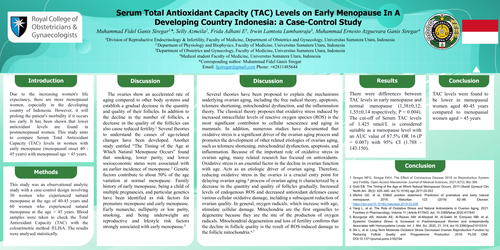
Serum Total Antioxidant Capacity (TAC) Levels on Early Menopause In A Developing Country Indonesia: a Case-Control Study
Introduction: Due to the increasing women's life expectancy, there are more menopausal women, especially in the developing country of Indonesia. However, it will prolong the patient's morbidity if it occurs too early. It has been shown that lower antioxidant levels are found in postmenopausal women. This study aims to compare Serum Total Antioxidant Capacity (TAC) levels in women with early menopause (menopausal onset 40 - 45 years) with menopausal age > 45 years.
Methods: This study was an observational analytic study with a case-control design involving 30 women who experienced natural menopause at the age of 40-45 years and 60 women who experienced natural menopause at the age > 45 years. Blood samples were taken to check the Total Antioxidant Capacity (TAC) with the colourimetric method /ELISA. The results were analysed statistically.
Discussion: The ovaries show an accelerated rate of aging compared to other body systems and establish a gradual decrease in the quantity and quality of their follicles. In addition to the decline in the number of follicles, a decrease in the quality of the follicles can also cause reduced fertility.1 Several theories to understand the causes of age-related changes have been developed. Another study entitled “The Timing of the Age at Which Natural Menopause Occurs” found that smoking, lower parity, and lower socioeconomic status were associated with an earlier incidence of menopause.2 Genetic factors contribute to about 50% of the age variation at normal menopause. Family history of early menopause, being a child of multiple pregnancies, and particular genetics have been identified as risk factors for premature menopause and early menopause. Early menarche, nulliparity or low parity, smoking, and being underweight are reproductive and lifestyle risk factors strongly associated with early menopause.3
Several theories have been proposed to explain the mechanisms underlying ovarian aging, including the free radical theory, apoptosis, telomere shortening, mitochondrial dysfunction, and the inflammation theory. The classical theory proposes that oxidative stress induced by increased intracellular levels of reactive oxygen species (ROS) is the most significant contributor to cellular senescence and aging in mammals. In addition, numerous studies have documented that oxidative stress is a significant driver of the ovarian aging process and promotes the development of other related etiologies of ovarian aging, such as telomere shortening, mitochondrial dysfunction, apoptosis, and inflammation. Because of the important role of oxidative stress in ovarian aging, many related research has focused on antioxidants. Oxidative stress is an essential factor in the decline in ovarian function with age. Acts as an etiologic driver of ovarian aging. Therefore, reducing oxidative stress in the ovaries is a crucial entry point for delaying ovarian aging.4process of ovarian aging is characterized by a decrease in the quantity and quality of follicles gradually. Increased levels of endogenous ROS and decreased antioxidant defenses cause various cellular oxidative damage, including a subsequent reduction of ovarian quality. In general, oxygen radicals, which increase with age, stimulate cellular damage. Mitochondria are the first organelles to degenerate because they are the site of the production of oxygen radicals. Mitochondrial degeneration and loss of fertility confirms that the decline in follicle quality is the result of ROS-induced damage to the follicle mitochondria.6,7
Results: There were differences between TAC levels in early menopause and normal menopause (1,38±0,12; 1,55±0,14 respectively, P = 0.004). The cut-off of Serum TAC levels of 1.425 nmol/L is considered suitable as a menopause level with an AUC value of 87.5% OR 16 (P = 0.007) with 95% CI (1.788 - 143.150).
Conclusion: TAC levels were found to be lower in menopausal women aged 40-45 years compared to menopausal women aged > 45 years
Keywords: Antioxidant, Early menopause, Menopause, Total Antioxidant Capacity