1,830 posters, 67 videos, 75 audios, 29 topics, 22 sessions, 4,727 authors, 1,697 institutions
ePostersLive by SciGen Technologies S.A. All rights reserved.
RCOG World Congress 2023
June 12 - 14, 2023 | London, UK

EP.0299
Vitamin D Serum and HOMA-IR in Indonesian Post-Menopause Women
Poster Presenter
Part of Topic
Post Reproductive Health
Video
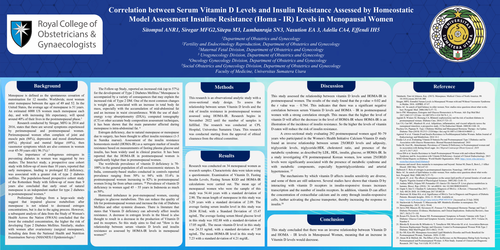
Correlation between Serum Vitamin D Levels and Insulin Resistance Assessed by Homeostatic Model Assessment Insuline Resistance (Homa - IR) Levels in Menopausal Women
Sitompul ANR1, Siregar MFG2,Sitepu M3, Lumbanraja SN3, Nasution EA 3, Adella CA4, Effendi IH5
1Department of Obstetrics and Gynecology
2Fertility and Endocrinology Reproduction, Department of Obstetrics and Gynecology
2Maternal Fetal Division, Department of Obstetrics and Gynecology
3 Urogynecology Division, Department of Obstetrics and Gynecology
4Oncology Gynecology Division, Department of Obstetrics and Gynecology
5Social Obstetrics and Gynecology Division, Department of Obstetrics and Gynecology
Faculty of Medicine, Universitas Sumatera Utara
Background: Hormonal imbalance in post-menopausal women, causing changes in glucose metabolism. This can reduce the quality of life for postmenopausal women and increase the risk of Diabetes Mellitus and other systemic diseases. There is literature that states that Vitamin D deficiency can adversely affect insulin resistance. A decrease in estrogen levels in the blood is also thought to result in a decrease in the production of Vitamin D and its receptors.
Methods: This research is an observational analytic study with a cross-sectional study design. To assess the relationship between serum Vitamin D levels and the risk of insulin resistance in postmenopausal women assessed using HOMA-IR. Research begins in November 2022 until the number of samples is fulfilled. The research was conducted at CPL Hospital, Universitas Sumatera Utara. This research was conducted starting from the approval of ethical clearance from the ethical committee.
Results: Research was conducted on 34 menopausal women as research samples. Characteristic data were taken using a questionnaire. Examination of Vitamin D, Fasting Insulin Levels, Fasting Serum KGD and HOMA-IR calculations were carried out. The mean age of menopausal women who were the sample of this study was 54.44 years with a standard deviation of 2.90. The mean length of menopause in this study was 5.29 years with a standard deviation of 2.09. The average fasting serum insulin level in this study was 28.04 IU/mL with a Standard Deviation of 15.47 ng/mL. The average fasting serum blood glucose level in this study was 102.88 with a standard deviation of 17.05 mg/dL. The mean vitamin-D level in this study was 24.33 ng/mL with a standard deviation of 7.89 ng/mL. The mean HOMA-IR level in this study was 7.23 with a standard deviation of 4.21 mg/dL.
Conclusion: This study concluded that there was an inverse relationship between Vitamin D and HOMA – IR levels in Menopausal Women, meaning that an increase in Vitamin D levels would decrease.
Keyword: Menoupause, Vitamin D, HOMA-IR
Background
Menopause is defined as the spontaneous cessation of menstruation for 12 months. Worldwide, most women enter menopause between the ages of 49 and 52. In the United States, the average age of menopause is 51 years. An estimated 6000 US women reach menopause each day, and with increasing life expectancy, will spend around 40% of their lives in the postmenopausal phase.1
Research conducted by Siregar, MFG in 2014 and 2016, states that there are several symptoms experienced by perimenopausal and postmenopausal women. Perimenopausal women often complain of joint and muscle pain (84%), depression and mood disturbances (68%), physical and mental fatigue (68%), then vasomotor symptoms which are also common in women over 45-50 years old ( 96.1%).2
The importance of endogenous estrogens in preventing diabetes in women was suggested by two studies. The InterAct study, a prospective case cohort study with follow-up of more than 10 years, reported that early menopause, leading to prolonged E2 deficiency, was associated with a greater risk of type 2 diabetes mellitus. The population-based prospective cohort study of the Rotterdam Study with follow-up of more than 9 years also concluded that early onset of natural menopause is an independent marker for type 2 diabetes in postmenopausal women.4
Preliminary findings from a large-scale study suggest that impaired glucose metabolism after menopause is not related to decreased estrogen concentrations, but is due to the aging process. However, a subsequent analysis of data from the Study of Women's Health Across the Nation (SWAN) concluded that the lower the estradiol concentration, the higher the risk of developing Type 2 Diabetes Mellitus. Similarly, studies with women after ovariectomy (surgical menopause), including data from the National Health and Nutrition Examination Survey (NHANES) I Epidemiologic.2
The Follow-up Study, reported an increased risk (up to 57%) for the development of Type 2 Diabetes Mellitus.5Menopause is accompanied by a variety of consequences that may explain the increased risk of Type 2 DM. One of the most common changes is weight gain, associated with an increase in total body fat mass, especially with the accumulation of mid-abdominal fat and an increase in waist circumference. With the use of dual-energy x-ray absorptiometry (DXA), computed tomography (CT) or other accurate body composition assessment techniques, it has been shown that the main parameter affected during menopause is intra-abdominal fat. 6
Estrogen deficiency, due to natural menopause or menopause due to surgery, has been thought to affect insulin resistance (1-3 in Sumika marsui). Assessment of the insulin resistance homeostasis model (HOMA-IR) as a surrogate marker of insulin resistance based on measurements of fasting plasma glucose and insulin, has been widely used in clinical practice. It has been reported that the HOMA-IR in postmenopausal women is significantly higher than in premenopausal women.
The worldwide prevalence of vitamin D deficiency is 70-100% in the general population of all socioeconomic statuses. In India, community-based studies conducted in controls reported prevalence ranging from 50% to 94% with 53.4% in postmenopausal women increasing to 82% in postmenopausal women living far from urban centers. 10Prevalence of vitamin D deficiency in women aged 45 – 55 years in Indonesia as much as 50%.
Hormonal imbalance in post-menopausal women, causing changes in glucose metabolism. This can reduce the quality of life for postmenopausal women and increase the risk of Diabetes Mellitus and other systemic diseases. There is literature that states that Vitamin D deficiency can adversely affect insulin resistance. A decrease in estrogen levels in the blood is also thought to result in a decrease in the production of Vitamin D and its receptors. So this study aims to find out "How is the relationship between serum vitamin D levels and insulin resistance as assessed by HOMA-IR levels in menopausal women?"
Methods
This research is an observational analytic study with a cross-sectional study design. To assess the relationship between serum Vitamin D levels and the risk of insulin resistance in postmenopausal women assessed using HOMA-IR. Research begins in November 2022 until the number of samples is fulfilled. The research was conducted at CPL Hospital, Universitas Sumatera Utara. This research was conducted starting from the approval of ethical clearance from the ethical committee.
Results
Research was conducted on 34 menopausal women as research samples. Characteristic data were taken using a questionnaire. Examination of Vitamin D, Fasting Insulin Levels, Fasting Serum KGD and HOMA-IR calculations were carried out. The mean age of menopausal women who were the sample of this study was 54.44 years with a standard deviation of 2.90. The mean length of menopause in this study was 5.29 years with a standard deviation of 2.09. The average fasting serum insulin level in this study was 28.04 IU/mL with a Standard Deviation of 15.47 ng/mL. The average fasting serum blood glucose level in this study was 102.88 with a standard deviation of 17.05 mg/dL. The mean vitamin-D level in this study was 24.33 ng/mL with a standard deviation of 7.89 ng/mL. The mean HOMA-IR level in this study was 7.23 with a standard deviation of 4.21 mg/dL.
Discussion
This study assessed the relationship between vitamin D levels and HOMA-IR in postmenopausal women. The results of the study found that the p-value = 0.02 and the r value was – 0.764. This indicates that there was a significant negative correlation between serum Vitamin D levels and HOMA – IR in postmenopausal women with a strong correlation strength. This means that the higher the level of vitamin D will affect the decrease in the level of HOMA-IR where HOMA-IR is an illustration of the incidence of insulin resistance. So the higher the levels of vitamin D eaten will reduce the risk of insulin resistance.
A cross-sectional study evaluating 292 postmenopausal women aged 50–79 years who participated in the Women's Health Initiative Calcium-Vitamin D study found an inverse relationship between serum 25(OH)D levels and adiposity, triglyceride levels, triglyceride:HDL cholesterol ratio, and presence of the metabolic syndrome. as described by LDL, HDL, insulin, glucose, or HOMA-IR. In a study investigating 478 postmenopausal Korean women, low serum 25(OH)D levels were significantly associated with the presence of metabolic syndrome and with metabolic components, especially hypertriglyceridemia and arterial hypertension. 37
The mechanisms by which vitamin D affects insulin sensitivity are diverse, and some of them are still unknown. Several studies have shown that vitamin D by interacting with vitamin D receptors in insulin-responsive tissues increases transcription and the number of insulin receptors. In addition, vitamin D can affect the concentration of extracellular calcium and its entry through insulin-responsive cells, further activating the glucose transporter, thereby increasing the response to insulin.39
Conclusion: This study concluded that there was an inverse relationship between Vitamin D and HOMA – IR levels in Menopausal Women, meaning that an increase in Vitamin D levels would decrease.
Reference
- Takahashi, Traci & Johnson, Kay. (2015). Menopause. Medical Clinics of North America. 99. 10.1016/j.mcna.2015.01.006
- Siregar, MFG. Estradiol Serum Levels in Menopausal Women with and Without Vasomotor Syndrome in Medan. 2016. ASPIRE; 67-87
- Bales AC. In search of lipid balance in older women; New studies raise questions about what works best. Postgrad. Med. 2000;108(7):57–72.
- Jarvis FM. Menopause, Estrogens and Glucose Homeostasis in Women. Adv Exp Med Biol 2017;1043:217-225.doi: 10.1007/978-3-319-70178-3_11.
- Appiah D, Winters SJ, Hornung CA. Bilateral oophorectomy and the risk of incident diabetes in postmenopausal women. Diabetes Care. 2014;37:725–33.
- Lee CG, Carr MC, Murdoch SJ, et al. Adipokines, inflammation, and visceral adiposity across the menopausal transition: a prospective study. J Clin Endocrinol Metab. 2009;94:1104–10.
- Paschou SA, Papanas N. Type 2 Diabetes Mellitus and Menopausal Hormone Therapy: An Update. Diabetes Ther (2019) 10:2313–2320 https://doi.org/10.1007/s13300-019-00695- y.
- Agarwal N et al. Vitamin D and Insulin Resistance in PostMenopausal Indian Women. Indian Journal of Endocrinology and Metabolism. 2014 18:1
- Fondjo LA et al. Evaluating Vitamin D Statusin Pre and Postmenopausal Type 2 Diabetics and Its Association with Glucose Homeostasis. Biomed Research International. 2018
- Sinha M, Goel JK, Akanshamani. Prevalence of Vitamin D Deficiency in Postmenopausal women and its association with fasting blood sugar. Int J Reprod Contracept Obstet Gynecol. 2019 Jul;8(7):2617-2621
- Alissa EM et al. Insulin Resistance in Saudi Postmenopausal Women with and without Metabolic Syndrome and Its Association with Vitamin D Deficiency. Journal of Clinical Endocrinology. 2015
- WHO Global Reports on Diabetes. World Health Organization. 2020. https://www.who.int/news-room/fact-sheets/detail/diabetes)
- Hormones and mood: from menarche to menopause and beyond. Steiner M, Dunn E, Born L, J Affect Disord. 2003 Mar; 74(1):67-83
- Halbreich U. Role of estrogen in postmenopausal depression. Neurology. 1997;48:16–9.
- Bales AC. In search of lipid balance in older women; New studies raise questions about what works best. Postgrad. Med. 2000;108(7):57–72.
- Igweh JC, et al. The effects of menopause on the serum lipid profile of normal females of south east Nigeria. Nigerian Journal of Physiological Sciences. 2005;20(1-2):48–53.
- Andany MMA; Felpete NP; Fernandez CF; Garcia CD; Garcia CP. Liver glucose metabolism in humans. Biosci. Rep. (2016) / 36 / art:e00416 / doi 10.1042/BSR20160385.
- Gupta S; Jain U; Chauhan N. Laboratory Diagnosis of HbA1c: A Review. J Nanomed Res.2017; 5(4): 00120. DOI: 10.15406/jnmr.2017.05.00120
- Sherwani SI; Khan HA; et al. Significance of HbA1c Test in Diagnosis and Prognosis of Diabetic Patients. Biomark Insights. 2016; 11: 95-104. Available at: https://www.ncbi.nlm.nih.gov/pmc/articles/PMC4933534/[Accessed on 23 July 2020]
- Stachowiak G; Pertynski T; Marczewska MP. Metabolic disorders in menopause. Prz Menopauzalny. 2015; 14(1): 59-64.
- Jarvis FM; Manson JE; Stevenson JC; Fonseca VA. Menopausal Hormone Therapy and Type 2 Diabetes Prevention: Evidence, Mechanisms, and Clinical Implications. Endocrine Reviews, June 2017, 38(3):173–188
- Rouen PA; Krein SL; Reame NE. Postmenopausal Symptoms in Female Veterans with Type 2 Diabetes: Glucose Control and Symptom Severity. Journal of women's health .2015; Volume 24, Number 6
- Bitoska IL Krstevska B; Milenkovic T; Temelkova SM; Misevska SJ; et al. Association Between Hormone Replacement Therapy and Glycemic Control in Postmenopausal Women With Type 2 Diabetes. Mak Med Pregled 2015; 69(1): 35-39.
- Ko SH; Kim HS. Menopause-Associated Lipid Metabolic Disordes and Foods Beneficial for Postmenopausal Women. Nutrients. 2020; 12:202.
- Ahsan M & Mallick AK. The Effect of Soy Isoflavones on the Menopause Rating Scale Scoring in Perimenopausal and Postmenopausal Women: A Pilot Study. Journal of Clinical and Diagnostic Research. 2017 Sep, Vol-11(9): FC13-FC16
- Pabich M; Materska M. Biological Effect of Soy Isoflavones in the Prevention of Civilization Diseases. Nutrients 2019, 11, 1660; doi:10.3390/nu11071660
- Lind L, Pollare T, Hvarfner A, Lithell H, Sørensen OH, Ljunghall S. Long-term treatment with active vitamin D (alphacalcidol) in middle-aged men with impaired glucose tolerance. Effects on insulin secretion and sensitivity, glucose tolerance and blood pressure. Diabetes Res 1989;11:141-7.
- Chiu KC, Chu A, Go VL, Saad MF. Hypovitaminosis D is associated with insulin resistance and beta cell dysfunction. Am J Clin Nutr 2004;79:820-5.
- Forouhi NG, Luan J, Cooper A, Boucher BJ, Wareham NJ. Baseline serum 25-hydroxy vitamin D is predictive of future glycemic status and insulin resistance: The medical research council Ely prospective study 1990-2000. Diabetes 2008;57:2619-25.
- Liu S, Song Y, Ford ES, Manson JE, Buring JE, Ridker PM. Dietary calcium, vitamin D, and the prevalence of metabolic syndrome in middle-aged and older U.S. women. Diabetes Care 2005;28:2926-32.
- Lu L, Yu Z, Pan A, Hu FB, Franco OH, Li H, et al. Plasma 25-hydroxyvitamin D concentration and metabolic syndrome among middle-aged and elderly Chinese individuals. Diabetes Care 2009;32:1278-83.
- Reis JP, von Mühlen D, Kritz-Silverstein D, Wingard DL, Barrett-Connor E. Vitamin D, parathyroid hormone levels, and the prevalence of metabolic syndrome in community- dwelling old adults. Diabetes Care 2007;30:1549-55.
33.Basit S. Vitamin D in health and disease: a literature review. Br J Biomed Sci 2013;70(4):161e72.
- Haffner SM, Miettinen H, Stern MP. The homeostasis model in the San Antonio Heart Study. Diabetes Care 1997;20:1087e92.
- Franssen R, Monajemi H, Stroes ES, Kastelein JJ. Obesity and dyslipidemia. Med Clin North Am 2011;95(5):893e902.
- Mora JR, Iwata M, von Andrian UH. Vitamin effects on the immune system: vitamins A and D take centre stage. Nat Rev Immunol 2008;8:685e98.
- Deleskog A, Hilding A, Brismar K, Hamsten A, Efendic S, Östenson CG. Low serum 25- hydroxyvitamin D level predicts progression to type 2 diabetes in individuals with prediabetes but not with normal glucose tolerance. Diabetologia 2012;55(6):1668e78.
- Chiu KC, Chu A, Go VL, Saad MF. Hypovitaminosis D is associated with insulin resistance and beta cell dysfunction. Am J Clin Nutr 2004;79(5):820e5.
- Horakova D, et al. Optimal Homeostasis Model Assesment of Insulin Resistance (HOMA- IR) Cut-Offs: A Cross-Sectional Study in The Czech Population. MDPI 2019;55(158)
- Lerchbaum E. Vitamin D and Menopause – Narrative review. Maturitas, Elsevier 2014; 79 (3-7)
- H.R. Song, C.H. Park, Low serum vitamin D level is associated with high risk of metabolic syndrome in post-menopausal women, J. Endocrinol. Invest. 36 (2013) 791- 796.
- Agarwal N, etal. Vitamin D and Insulin Resistance in Postmenopaul Indian Women, Indian Journal of Endocrinology and Metabolism 2014; 18(1)
- Xin Y, et al. Association Between Vitamin D Serum Levels and Insulin Resistance Assessed by HOMA-IR among Non-Diabetic Adults in The United States: Results from NHANES 2007 – 2014, Frontiers. 2022