1,830 posters, 67 videos, 75 audios, 29 topics, 22 sessions, 4,727 authors, 1,697 institutions
ePostersLive by SciGen Technologies S.A. All rights reserved.
RCOG World Congress 2023
June 12 - 14, 2023 | London, UK

EP.0960
Unexpected term breech – Experience in a Rural District General Hospital
Poster Presenter
Authors
Affiliations
Part of Topic
Women’s Health and Policies
UNEXPECTED TERM BREECH – OUR EXPERIENCE IN A DISTRICT GENERAL HOSPITAL
Abhishek Malakar1 , Clare Richards2 , Aik Goh3
1. LAT ST3, O&G, Raigmore Hospital, NHS Highland
2. ST3, O&G, Raigmore Hospital, NHS Highland
3. Consultant, O&G, Raigmore Hospital, NHS Highland
Objectives:
To study the incidence of singleton women in labour with an unexpected breech presentation at term in our trust, with focus given to their maternal and perinatal outcomes. We hypothesize that such women might have suboptimal outcomes and are keen to investigate if improvements are required locally to reduce its incidence.
Design:
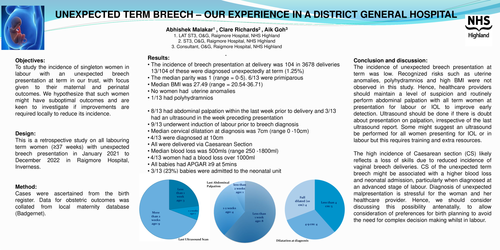
This is a retrospective study on all labouring term women (≥37 weeks) with unexpected breech presentation in January 2021 to December 2022 in Raigmore Hospital, Inverness.
Method:
Cases were ascertained from the birth register. Data for obstetric outcomes was collated from local maternity database (Badgernet).
Results:
Conclusion and discussion:
The incidence of unexpected breech presentation at term was low. Recognized risks such as uterine anomalies, polyhydramnios and high BMI were not observed in this study. Hence, healthcare providers should maintain a level of suspicion and routinely perform abdominal palpation with all term women at presentation for labour or IOL to improve early detection. Ultrasound should be done if there is doubt about presentation on palpation, irrespective of the last ultrasound report. Some might suggest an ultrasound be performed for all women presenting for IOL or in labour but this requires training and extra resources.
The high incidence of Caesarean section (CS) likely reflects a loss of skills due to reduced incidence of vaginal breech deliveries. CS of the unexpected term breech might be associated with a higher blood loss and neonatal admission, particularly when diagnosed at an advanced stage of labour. Diagnosis of unexpected malpresentation is stressful for the woman and her healthcare provider. Hence, we should consider discussing this possibility antenatally, to allow consideration of preferences for birth planning to avoid the need for complex decision making whilst in labour.