1,830 posters, 67 videos, 75 audios, 29 topics, 22 sessions, 4,727 authors, 1,697 institutions
ePostersLive by SciGen Technologies S.A. All rights reserved.
RCOG World Congress 2023
June 12 - 14, 2023 | London, UK

EP.0057
Performance of the London Measure of Unplanned Pregnancy in antenatal care
Poster Presenter
Authors
Catherine Steward, Bryony Stoneman, Geraldine Barrett, Jennifer Hall
Affiliations
Part of Topic
Women’s Health and Policies
Performance of the London Measure of Unplanned Pregnancy in antenatal care.
Catherine Stewart (1), Bryony Stoneman (2), Dr Geraldine Barrett (1), Dr Jennifer Hall (1).
(1) Sexual and Reproductive Health Research Team, UCL EGA Institute of Women’s Health.
(2) Research Midwife, Maternity Services, EGA Wing, UCLH.
This study evaluates the uptake and acceptability of the implementation of the London Measure of Unplanned Pregnancy (LMUP) into antenatal care in the UK and assesses whether the LMUP is working as expected.
Introduction
Unplanned pregnancies are associated with increased risks of adverse outcomes (1); it is estimated that 45% of pregnancies in the UK are unplanned(2). Despite this they are currently not routinely detected during antenatal care.
We piloted the implementation of the London Measure of Unplanned Pregnancy (LMUP) – a validated measure of pregnancy planning – into antenatal care at University College London Hospital (UCLH) and Homerton University Hospital (HUH). Here we present two month’s data from UCLH.
Methodology
Uptake and acceptability were measured using anonymised data from August – September 2022, comprising 1221 women. Non-completion of the LMUP was used as a proxy measure of acceptability overall.
Women’s demographic and obstetric history data were also considered to ascertain whether certain groups of women are less likely to complete the LMUP and to check the LMUP is working as expected, based on previous literature.
Results
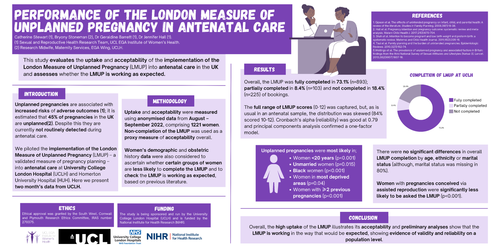
Overall, the LMUP was fully completed in 73.1% (n=893); partially completed in 8.4% (n=103) and not completed in 18.4% (n=225) of bookings.
The full range of LMUP scores (0-12) was captured, but, as is usual in an antenatal sample, the distribution was skewed (84% scored 10-12). Cronbach’s alpha (reliability) was good at 0.79 and principal components analysis confirmed a one-factor model.
Unplanned pregnancies were most likely in;
- Women <20 years (p<0.001)
- Unmarried women (p=0.015)
- Black women (p<0.001)
- Women in most deprived areas (p=0.04)
- Women with ≥2 previous pregnancies (p<0.001)
There were no significant differences in overall LMUP completion by age, ethnicity or marital status (although, marital status was missing in 80%).
Women with pregnancies conceived via assisted reproduction were significantly less likely to be asked the LMUP (p<0.001).
Conclusion
Overall, the high uptake of the LMUP illustrates its acceptability and preliminary analyses show that the LMUP is working in the way that would be expected, showing evidence of validity and reliability on a population level.
Ethics
Ethical approval was granted by the South West, Cornwall and Plymouth Research Ethics Committee, IRAS number 270375.
Funding
The study is being sponsored and run by the University College London Hospital (UCLH) and is funded by the National Institute for Health Research (NIHR).
References
1. Gipson et al. The effects of unintended pregnancy on infant, child, and parental health: A review of the literature. Studies in Family Planning. 2008;39(1):18-38.
2. Hall et al. Pregnancy intention and pregnancy outcome: systematic review and meta-analysis. Matern Child Health J. 2017;21(3):670-704.
3. Shah et al. Intention to become pregnant and low birth weight and preterm birth: a systematic review. Maternal and Child Health Journal. 2011;15(2):205-16.
4. Tsui et al. Family planning and the burden of unintended pregnancies. Epidemiologic Reviews. 2010;32(1):152-74.
5.Wellings et al. The prevalence of unplanned pregnancy and associated factors in Britain: findings from the third National Survey of Sexual Attitudes and Lifestyles (Natsal-3). Lancet. 2013;382(9907):1807-16.