1,830 posters, 67 videos, 75 audios, 29 topics, 22 sessions, 4,727 authors, 1,697 institutions
ePostersLive by SciGen Technologies S.A. All rights reserved.
RCOG World Congress 2023
June 12 - 14, 2023 | London, UK

EP.0927
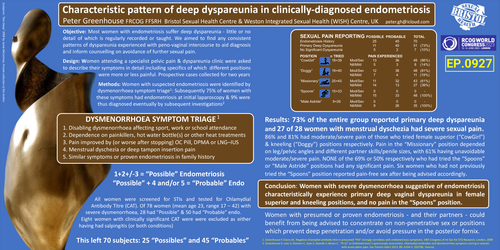
Characteristic pattern of deep dyspareunia in clinically-diagnosed endometriosis
Poster Presenter
Authors
Affiliations
Part of Topic
Endometriosis and Uterine Disorders
Characteristic pattern of deep dyspareunia in clinically-diagnosed endometriosis
Objective: Most women with endometriosis suffer deep dyspareunia - little or no detail of which is regularly recorded or taught. We aimed to find any consistent patterns of dyspareunia experienced with peno-vaginal intercourse to aid diagnosis and inform counselling on avoidance of further sexual pain.
Design: Women attending a specialist pelvic pain & dyspareunia clinic were asked to describe their symptoms in detail including specifics of which different positions were more or less painful. Prospective cases collected for two years
Methods: Women with suspected endometriosis were identified by dysmenorrhoea symptom triage1: Subsequently 75% of women with these symptoms had endometriosis at initial laparoscopy & a further 9% were thus diagnosed eventually by subsequent investigations2.
DYSMENORRHOEA SYMPTOM TRIAGE1
1. Disabling dysmenorrhoea affecting sport, work or school attendance
2. Dependence on painkillers, hot water bottle(s) or other heat treatments
3. Pain improved by (or worse after stopping) OC Pill, DPMA or LNG–IUS
4. Menstrual dyschezia or deep tampon insertion pain
5. Similar symptoms or proven endometriosis in family history
1+2+/-3 = “Possible” Endometriosis
“Possible” + 4 and/or 5 = “Probable” Endo
All women were screened for STIs and tested for Chlamydial Antibody Titre (CAT). Of 78 women (mean age 23, range 17 – 42) with severe dysmenorrhoea, 28 had “Possible” & 50 had “Probable” endo. Eight women with clinically significant CAT were were excluded as either having had salpingitis or both conditions. This left 70 subjects: 25 “Possibles” and 45 “Probables”
Results: 73% of the entire group reported primary deep dyspareunia and 27 of 28 women with menstrual dyschezia had severe sexual pain.
86% and 81% had moderate/severe pain of those who tried female superior (“CowGirl”) & kneeling (“Doggy”) positions respectively. Pain in the “Missionary” position depended on leg/pelvic angles and different partner skills/penile sizes, with 61% having unavoidable moderate/severe pain. NONE of the 69% or 50% respectively who had tried the “Spoons” or “Male Astride” positions had any significant pain. Six women who had not previously tried the “Spoons” position reported pain-free sex after being advised accordingly.
Conclusion: Women with severe dysmenorrhoea suggestive of endometriosis characteristically experience primary deep vaginal dyspareunia in female superior and kneeling positions, and no pain in the “Spoons” position.
Women with presumed or proven endometriosis - and their partners - could benefit from being advised to concentrate on non-penetrative sex or positions which prevent deep penetration and/or avoid pressure in the posterior fornix.
References:
1. Greenhouse P, Evans AE. Negative chlamydial antibody titre in presumed “PID” strongly correlates with endometriosis symptoms. 18th Congress of International Society for STD Research [ISSTDR], London, 2009.
2. Greenhouse P, Lees V, Overton C, Vyas S, Akande V, Bevan C. “P.I.D.” or Endometriosis? Laparoscopic assessment, chlamydial antibodies and dysmenorrhea symptom scoring in women with acute pelvic pain. Sex Transm Infect 2013; 89: A104-5 [ISSTDR, Vienna]