1,830 posters, 67 videos, 75 audios, 29 topics, 22 sessions, 4,727 authors, 1,697 institutions
ePostersLive by SciGen Technologies S.A. All rights reserved.
RCOG World Congress 2023
June 12 - 14, 2023 | London, UK

EP.0050
Coexisting gynaecological conditions in the relationship between endometriosis and adverse pregnancy outcomes.
Part of Topic
Endometriosis and Uterine Disorders
Coexisting gynaecological conditions in the relationship between endometriosis and adverse pregnancy outcomes.
Introduction
•Endometriosis is a chronic and debilitating condition which can affect the entire reproductive life course of women and increases the risk of pregnancy complications.
•The presence of a coexisting gynaecological condition is hypothesised to worsen the relationship between endometriosis and pregnancy outcomes further.
•This review aimed to investigate if an increased risk exists with comorbidity, and if so, to quantify this risk.
Method
•Prospectively registered systematic review and meta-analysis (PROSPERO id: CRD42022307527).
•MEDLINE and Embase searched from inception to June 2022.
•Search terms included endometriosis and six coexisting benign gynaecological conditions; adenomyosis, fibroids, endometrial polyps (EPs), polycystic ovarian syndrome (PCOS), benign ovarian cysts (BOC) and pelvic inflammatory disease (PID).
•Grading of Recommendations, Assessment, Development and Evaluation (GRADE) tool used to assess the quality of evidence with the risk of bias in non-randomised studies of interventions (ROBINS-I) tool incorporated.
•2 independent reviewers involved in article screening and data extraction.
•Meta-analysis performed on Review manager using the random effects model.
•Primary outcome: livebirth rate. Secondary outcomes: conception rate and miscarriage rate.
Results
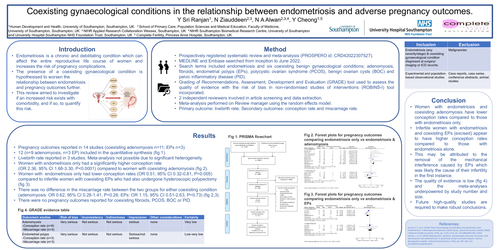
•Pregnancy outcomes reported in 14 studies (coexisting adenomyosis n=11; EPs n=3).
•12 (n=9 adenomyosis, n=3 EP) included in the quantitative synthesis (fig 1).
•Livebirth rate reported in 3 studies. Meta-analysis not possible due to significant heterogeneity.
•Women with endometriosis only had a significantly higher conception rate (OR 2.36, 95% CI 1.68-3.30, P<0.0001) compared to women with coexisting adenomyosis (fig 2).
•Women with endometriosis only had lower conception rates (OR 0.51, 95% CI 0.32-0.81, P=0.005) compared to infertile women with coexisting EPs who had also undergone hysteroscopic polypectomy (fig 3).
•There was no difference in the miscarriage rate between the two groups for either coexisting condition (adenomyosis: OR 0.62, 95% CI 0.28-1.41, P=0.26; EPs: OR 1.15, 95% CI 0.51-2.63, P=0.73) (fig 2,3).
•There were no pregnancy outcomes reported for coexisting fibroids, PCOS, BOC or PID.
Conclusion
•Women with endometriosis and coexisting adenomyosis have lower conception rates compared to those with endometriosis only.
•Infertile women with endometriosis and coexisting EPs (excised) appear to have higher conception rates compared to those with endometriosis alone.
•This may be attributed to the removal of the mechanical interference caused by EPs which was likely the cause of their infertility in the first instance.
•The quality of evidence is low (fig 4) and the meta-analyses underpowered by study number and size.
• Future high-quality studies are required to make robust conclusions.