1,830 posters, 67 videos, 75 audios, 29 topics, 22 sessions, 4,727 authors, 1,697 institutions
ePostersLive by SciGen Technologies S.A. All rights reserved.
RCOG World Congress 2023
June 12 - 14, 2023 | London, UK

EP.0903
Increasing rates and improving maternal and neonatal outcomes of vaginal breech births.
Poster Presenter
Authors
Affiliations
Part of Topic
Women’s Health and Policies
INCREASING RATES AND IMPROVING MATERNAL AND NEONATAL OUTCOMES OF VAGINAL BREECH BIRTHS
Azahara Perez Rodriguez - Registered Midwife, Queen Alexandra Hospital, Portsmouth Hospitals University NHS Trust, UK
INTRODUCTION
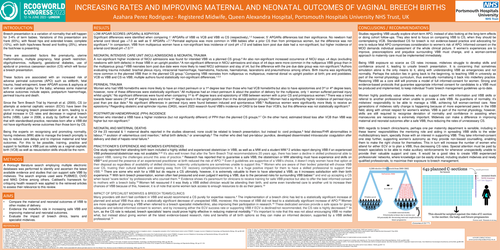
Breech presentation is a variation of normality that will happen for 3-4% of term babies. Variations of this presentation are frank (65%), with flexed hips and extended knees; complete (10%), with both hips/knees flexed and footling (25%), where the foot/knee is presenting. There are associated factors like prematurity, uterine malformations, multiple pregnancy, fetal growth restriction, oligohydramnios, nulliparity, gestational diabetes, use of epidural or previous caesarean section (CS) which will favour a breech presentation. These factors are associated with an increased risk of adverse perinatal outcomes (APO) such as stillbirth, fetal trauma, head entrapment, lower APGAR scores & asphyxia at birth or cerebral palsy for the baby; whereas some maternal adverse outcomes include sepsis, postpartum haemorrhage, perineal trauma and death. Since the Term Breech Trial by Hannah et al. (2000), CS (or attempts at external cephalic version (ECV)) have been the norm in managing breech presentation at term, leading to a global increase in CS rates and decrease in vaginal breech births (VBB). Later in 2006, a study by Goffinet et al. found that with standardised practice, neonates born after a VBB did not have significantly worse outcomes than those born by CS. Being the experts on recognising and promoting normality, having midwives (MW) able to manage the breech promptly is key to reduce care delays and to improve maternal and fetal outcomes. For this to be possible, training, practice and support to facilitate a VBB just as safely as a vaginal cephalic birth (VCB) as well as resuscitation skills should be the norm.
METHODS
A thorough literature search employing multiple electronic databases was performed to identify and ascertain the latest available evidence and studies that can support safe VBB by midwives. The search engines used were PUBMED, OVID and MAG Online among others. Caldwell’s framework for critiquing health research was applied to the retrieved articles to assess their relevance to this review.
AIM
LOW APGAR SCORES (APGARs) & ASPHYXIA
Significant differences were identified when comparing 1’ APGARs of VBB vs VCB and VBB vs CS (respectively),1-2 however, 5’ APGARs differences lost their significance. No newborn had arterial cord blood gas <7.0 as well as 5’ APGARs <7.3 Perinatal asphyxia was more common in VBB babies after a prior CS than from primiparous women, but the difference was not significant.4 In comparison, VBB from multiparous women have a non-significant less incidence of cord pH <7.0 and babies born post due date had a non-significant, but higher incidence of arterial cord blood pH <7.0.2,5
NEONATAL INTENSIVE CARE UNIT (NICU) ADMISSIONS & NEONATAL TRAUMA
A non-significant higher incidence of NICU admissions was found for intended VBB vs a planned CS group.6 An also non-significant increased occurrence of NICU stays >4 days (excluding newborns with birth defects) in those VBB in an upright position.3 A non-significant difference in NICU admissions and stays of ≥4 days were more common in the nulliparous VBB group than in the multiparous group.2 VBB neonates born post due date were more likely to need NICU admission and stay of ≥4, but the difference with the pre due date group was non-significant.5 Authors evaluating trauma included: brachial plexus injury, intracranial haemorrhage, haematoma, fractures, haematomas, lacerations and pneumothorax among others. Birth trauma was significantly more common in the planned VBB than in the planned CS group.7 Comparing VBB neonates from nulliparous vs multiparous; maternal dorsal vs upright position at birth; pre and postdates; VCB vs VBB and CS vs VBB; multiple authors found statistically non-significant differences.1-3,5
PERINEAL TRAUMA
Women who had VBB homebirths were more likely to have an intact perineum or a 1st degree tear than those who had VCB homebirths but also to have episiotomies and 3rd or 4th degree tears, however, none of these differences were statistically significant.1 All multiparas had an intact perineum & about the position of delivery for the nulliparas, only 1 woman suffered perineal injury whilst upright.1 No significant differences were found when comparing 1st to 4th degree tears and episiotomy of VBB between women with a prior CS and primiparous women.4 There was a trend towards fewer severe (3rd and 4th degree) tears and more 1st degree tears in the upright position than in the dorsal position groups.3 Women had a significantly higher incidence of perineal injury post than pre due date.5 No significant differences in perineal injury were found between induced and spontaneous VBB.5 Nulliparous women were significantly more likely to receive an episiotomy.2 Regarding obstetric anal sphincter injuries (OASI), recent 2023 research found VBB’s incidence of OASI to be lower than VCB’s, but this difference was not statistically significant.8
POSTPARTUM HAEMORRHAGE (PPH) INCIDENCE
Women who intended a VBB have a higher incidence (but not significantly different) of PPH than the planned CS groups.6-7 On the other hand, estimated blood loss after VCB than VBB was higher but non-significant.2
NEONATAL AND MATERNAL DEATHS
Of the 23 neonatal & 1 maternal deaths reported in the studies observed, none could be related to breech presentation, but instead to: cord prolapse,9 fetal distress/FHR abnormalities in labour,7,9 avulsion of velamentous cord insertion,1 lethal birth defects,3 or anencephaly.2 The mother who died had pre-labour jaundice, developed disseminated intravascular coagulation after delivery and died of hepato-renal failure.9
PRACTITIONER’S EXPERIENCE AND WOMEN'S EXPERIENCES
One study reported their attending-birth team included a highly skilled and experienced obstetrician in VBB, as well as a MW and a student MW.2 2 articles report denying VBB if an experienced VBB professional/obstetrician was not available.3,10 It's also well known that after the Term Breech Trial recommendations 20 years ago, there has been a decline in skilled professional able to support VBB, raising the challenges around this area of practice.11 Research has reported that to guarantee a safe VBB, the obstetrician or MW attending must have experience and skills on VBB12 and proved the presence of an experienced practitioner at birth reduced the risk of APO.13 Even if guidelines are supportive of a VBB’s choice, it doesn’t imply women have that option at their disposal as regardless of availability of skilled clinicians, maternity units/systems are sometimes unable to support this.14 Women who are aware of their bodies’ potential will choose VBB over CS, trusting their cultural beliefs and steering away from CS’ recovery complications/concerns. It is a huge positive impact for them to have a skilled professional to support their VBB.15 There are some who wish for a VBB but do require a CS ultimately, however, it is extremely valuable to them to have attempted a VBB, as it increases satisfaction with their birth experience.16 With term breech presentation, women often feel pressured and even judged if wanting a VBB, due to the perceived risks for surrounding VBB babies17 and end up accepting a CS when faced “scare-tactics” by professionals who counsel them.16 Evidence shows it's paramount for clinicians to receive training for safe VBB practice but also to offer the best informed consent to mothers with a breech baby.18 Women felt reassured if it was likely a VBB skilled clinician would be attending their birth, and some even transferred care to another unit to increase their chances of VBB because of this, however, it is of note that some women lack access to enough resources to do as their peers.19
IMPACT OF SPECIALIST MIDWIVES & BREECH TEAMS/CLINICS
Many providers still don’t feel confident in VBB and would recommend a CS purely for expertise reasons.4 The implementation of a breech clinic has led to a statistically significant increase of planned and actual VBB thus also to a statistically significant decrease of unexpected VBB, moreover, this increase of VBB did not lead to a statistically significant increase of APO.20 Women are more capable of planning a VBB when referred to a breech specialist midwife/clinic, also improving their participation in research.19 These dedicated services provide a safe space for giving adequate and tailored informed consent to women, and by increasing either the ECV success rate or supporting VBB if ECV is declined/not recommended, the CS rate is highly decreased.21 In turn, as the CS rate is reduced, breech specialists' teams could prove highly effective in reducing maternal morbidity.17 It’s important to note that this was not about encouraging VBB no matter what, but instead about giving women all the latest evidence-based research, risks and benefits of all birth options so they can make an informed decision, supported by a VBB skilled professional.19
CONCLUSIONS / RECOMMENDATIONS
Studies regarding VBB usually explore short-term APO, instead of also looking at the long-term effects or doing cohort follow-ups. They also tend to focus on comparing VBB to CS, when they should be contemplating VCB. Standardised CS for breech is not evidence-based practice and advocating for one to reduce fetal APO compromises consideration to women’s risk of APO. Informed consent on the MOD demands individual assessment of the whole clinical picture. If women’s experiences are to improve, preconceptions and prejudice surrounding VBB must change, and a woman-centred approach to maternity care must be implemented immediately.
Being VBB exposure so scarce as CS rates increase, midwives struggle to develop skills and confidence around it, leading to unsafe breech presentation. It is concerning that sometimes simulation alone is the only means to it, along with understanding VBB as emergencies and not normality. Perhaps the solution lies in going back to the beginning, to teaching VBB in university as part of the normal physiology curriculum, thus eventually normalising it back into midwifery practice. Restoring VBB as a core skill will promote a model of full informed-consent for women. Strong and evidence-based protocols that guarantee appropriate informed consent for candidates to a VBB must be produced and implemented, to keep individual Trusts’ breech management guidelines up-to-date.
Women highly positively value midwives who can support them with information and VBB skills or referral to another professional when unable to provide a safe VBB. As guardians of normality, it’s midwives’ responsibility to be able to manage a VBB, achieving full woman-centred care. New generations of midwives ratify change is happening because of more experienced peers in the VBB field, along with utmost respect for women’s wishes. VBB is part of the normal physiology, however, skills are still required to recognise deviation of normality and confidence in assisting when manoeuvres are necessary is extremely important. Midwives can make a difference in improving maternal and neonatal outcomes after a safe VBB, thus reducing the rates of unnecessary CS.
With regards to breech clinics/teams, perhaps one per maternity department is sensible, including in these teams’ responsibilities the mentoring role and aiding in spreading VBB skills to the wider multidisciplinary team, specially those with an interest in supporting VBB. They take informed-consent one step further, supporting women’s autonomy as they provide non-biased counselling, enabling them to make the right choice for themselves. This in turn will increase the number of women who attend for either ECV or to plan a VBB, thus decreasing CS rates. Special attention must be paid by breech specialists to be able to make auxiliary reinforcements for whenever unexpectedly unable to provide their valuable support and care. It would be a good idea to create VBB experienced professionals’ networks, where knowledge can be easily shared, including student midwives and newly qualified professionals, to maximise their exposure to breech management.
REFERENCES