1,830 posters, 67 videos, 75 audios, 29 topics, 22 sessions, 4,727 authors, 1,697 institutions
ePostersLive by SciGen Technologies S.A. All rights reserved.
RCOG World Congress 2023
June 12 - 14, 2023 | London, UK

EP.0084
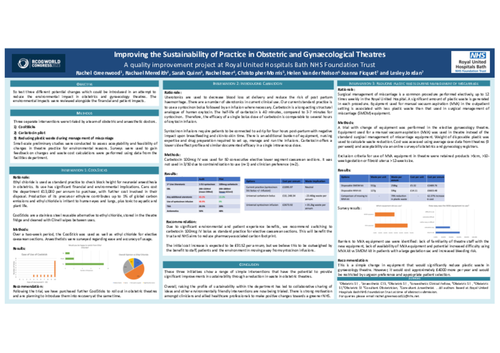
Three measures to reduce the environmental impact of theatre activity: a pilot
Poster Presenter
Authors
Rachel Greenwood, Sarah Quinn, Rachel Beer, Christopher Morris, Helen Van Der Nelson, Lesley Jordan, Joanna Ficquet
Affiliations
Part of Topic
Women’s Health and Policies
Objective:
To test three different potential changes which could be introduced in an attempt to reduce the environmental impact in obstetrics and gynaecology theatres. The environmental impacts were reviewed alongside the financial and patient impacts.
Methods:
Three separate interventions were trialed by a team of obstetric and anaesthetic doctors.
Small-scale preliminary studies were conducted to assess acceptability and feasibility of changes in theatre practice for environmental reasons. Surveys were used to gain feedback on changes and waste cost calculations were performed using data from the facilities department.
Intervention 1: Coolstick
Rationale:
Ethyl chloride is used as standard practice to check block height for neuraxial anaesthesia in obstetrics. Its use has significant financial and environmental implications. Cans cost the department £13,080 per annum to purchase, with further cost involved in their disposal. Production of its precursor ethylene contributes up to 1% of global carbon emissions and ethyl chloride is irritant to human eyes and lungs, plus toxic to aquatic and plant life.
CoolSticks are a stainless steel reusable alternative to ethyl chloride, stored in the theatre fridge and cleaned with Clinell wipes between uses.
Methods:
Over a two-week period, the CoolStick was used as well as ethyl chloride for elective caesarean sections. Anaesthetists were surveyed regarding ease and accuracy of usage.
Recommendation:
Following the trial, we have purchased further CoolSticks to roll out in obstetric theatres and are planning to introduce them into recovery at the same time.
Intervention 2: Carbotocin
Rationale:
Uterotonics are used to decrease blood loss at delivery and reduce the risk of post partum haemorrhage. There are a number of uterotonics in current clinical use. Our current standard practice is to use a syntocinon bolus followed by an infusion where necessary. Carbetocin is a long-acting structural analogue of human oxytocin. The half-life of carbetocin is 40 minutes, compared to 3-7 minutes for syntocinon. Therefore, the efficacy of a single bolus dose of carbetocin is comparable to several hours of oxytocin infusion.
Syntocinon infusions require patients to be connected to a drip for four hours post-partum with negative impact upon breastfeeding and skin-to-skin time. There is an additional burden of equipment, nursing expertise and drug preparation required to set up, manage and run the infusions. Carbetocin offers a lower side effect profile and similar documented efficacy in a single intravenous dose.
Methods:
Carbetocin 100mcg IV was used for 50 consecutive elective lower segment caesarean sections. It was not used in 3/50 due to contraindication to use (n=1) and clinician preference (n=2).
Recommendation:
Due to significant environmental and patient experience benefits, we recommend switching to carbetocin 100mcg IV bolus as standard practice for elective caesarean sections. This will benefit the trust and NHS aims to reduce pharmacy-associated carbon footprint.
The initial cost increase is expected to be £9152 per annum, but we believe this to be outweighed by the benefit to staff, patients and the environment in moving away from syntocinon infusions.
Intervention 3: reducing plastic waste
Rationale:
Surgical management of miscarriage is a common procedure performed electively, up to 12 times weekly in the Royal United Hospital. A significant amount of plastic waste is generated in each procedure. Equipment used for manual vacuum aspiration (MVA) in the outpatient setting is associated with less plastic waste than that used in surgical management of miscarriage (SMOM) equipment.
Methods:
A trial with change of equipment was performed in the elective gynaecology theatre. Equipment used for a manual vacuum aspiration (MVA) was used in theatre instead of the standard surgical management of miscarriage equipment. Weight of disposable plastic was used to calculate waste reduction. Cost was assessed using average case data from theatres (9 per week) and acceptability via an online survey of obstetrics and gynecology registrars.
Exclusion criteria for use of MVA equipment in theatre were retained products >5cm, >10-week gestation or fibroid uterus >12-week size.
Barriers to MVA equipment use were identified: lack of familiarity of theatre staff with the new equipment, lack of availability of MVA equipment and potential increased difficulty using MVA kit vs SMOM kit in patients with a large gestation sac and increased bleeding risk.
Recommendation:
This is a simple change in equipment that would significantly reduce plastic waste in gynaecology theatre. However, it would cost approximately £4000 more per year and would be restricted by surgeon preference and appropriate patient selection.
Conclusion:
These three initiatives show a range of simple interventions that have the potential to provide significant improvements in sustainability through a reduction in waste in obstetric theatres.
Overall, raising the profile of sustainability within the department has led to collaborative sharing of ideas and other environmentally friendly interventions are now being trialed. There is strong motivation amongst clinicians and allied healthcare professionals to make positive changes towards a greener NHS.