1,830 posters, 67 videos, 75 audios, 29 topics, 22 sessions, 4,727 authors, 1,697 institutions
ePostersLive by SciGen Technologies S.A. All rights reserved.
RCOG World Congress 2023
June 12 - 14, 2023 | London, UK

EP.0833
Delays in Emergency Caesarean Section and its Associated Feto-maternal Outcomes
Poster Presenter
Authors
Affiliations
Part of Topic
Women’s Health and Policies
Delays in Emergency Caesarean Section and its Associated Feto-maternal Outcomes
in Secondary Care Hospital.
Naureen Anjum1, Neelofur Babar2, Zahid Hyder Wadani3, Amir Raza4
1,2 Aga Khan Hospital for Women, Karimabad. 3,4 Aga Khan University, Karachi
Introduction
Caesarean section is the most common surgical procedure done and can improve neonatal and maternal outcomes if done appropriately and on time. Royal College of Obstetrics and Gynecology (RCOG) classifies caesarean sections into four categories according to need for urgency of delivery of fetus, i.e., category 1 (within 30 minutes) when there is immediate threat to life of fetus or mother, category 2 (within 75 minutes) when there is no immediate threat and category 3 when caesarean section done for early delivery due to other reasons. Women with category 4 caesarean sections includes elective cases. Decision to delivery Interval (DDI) is an important predictor for feto-maternal outcomes. Prolong DDI may increase the risk of maternal and neonatal complications with devastating early and long-term effects (1). These delays could occur due to patient or theater preparation time, non-availability of anesthetist or obstetrician on floor or due to prolong surgical time . Increased burden on health care facilities in developing countries with limited resources is a contributing factor to increase the DDI (2).
Objective
To find out major factors that result in DDI of emergency cesarean sections in a secondary care hospital and its effects on feto-maternal outcomes.
Methodology
Design: Cross-sectional observational study.
Population Setting: Aga Khan Hospital for Women-Karimabad (AKHW-K), Pakistan.
Duration: This study was conducted from June-December, 2022 over a period of six months.
Eligibility Criteria: All pregnant women with singleton pregnancies and decided for emergency cesarean sections were included in the study.
Sampling Technique: Nonprobability convenient sampling was used to recruit study participants. Women grouped in Category 1, category 2, and Category 3 were included, but Category 4 cesarean sections were excluded from the study as it doesn’t indicate DDI. Data was collected using a predesigned Performa which comprised four sub-groups that included patient factors, obstetrician factors, anesthesia factors, and lack of resources and staff. Maternal and fetal outcomes were also assessed.
Statistical analysis: SPSS version 19.0 was used for the analysis of data.
Result
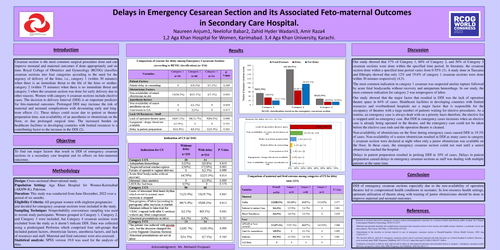
A total of 244 pregnant women for emergency caesarean section were included in this study. The average age of the patients was 28.37±4.56 years and almost 72% of the women were primiparous (71.7%) Demographic characteristics of patients is shown in table 1. According to RCOG classification based on the emergency caesarean section, 54 of 244 women (22.1%) were belonged to RCOG category 1 (immediate threat to life of fetus and mother), in which only 20 of the 54 (37.2%) women delivered according to the ROCG standards, whereas 34 (63%) women did not achieve ROCG standard. According to ROCG group 2 (No immediate threat), 162 pregnant women (65.9%) fell into this category, however only 96 of them (59.3%) delivered on time, and the remaining 66 (40.7%) delayed. Only 28 (11.5%) of women belonged to ROCG Category 3, and 50% of them delivered within the allotted time while the other 50% were deemed to have delayed delivery (>100 minutes) as shown figure 1.
Delay decision to delivery time as per ROCG based on the emergency caesarean section was observed in 46.7% (114/244) [95%CI: 40.35 to 53.2%] cases. Regarding the reason for delay, lack of operation theater space 64% [95%CI:54.5% to 72.8%] was the commonest reason followed by non-availability of senior obstetrician on site 19.3% [12.5% to 27.7%] delay in patient preparation 9.6% [95%CI: 4.9% to 16.6%] and consenting issues 3.5% [1% to 8.7%] other reasons of delay are also reported in figure 2. Women who needed to give birth within 30 minutes experienced significant delays since there was no senior physician on site. Similarly, women had to deliver according to ROCG category 2, however due to a lack of operating room capacity, the rate of delayed births was also significantly high in this category as shown in table 2.
Table 3 illustrates the reasons for the indication for C-section and categorization based on emergency status. Among patients who were labelled as category 1 and indicated for emergency c-section but delayed, 17 (50%) were suspected/actual uterine rupture and 12 (35%) had acute fetal bradycardia without recovery. Among orange code patients whose emergency c-section was delayed, 45(68%) patients with non-progress of labor and 13(20%) had abnormal fetal heart rhythm which reverted to normal once oxytocin was stopped.
Table 4 describes comparison of maternal and fetal outcomes among categories with delayed emergency c-section. Overall, majority of the mothers i.e., 112(98%) were stable despite of delay and 111 (97%) neonates had normal APGAR at 5 minutes. 3 (4.5%) and 2 (6%) mothers were referred to tertiary care and needed blood transfusion, who were categorized as orange code and red code, respectively. Only one neonate who was delivered by a mother whose c-section was delayed under orange code needed resuscitation. Among neonates who were neonates who were referred to other hospitals, 2 (6%) and 3 (5%) were delivered by mothers who were categorized as red code and orange code, respectively. None of the delays resulted in still birth.
Discussion
Our study showed that 37% of Category 1, 60% of Category 2, and 50% of Category 3 cesarean sections were done within the specified time period. In literature, the cesarean section done within a specified time period varies from 0-55%. (3) A study done in Tanzania and Ethiopia showed that only 12% and 19.6% of category 1 cesarean sections were done within 30 minutes respectively (4,5).
The most common indication in category 1 cesarean was suspected uterine rupture followed by acute fetal bradycardia without recovery and antepartum hemorrhage. In our study, the most common indication for category 2 was nonprogress of labor.
Our study showed that the major factor that resulted in DDI was the lack of operation theatre space in 64% of cases. Healthcare facilities in developing countries with limited resources and overburdened hospitals are a major factor that is responsible for the occupancy of theatres with a large number of patients waiting for elective procedures. As a routine, an emergency case is always dealt with on a priority basis therefore, the elective list is stopped until no emergency case. But DDI in emergency cases increases when an elective case is already being operated in the theatre, and the emergency case could not be taken before the elective case ends and the operation theatre is cleaned.
Non-availability of obstetricians on the floor during emergency cases caused DDI in 19.3% of cases. Non-availability of a senior obstetrician resulted in DDI as most of the cases in category 1 cesarean section were declared at night when only a junior obstetrician was available on the floor. In these cases, the emergency cesarean section could not start until a senior obstetrician reached the hospital.
Delays in patient preparation resulted in DDI in 10% of cases. Delays in patient preparation caused delays in emergency cesarean sections as staff must deal with multiple patients at the same time.
Conclusion
DDI of emergency caesarean sections especially due to non-availability of operation theatres led to compromised health condition in neonates. In low resource health settings, optimum utilization of theatre along with training of junior obstetricians should be done to improve maternal and neonatal outcomes.
Refrences