1,830 posters, 67 videos, 75 audios, 29 topics, 22 sessions, 4,727 authors, 1,697 institutions
ePostersLive by SciGen Technologies S.A. All rights reserved.
RCOG World Congress 2023
June 12 - 14, 2023 | London, UK

EP.0775-2
CASE REPORT- A RARE CASE OF VULVAR ENDOMETRIOSIS - 2
Poster Presenter
Authors
Affiliations
Part of Topic
Endometriosis and Uterine Disorders
A RARE CASE OF VULVAR ENDOMETRIOSIS
Dr. Reshme Rafiahamed 1, Dr. Omaema Al-Baghdadi 2, Dr. Zainab Alshaban 2
1 Y2 Medical Resident, OBG department, Tawam Hospital, Alain, UAE.
2 Consultant, OBG department, Tawam Hospital, Alain, UAE.
ü Background:
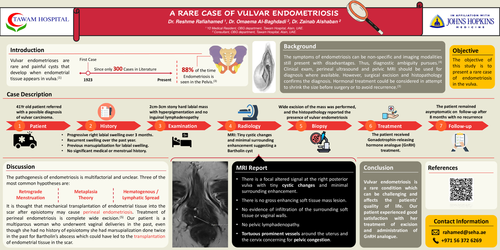
Vulvar endometrioses are rare and painful cysts that develop when endometrial tissue appears in vulva. (1) Endometriosis commonly occurs in pelvis. Although, it rarely occurs outside pelvis (~12%), perineal endometriosis is an even rarer entity. First vulvar endometriosis was reported in 1923 (2) and since then only 300 cases are available in literature.(3) While symptoms of endometriosis can be non-specific and imaging modalities still present with disadvantages, diagnostic ambiguity pursues (4) Diagnosis should be done with clinical exam, perineal ultrasound and pelvic MRI where available .However, surgical excision and histopathology confirms the diagnosis. Hormonal treatment could be considered in attempt to shrink the size before surgery or to avoid recurrence. (3)
ü Objective:
The objective of this study is to present a rare case of endometriosis in the vulva.
ü Case presentation:
A 41-year-old woman with uncomplicated medical and menstrual history, was referred to our center with a possible diagnosis of vulvar carcinoma. She gave a history of recurrent labial swelling which previously required marsupialization. It recurred over the past year and increased in size since 3 months. Examination revealed a 2-3cm stony hard labial mass with hyperpigmentation and no inguinal lymphadenopathy. Magnetic resonance imaging showed tiny cystic changes and minimal surrounding enhancement sugessting a bartholin cyst. Wide excision of the mass was performed, and the histopathology reported presence of vulvar endometriosis. She subsequently received Gonadotrophin-releasing hormone analogue (GnRH). The patient remained asymptomatic on later follow up with no recurrence.
ü Discussion:
The pathogenesis of endometriosis is multifactorial and unclear. Three of the most common hypotheses are: retrograde menstruation, metaplasia theory, hematogenous and lymphatic spread. It is thought that mechanical transplantation of endometrial tissue into the scar after episiotomy may cause perineal endometriosis. Treatment of perineal endometriosis is complete wide excision.(5) Our patient is a multiparous woman who underwent vaginal deliveries in the past, even though she had no history of episiotomy she had marsupialization done twice in the past for Bartholin’s abscess which could have led to the transplantation of endometrial tissue in the scar.
ü Conclusion:
Vulvar endometriosis is a rare condition which can be challenging and affecting the patients’ quality of life. Our patient experienced good satisfaction with her treatment of excision and administration of GnRH.
ü References:
2) https://www.ncbi.nlm.nih.gov/pmc/articles/PMC8148344/