1,830 posters, 67 videos, 75 audios, 29 topics, 22 sessions, 4,727 authors, 1,697 institutions
ePostersLive by SciGen Technologies S.A. All rights reserved.
RCOG World Congress 2023
June 12 - 14, 2023 | London, UK

EP.0751
Endometriosis presenting as relapsing hemorrhagic ascites in a south Asian woman
Poster Presenter
Authors
Affiliations
Part of Topic
Endometriosis and Uterine Disorders
Endometriosis presenting as relapsing hemorrhagic ascites in a south Asian woman: a case report Dr. Ushna Ahmed, Dr. Novera Ghayoor Chughtai. Department of Obstetrics and Gynaecology, Aga Khan University. Pakistan
Abstract
Endometriosis presenting as ascites is a rare entity.Worldwide, less than a hundred cases have been reported, delaying diagnosis and hindering fertility prospects Ovarian suppression has been employed as a successful treatment, followed by definitive surgery. We present the case of a reproductive aged woman, seeking fertility treatment, who had a more subtle presentation of moderate, but relapsing ascites of unknown origin since two years
Introduction
Endometriosis, a benign, estrogen dependent disease, with ectopic implantations of endometrial glands and stroma, affecting 6-10% of all reproductive age women, can present as chronic pelvic pain, dysmenorrhea, dyspareunia, and infertility. Endometriosis-related ascites was initially described by Brews in 1954, and further explored by Charles in 1957.It is a rare occurrence, more so in women of Asian ethnicity. Nulligravid, African women are the primary victims. Recognizing this diagnosis is further complicated by the presence of ascites in other circumstances like malignancy, infection, cirrhosis, or trauma.The purpose of this case report thus is to propose that how a diagnosis of ascites secondary to endometriosis could be suspected in Asian women and what would be its predictable course and management options.
Case Report
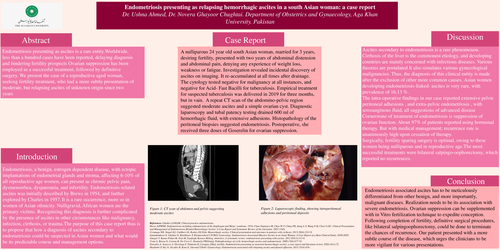
A nulliparous 24 year old south Asian woman, married for 3 years, desiring fertility, presented with two years of abdominal distension and abdominal pain, denying any experience of weight loss, weakness or fatigue. Investigation revealed incidental discovery of ascites on imaging. It re-accumulated at all times after drainage. The cytology tested negative for malignancy at all instances, and negative for Acid- Fast Bacilli for tuberculosis. Empirical treatment for suspected tuberculosis was delivered in 2019 for three months, but in vain. A repeat CT scan of the abdomino-pelvic region suggested moderate ascites and a simple ovarian cyst. Diagnostic laparoscopy and tubal patency testing drained 600 ml of hemorrhagic fluid, with extensive adhesions. Histopathology of the peritoneal biopsies suggested endometriosis. Postoperative, she received three doses of Goserelin for ovarian suppression.
Discussion
Ascites secondary to endometriosis is a rare phenomenon. Cirrhosis of the liver is the commonest etiology, and developing countries are mainly concerned with infectious diseases. Various theories are postulated.It also simulates various gynecological malignancies. Thus, the diagnosis of this clinical entity is made after the exclusion of other more common causes. Asian women developing endometriosis-linked- ascites is very rare, with prevalence of 16.13 %. The intra-operative findings in our case reported extensive pelvic peritoneal adhesions , and extra-pelvic endometriosis , with serosanginous fluid, all suggestions of advanced disease Cornerstone of treatment of endometriosis is suppression of ovarian function. About 97% of patients reported using hormonal therapy. But with medical management; recurrence rate is unanimously high upon cessation of therapy. Surgically, fertility sparing surgery is optimal, owing to these women being nulliparous and in reproductive age.The most successful treatments were bilateral salpingo-oophorectomy, which reported no recurrences
Conclusion
Endometriosis associated ascites has to be meticulously differentiated from other benign, and more importantly, malignant diseases. Realization needs to be its association with severe endometriosis. Ovarian suppression can be supplemented with in Vitro fertilization technique to expedite conception. Following completion of fertility, definitive surgical procedures, like bilateral salpingoophorectomy, could be done to terminate the chances of recurrence. Our patient presented with a more subtle course of the disease, which urges the clinicians to be more vigilant for various presentations.