1,830 posters, 67 videos, 75 audios, 29 topics, 22 sessions, 4,727 authors, 1,697 institutions
ePostersLive by SciGen Technologies S.A. All rights reserved.
RCOG World Congress 2023
June 12 - 14, 2023 | London, UK

EP.0750
Abnormal uterine bleeding in young women – when to biopsy?
Poster Presenter
Part of Topic
Endometriosis and Uterine Disorders
Introduction:
The incidence of endometrial cancer continues to rise with the increasing prevalence of risk factors associated with oestrogen exposure including obesity, nulliparity and diabetes1. It most commonly presents with post-menopausal bleeding, with younger affected patients usually having a genetic predisposition2,3. The hypothesised pathogenesis of endometrial cancer means that disease presentation in young women without any accompanying risk factors is rare. We herein report an unusual presentation of endometrial cancer in a 26-year-old woman.
Case presentation:
A 26-year-old Singaporean nulliparous woman presented with intermenstrual bleeding (IMB) and occasional dysmenorrhoea. She has a 28-day menstrual cycle and a BMI of 24, with no past medical or family history. Pelvic ultrasound demonstrated a 1.3 cm endometrial polyp and a 9 mm thick endometrial lining. Initially the patient opted for conservative management, however surveillance scan six months later showed three endometrial polyps (1.6 cm, 1.5 cm and 2.1 cm).
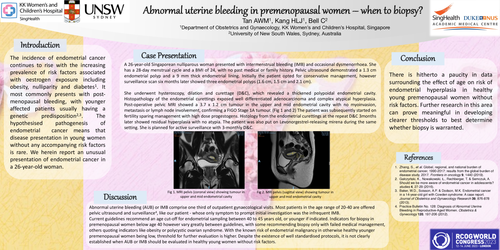
She underwent hysteroscopy, dilation and curettage (D&C), which revealed a thickened polypoidal endometrial cavity. Histopathology of the endometrial curettings exposed well differentiated adenocarcinoma and complex atypical hyperplasia. Post-operative pelvic MRI showed a 3.7 x 1.2 cm tumour in the upper and mid endometrial cavity with no myoinvasion, metastasis or lymph node involvement, confirming a FIGO Stage 1A tumour. (Fig 1 and 2) The patient was subsequently started on fertility sparing management with high dose progestogens. Histology from the endometrial curettings at the repeat D&C 3months later showed residual hyperplasia with no atypia. The patient was also put on Levonorgestrel-releasing mirena during the same setting. She is planned for active surveillance with 3-monthly D&C.
Discussion:
Abnormal uterine bleeding (AUB) or IMB comprise one third of outpatient gynaecological visits. Most patients in the age range of 20-40 are offered pelvic ultrasound and surveillance4, like our patient - whose only symptom to prompt initial investigation was the infrequent IMB.
Current guidelines recommend an age cut-off for endometrial sampling between 40 to 45 years old, or younger if indicated. Indicators for biopsy in premenopausal women below age 40 however vary greatly between guidelines, with some recommending biopsy only with failed medical management, others quoting indicators like obesity or polycystic ovarian syndrome. With the known risk of endometrial malignancy in otherwise healthy younger premenopausal women being low, threshold for further evaluation is higher. Despite the existence of well standardised protocols, it is not clearly established when AUB or IMB should be evaluated in healthy young women without risk factors.
Conclusion:
There is hitherto a paucity in data surrounding the effect of age on risk of endometrial hyperplasia in healthy young premenopausal women without risk factors. Further research in this area can prove meaningful in developing clearer thresholds to best determine whether biopsy is warranted.