1,830 posters, 67 videos, 75 audios, 29 topics, 22 sessions, 4,727 authors, 1,697 institutions
ePostersLive by SciGen Technologies S.A. All rights reserved.
RCOG World Congress 2023
June 12 - 14, 2023 | London, UK

EP.0746
Extremely high CA 125, elevated CA-19-9, and signet ring cells - Still benign!
Poster Presenter
Part of Topic
Endometriosis and Uterine Disorders
Extremely high CA 125, elevated CA 19-9, and signet ring cells in ascitic fluid - Still benign!
Isanka S1, Jayasinghe K2, Premaratne S2, Senthilnathan PG1
1- De Soysa Hospital for Women.Colombo.Srilanka
2- Apeksha Hospital.Colombo.SriLanka
Introduction
Carbohydrate antigen 125 (CA 125) and Carbohydrate antigen 19-9 (CA 19-9) are considered serum biomarkers of malignancies.CA 125 has a 96% positive predictive value in detecting Epithelial Ovarian Cancers among menopausal women. Ovarian Endometrioma and deeply infiltrating Endometriosis are the most common benign gynecological conditions associated with elevated CA 125 levels. High CA 19-9 levels were detected in ovarian malignancies, Endometriosis, and Mature Cystic Teratomas.
Case
A 19-year-old girl Presented with lower abdominal pain and fullness following accidental falls. She had a Loss of appetite over 4 months. Her BMI was 22Kg/m2. The abdomen was distended. Tender, firm, abdominopelvic mass felt over the suprapubic, right, and left iliac fossa. Bilateral flank dullness was noted.
Ultrasound scan(USS) and CECT showed turbid moderate ascites with large complex bilateral ovarian masses. Ca 125 was extremely high (13 279 U/ml) and ca 19-9 was 1200u/ml. Serum beta HCG, AFP, LDH, and CEA were within the normal range.
Peritoneal fluid Cytology showed signet ring cells. High Ca 19-9 along with signet ring cells in cytology and bilateral ovarian masses were highly suspicious of a Krukenberg tumor. Upper gastro-intestinal endoscopy excluded luminal abnormality.
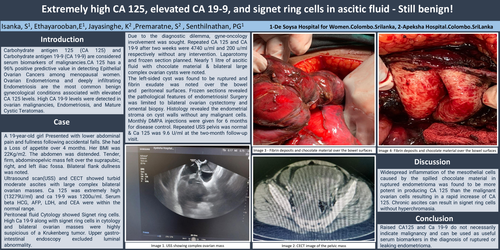
Due to the diagnostic dilemma, gyne-oncology involvement was sought. Repeated CA 125 and CA 19-9 after two weeks were 4740 u/ml and 200 u/ml respectively without any intervention. Laparotomy and frozen section planned. Nearly 1 litre of ascitic fluid with chocolate material & bilateral large complex ovarian cysts were noted.
The left-sided cyst was found to be ruptured and fibrin exudate was noted over the bowel and peritoneal surfaces. Frozen sections revealed the pathological features of endometriosis! Surgery was limited to bilateral ovarian cystectomy and omental biopsy. Histology revealed the endometrial stroma on cyst walls without any malignant cells. Monthly DMPA injections were given for 6 months for disease control. Repeated USS pelvis was normal & Ca 125 was 9.6 U/ml at the two-month follow-up visit.
Discussion
Widespread inflammation of the mesothelial cells caused by the spilled chocolate material in ruptured endometrioma was found to be more potent in producing CA 125 than the malignant ovarian cells resulting in a rapid increase of CA 125. Chronic ascites can result in signet ring cells without hyperchromasia.
Conclusion
Raised CA125 and Ca 19-9 do not necessarily indicate malignancy and can be used as useful serum biomarkers in the diagnosis of ruptured or leaking endometrioma.