1,830 posters, 67 videos, 75 audios, 29 topics, 22 sessions, 4,727 authors, 1,697 institutions
ePostersLive by SciGen Technologies S.A. All rights reserved.
RCOG World Congress 2023
June 12 - 14, 2023 | London, UK

EP.0603
Diagnostic Experiences in PCOS: Are Physicians Using Lifestyle Interventions As First-line Management?
Poster Presenter
Authors
Affiliations
Part of Topic
Lifestyle Medicine in Woman's Health
Audio
Diagnostic Experiences of Women with Polycystic Ovary Syndrome (PCOS):
Are Physicians Using Lifestyle Interventions As First-line Management?
Dana Saeed and Aarti Javeri-Mehta
Introduction
Polycystic Ovary Syndrome (PCOS) is the most common endocrine disorder amongst women of reproductive age, affecting up to 1 in 4 women in high incidence ethnic groups. PCOS is a complex, chronic and multisystem syndrome that significantly impacts quality of life and mental health (1,2). Lifestyle modifications have been shown to positively impact signs and symptoms of the condition, and are first-line management according to international clinical practice guidelines (3). Although a widespread dissatisfaction with care has been reported amongst women with PCOS, evidence is lacking as to whether physicians routinely give lifestyle advice and support on diagnosis (4). This study aims to explore women’s experiences of their PCOS diagnosis, and establish whether lifestyle interventions and advice were offered as first-line management.
Methods
This cross-sectional study used a mixed-methods approach to interview 36 women between the ages of 18 and 39 with a diagnosis of PCOS [in the Middle East, India, Ireland, the United States and the United Kingdom]. The sample was a convenience sample drawn from clinical practice, social media platforms, and word of mouth. An in-depth 30-item online survey and remote video interviews were carried out that explored women’s experiences at diagnosis of PCOS, including provision of lifestyle advice.
Results
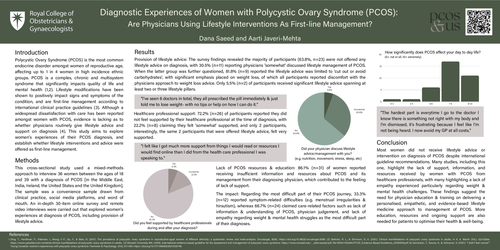
Provision of lifestyle advice: The survey findings revealed the majority of participants (63.8%, n=23) were not offered any lifestyle advice on diagnosis, with 30.5% (n=11) reporting physicians 'somewhat' discussed lifestyle management of PCOS. When the latter group was further questioned, 81.8% (n=9) reported the lifestyle advice was limited to 'cut out or avoid carbohydrates', with significant emphasis placed on weight loss, of which all participants reported discomfort with the physicians approach to weight loss advice. Only 5.5% (n=2) of participants received significant lifestyle advice spanning at least two or three lifestyle pillars.
Healthcare professional support: 72.2% (n=26) of participants reported they did not feel supported by their healthcare professional at the time of diagnosis, with 22.2% (n=8) claiming they felt 'somewhat' supported, and only 2 participants, interestingly, the same 2 participants that were offered lifestyle advice, felt very supported.
Lack of PCOS resources & education: 86.1% (n=31) of women reported receiving insufficient information and resources about PCOS and its management from their diagnosing physician, which contributed to the feeling of lack of support.
The impact: Regarding the most difficult part of their PCOS journey, 33.3% (n=12) reported symptom-related difficulties (e.g. menstrual irregularities & hirsutism), whereas 66.7% (n=24) claimed care-related factors such as lack of information & understanding of PCOS, physician judgement, and lack of empathy regarding weight & mental health struggles as the most difficult part of their diagnoses.
Conclusion
Most women did not receive lifestyle advice or intervention on diagnosis of PCOS despite international guideline recommendations. Many studies, including this one, highlight the lack of support, information, and resources received by women with PCOS from healthcare professionals, with many highlighting a lack of empathy experienced particularly regarding weight & mental health challenges. These findings suggest the need for physician education & training on delivering a personalised, empathetic, and evidence-based lifestyle medicine approach to management of PCOS. More education, resources and ongoing support are also needed for patients to optimise their health & well-being.