1,830 posters, 67 videos, 75 audios, 29 topics, 22 sessions, 4,727 authors, 1,697 institutions
ePostersLive by SciGen Technologies S.A. All rights reserved.
RCOG World Congress 2023
June 12 - 14, 2023 | London, UK

EP.0081
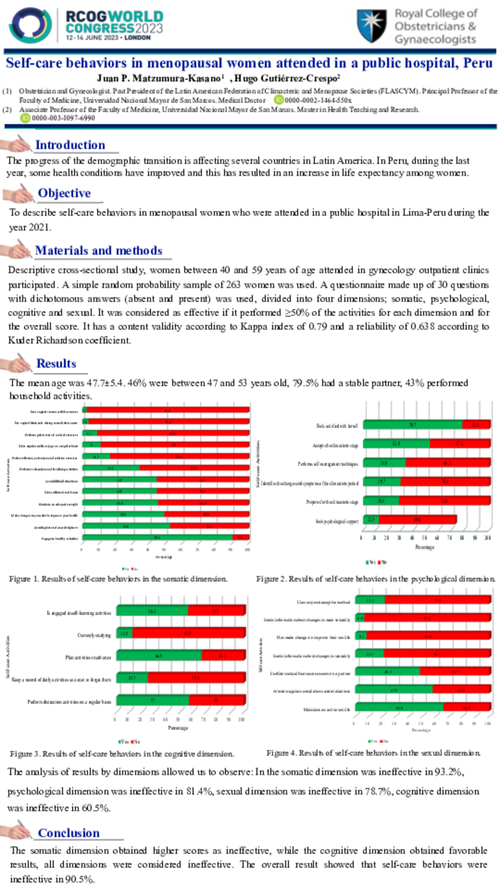
Self-care behaviors in menopausal women attended in a public hospital, Peru
Poster Presenter
Part of Topic
Lifestyle Medicine in Woman's Health
Introduction. The progress of the demographic transition is affecting several countries in Latin America. In Peru, during the last year, some health conditions have improved and this has resulted in an increase in life expectancy among women.
Objective. To describe self-care behaviors in menopausal women who were attended in a public hospital in Lima-Peru during the year 2021.
Materials and Methods. Descriptive cross-sectional study, women between 40 and 59 years of age attended in gynecology outpatient clinics participated. A simple random probability sample of 263 women was used. A questionnaire made up of 30 questions with dichotomous answers (absent and present) was used, divided into four dimensions; somatic, psychological, cognitive and sexual. It was considered as effective if it performed ≥50% of the activities for each dimension and for the overall score. It has a content validity according to Kappa index of 0.79 and a reliability of 0.638 according to Kuder Richardson coefficient.
Results. The mean age was 47.7±5.4. 46% were between 47 and 53 years old, 79.5% had a stable partner, 43% performed household activities. Somatic dimension: 90.5% performed healthy activities, 52.9% avoided hot and crowded places, while 97.3% did not use menopausal hormone therapy and 90.9% did not perform pelvic muscle control exercises. Psychological dimension; 78.7% showed self-esteem, 52.9% accepted the climacteric stage positively, while 87.5% did not seek psychological support, 71.5% did not prepare for the climacteric stage and 70.3% did not identify climacteric changes and symptoms. Cognitive dimension; 66.9% stated that they plan their activities, 57% engage in distraction activities, 87.5% do not engage in extra-occupational activities. Sexual dimension; 65.8% maintain an active sexual life, 57.8% perform self-care activities for the prevention of genital tract infections, 93.2% do not seek information on changes in sexuality and 91.6% do not perform self-care activities to improve their sexual life.
Conclusion. The somatic dimension obtained higher scores as ineffective, while the cognitive dimension obtained favorable results, all dimensions were considered ineffective. The overall result showed that self-care behaviors were ineffective in 90.5%.